Just as the kitchen is the heart of a home, the cafeteria is the heart of the office. It is where colleagues connect, trade ideas, and build the workplace and personal relationships that make a company feel like more than a place to clock in.
Whether in a corporate office complex, hospital, or college campus, a well-planned cafeteria can be a sanctuary for anyone who visits. A fresh, inviting space gives employees room to decompress, recharge, and reset before the second half of the workday, which is exactly why thoughtful office cafeteria design pays off well beyond the lunch hour.
Below, we review the best office cafeteria design ideas and show how smart layouts and versatile food programs bring out the very best in the people they serve.
Download our free Corporate Cafeteria RFP Template to get started immediately - complete with all essential sections, sample questions, and evaluation criteria.

The success of your cafeteria depends on its design. A clunky path to food stations, unclear menu and payment options, and cluttered seating can drive diners away before they ever pick up a tray.
Whether you are starting from scratch or reinventing your current space, here are foundational questions about office cafeteria design ideas to work through:
Working through these questions helps you separate your key priorities, nice-to-haves, and nonessential cafeteria elements, so budget conversations later start from a clear list rather than a blank page.
If you are struggling to narrow down your options on your own, ask other decision-makers to build lists of their own and compare notes. You can also survey employees for their opinions and feedback, since everyone will be using the space.
Remember, your dining area should inspire collaboration, accommodate different dietary needs, and support a rotation of food programs (Orange by Fooda can help with this).

Reimagining your office cafeteria does not have to be overwhelming. Three core tenets of great cafeteria design keep you on track: flexibility, sustainability, and wellness.
The most reliable way to please a crowd is to build food halls and multi-station cafeterias that offer a variety of dining options. Rotating or resident restaurants let you constantly reinvent menus, and you can plan for lighter and heavier traffic around hybrid working schedules.
Here are some of the corporate office cafeteria design ideas shaping lunchrooms around the world.
If you have the room, offering a variety of dining and seating arrangements makes sure the entire team is accommodated.
Long tables are practical for team lunches and collaboration, while small tables and booths are convenient for grabbing a quick bite between meetings (though here at Fooda, we believe you should spend a proper amount of time enjoying your lunch break).
Large space or not, modular furniture and open layouts are extremely useful because they let you reconfigure the room for whatever the day calls for, whether that is a company-wide party, a team lunch, or back-to-back department meetings. The more versatile the space, the more everyone can benefit from it.
Reducing food waste, limiting energy use, and decreasing water consumption are good for the planet, and they also strengthen your business case by lowering operating costs over time.
If your company has an eco-friendly pledge, your cafeteria is the perfect place to showcase those values. Environmentally friendly architecture and sustainable food programs can make you a leader in your community and please eco-conscious employees.
Here are some eco-friendly options to consider in your cafeteria redesign:
Additionally, when considering food sourcing for your cafeteria, a food service provider like Fooda can connect your team with restaurants that value sustainability and green options.
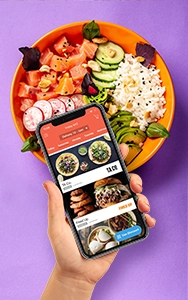
Technological innovations are transforming cafeterias around the world. Digital menus, ordering, and cafeteria POS systems streamline the way your cafeteria flows.
Your team can explore cafeteria menu options ahead of time, place orders, and pay in advance, which means they get fed sooner and gain more time to eat, socialize, and relax. That reclaimed time is a small perk that employees notice every single day.
Screens around the space also market internal company news and upcoming events, such as a Popup Restaurant organized by Fooda.
While socialization matters in the workplace, the cafeteria can also serve as a valuable space to unwind, relax, and focus.
Much like your company's color branding, food color branding elicits different emotional responses. Red can make us feel hungry, blue is calming, and purple reads as luxurious. Our senses directly shape our mood, which in turn influences productivity and output at work.
Access to natural elements such as the color green, natural light, and plant life also has a large effect and is great for reducing stress and anxiety. The right blend of color and lighting, green plants, and ambient background music helps you curate a welcoming, relaxing dining experience for your team.
Want additional design tips? Read more about cafeteria trends here.
Putting corporate cafeteria design ideas into practice is much more than following popular trends. A thoughtful space has direct impacts on your employee experience along with your recruitment and retention efforts.
A welcoming, dynamic lunchroom can attract top talent, spark novel ideas, and encourage a stronger sense of community.
Health is wealth, literally. When your workers are well cared for and in good spirits, productivity and motivation climb, because people who feel supported bring more energy to their work.
Providing your team with great dining experiences is a concrete demonstration of how much you value them. When companies offer a quality food program, employees are more likely to eat and spend time together, which directly strengthens company culture and a sense of belonging.
Access to nutritious meals also makes it easier for employees to stay healthy. They can reduce sick days, spend more time around colleagues they enjoy, and contribute to stronger output at work.
A great cafeteria is significant for recruiting and retention because it can attract and retain top talent.
Meal planning and preparation is stressful for many commuters. While meal prepping can be a healthy habit, the mental fatigue of deciding what to make next can turn the process into a chore. A rotation of restaurants and access to healthy, convenient meals removes that mental workload for your team.
Food is a powerful motivator: simply hearing about an upcoming restaurant Popup can inspire workers to come into the office instead of working from home. An increase in employee satisfaction benefits everyone, because people want to work at companies where the staff is happy.
There is more to building community than providing a place to eat lunch. Outside of serving meals, the space can host ad hoc meetings and after-work events.
Bringing people together in social settings, especially across different departments, leads to spontaneous idea sharing, innovation, and accidental discoveries. This surge in creativity produces stronger contributions in meetings and across the workplace.
Jumping from the design board into reality can be a challenge. Ideas can clash, space and budget can constrain you, and the timeline can feel daunting. Here are some common hindrances and how to tackle them.
It is easy to go overboard or lose focus when designing your dream space. A certain food station might sound attractive on paper, but if it creates long lines and considerable wait times, it might not be worth it.
Creating a welcoming, inspiring space comes down to real value rather than the most bells and whistles or the biggest budget. Fancy wallpaper, grand light fixtures, and an indoor fountain can help a space look great, yet if food variety, wait times, pricing, and seating fall short, your staff likely will not use it.
Always try to be realistic when planning. Your team wants to eat great meals, have meaningful conversations, and reenergize within the limited break time they have.
Juggling your dream corporate cafeteria design ideas with the reality of a fixed budget can be a conundrum.
This is where your priorities, nice-to-haves, and nonessential lists from earlier will be most helpful. They speed up decision-making, help you make sensible choices, and let you finalize plans faster.
While it would be exciting to serve shawarma, ramen, burgers, and tacos on a single day, it simply is not realistic. Rotating through one or two food providers per day, and mixing up your salad or sandwich bar based on seasonality, is a great way to keep things fresh.
Need help executing your vision? Fooda's Catering Managers can partner with you to bring unforgettable meals to your workplace.
Unless you are building a new office complex from scratch, you will have to work with the space you already have. While that can seem restraining, working within existing confines keeps you focused and realistic.
If your space does not have room for full kitchens, or if you do not currently have the budget to revamp them, hosting Popup Restaurants and corporate event catering is a great way to provide quality meals without investing in new appliances. This approach can also measurably reduce ongoing maintenance and repair costs for your company.
Large changes take time. Employees and business leaders can grow impatient, and construction can be noisy and disruptive. Depending on the scope of your project, you might have to work with contractors to limit loud work to outside business hours or a set number of days.
You can also make gradual changes and adjust based on early feedback. This helps with risk mitigation, since you can identify issues early in the process, and it makes it easier to educate your team and prepare everyone for new policies.
Try implementing core changes first, such as creating clearer pathways, moving to a mobile ordering and payment system, or hosting a local restaurant to cater lunch.
With a partner retention rate of over 90%, Fooda is a premier cafeteria management company, helping both new and existing workplaces perfect their meal programs. Among cafeteria management companies, we stand out by guiding you through building a food program from the ground up or adjusting your existing processes.
Cafeterias built with Fooda are dynamic and help impact the community by supporting local restaurants. Based on daily demand, our team of experts helps you bring a rotation of local favorites into your space and execute flawless culinary events.

Providing a wide range of rotating options is a great way to avoid menu fatigue and encourage the natural cross-team collaboration that happens when everyone sits down for lunch together.
We take this seriously, and food variety is a main pillar of Fooda's partnership program. Here is a real-life example of Fooda in action.
Marquette University, a Fooda client, noticed two food stations on its main campus cafe were significantly underperforming, serving only about 100 meals a day. Fooda tackled the issue with a three-pronged approach.
First, Fooda integrated with the university's existing food service provider to adapt the main campus menu toward more affordable items. Then Fooda helped Marquette replace one of its lower-performing stations with a crowd-favorite restaurant partner. Finally, to keep options fresh, the second station now hosts rotating restaurant Popups.
This consistently attracts increased foot traffic, and the partnerships directly benefit the local restaurant community. With the upgraded system, Marquette sees an average 2.5x increase in incremental profit from those two stations alone.
If you are wondering about college cafeteria design ideas, it comes down to balance. You can offer consistent meal types, such as a salad bar and hot food section, while introducing a rotation of exciting menus from restaurant partners.
Too many cafeterias suffer from poor inventory management and food waste. We help you cut costs while accommodating your team’s hybrid work patterns.
Fooda's smart technology learns from your team's work and dining habits, so you have the right amount of food each day. You take fuller control of your ordering and food production model, saving valuable time and money in the long run.
Long payment lines can jam up your cafeteria's flow. Mobile payments through the Fooda app help your employees enjoy their meals sooner. With versatile payment options, whether you want to accept cash or step into the future with digital payments, we make sure you get paid your way.
Unlike other providers, Fooda's earnings are based on meals sold rather than added fees. All savings are passed to our clients and the restaurants you work with, so you can continuously reinvest in both your employees and the local restaurant community.
As an extension of a great food program, employee subsidies are an increasingly popular benefit. They encourage staff to participate in your lunch program and gather in person, and the local businesses you bring into your space profit too.
The Fooda platform takes the stress out of offering and tracking payments. Admins can add and adjust subsidies by individual, team, or department, so you stay in control and your employees feel valued.
Ultimately, a well-designed cafeteria is a direct reflection of your brand. It is a true perk that fosters community, provides diverse food options, and promotes wellness.
When your corporate cafeteria design balances a flexible layout, updated technology, and sustainable options, your lunchroom becomes a launch pad for your team’s success.
Ready to take your cafeteria to the next level? Talk with Fooda today.
What staffing is typically required to operate a corporate cafeteria?
Staffing needs depend heavily on your service model. A full-service cafeteria with on-site cooking might need kitchen staff, servers, cashiers, and maintenance personnel. If you partner with Fooda, we remove that overhead, and you may only need one or two cafeteria coordinators to manage logistics, vendors, and daily operations. Many companies find this hybrid model reduces labor costs while still delivering an excellent dining experience.
How do I measure whether my cafeteria redesign or food program is successful?
Track both quantitative and qualitative metrics. Quantitative measures include daily participation rates, average transaction values, food waste percentages, and employee retention rates. Qualitative feedback comes from employee surveys about satisfaction, menu variety, and overall experience. Many companies also track in-office attendance on food service days for hybrid workforces to gauge how much the cafeteria drives office presence.
How do I handle food safety compliance and health department regulations?
Food safety requirements vary by state and municipality, but they generally include proper food storage temperatures, handwashing stations, and regular health inspections. If you are working with Fooda, we take this off your plate by thoroughly vetting all restaurant partners and confirming they hold the necessary certifications.
How much does it cost to design an office cafeteria?
Costs vary widely based on square footage, whether you are building from scratch or renovating, and how much kitchen infrastructure you need. A light refresh focused on seating, layout, and mobile ordering can run a few thousand dollars per station, while a full build-out with commercial kitchens reaches six figures. Partnering with a food service provider that hosts restaurant Popups lets you offer quality dining without the capital expense of full kitchen equipment, which is why many companies start there before committing to construction.
How much space do you need for a corporate cafeteria?
A common planning benchmark is 12 to 15 square feet per seat for the dining area alone, plus additional room for serving lines, kitchen or prep areas, and circulation. To size seating, estimate your peak lunch headcount and how many turnover cycles you expect during the busiest hour rather than your total employee count, since not everyone eats at once. Building in flexible, modular furniture lets a smaller footprint stretch further across different uses.
How do you design an office cafeteria for a small space or tight budget?
Focus on flow and flexibility before finishes. Prioritize a clear path to food and payment, modular tables that reconfigure for meetings or events, and a mobile ordering system that shortens lines. Rather than installing a full kitchen, host rotating restaurant Popups or catered lunches, which deliver variety without heavy build-out costs. A phased rollout also lets you make core changes first and expand as budget allows.
What office cafeteria design trends should companies prioritize right now?
The trends with the most staying power center on flexibility, sustainability, and wellness. That means modular layouts that flex between dining and events, digital ordering and payment to reduce wait times, rotating restaurant programs that keep cafeteria menus fresh, and design choices such as natural light, greenery, and quieter acoustics that make the space somewhere people want to spend their break. Programs that adapt to hybrid schedules tend to outperform static, one-size-fits-all cafeterias.