Updated 10/27/2026
According to Tork, 94% of employees are happier when they take a lunch break. Workplace food programs provide convenient access to food that gives employees more time to enjoy their breaks, but as a workplace leader, deciding between cafeteria, catering, delivery, and Popup for your business can be a daunting task. There’s a lot to consider, and it’s important to understand the perfect program will look different for every workplace. Each solution gives your employees easy access to great food, but the right solution will depend on your work culture, office dynamic, and staff size.
Keep reading to explore the logistics of each solution and learn how to pick the best option for your team.
To help you better understand the differences between each type of food program, we’ve put together a quick comparison chart:
When you’re choosing between cafeteria, catering, delivery, and Popup, you need to consider the advantages and disadvantages of each. Every office will have different needs that will influence this decision.

With the capacity to serve over 1,000 meals per week, cafeterias work well for large companies focused on employee well-being and workplace culture. They offer a dedicated space for dining, giving employees a way to step away from their desks and engage with their colleagues.
While traditional cafeteria providers require employers to account for hidden fees such as maintenance and staffing, more modern cafeteria setups offer lower-cost models that deliver higher ROI over time.
Modern models are also built to evolve with employers’ needs. Day-to-day operational adjustments can accommodate hybrid schedules or non-standard hours. Offerings can also be adjusted to fit employee preferences. This creates a more dynamic experience that allows you to get the most out of your program without overspending or wasting food.
Catering is best suited to single or recurring events of any kind, from small working lunches to large formal celebrations. Employees can enjoy a variety of local restaurants, building excitement around office events and encouraging guests to stay engaged. It’s a specialized service that suits your staff and elevates your event.
There are different catering formats that can be tailored to fit the atmosphere of your event, and menus can be adjusted to meet specific dietary needs, headcount, and budget.

Office lunch delivery works best for businesses that want to prioritize convenience, flexibility, and individual preferences. Employees get plenty of options to choose from every day, keeping them interested over time. Additionally, not having to wait in line allows them to make the most of their breaks.
This model is able to accommodate 30-50+ meals per day, making it great for smaller teams. This ordering system also accommodates hybrid offices with fluctuating attendance. Because each employee orders for themselves, you never get more food than you need.
For workplaces that want to build community and morale but don’t have the bandwidth to support a full cafeteria, Popups are a great option. With Popup, you can create a serviced program without building out new infrastructure. Restaurants prepare food off-site and bring it into the workplace to serve to employees, creating Popup is a unique, low-lift workplace food solution that builds community.
This model works best for workplaces that are able to serve 50+ meals a day. This is also a cost-effective solution, as you don’t have to pay delivery or maintenance fees. Popup is uniquely suited for hybrid offices, as you can choose to only offer it on peak attendance days.
When deciding which workplace food solution is right for you, consider these five factors:
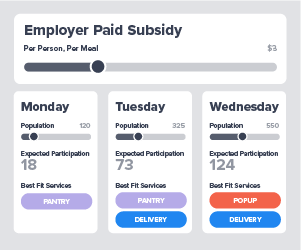
If you’re still unsure of the right solution, try Fooda’s Food at Work Calculator. It’s a decision-support tool that allows you to input your budget per person per day and an estimated headcount, then gives you the best options for your office and an estimated total weekly cost.

Fooda offers cafeteria, catering, delivery, and Popup workplace food solutions all under one roof. Our programs are all powered by local restaurants, allowing employees to enjoy their favorite local spots right in the office.
Our programs were created by logistics professionals whose goal was to bring delicious food into the workplace while supporting the local community. Today, we work with companies to create customized solutions that meet all of our clients’ needs. You can even mix and match to build a program that fits your budget and attendance patterns. Fooda’s solutions are unique to each client, allowing you to make adjustments over time as your workplace evolves.
There is no one-size-fits-all food service solution. Unlike generic food service providers, Fooda offers multiple service options, all of which can be adjusted to meet your unique requests. We work with you to find the right solution, whether that’s a cafeteria, catering, delivery, Popup, or a combination.
Reach out to one of our experts today to learn more about our services or schedule a free, professional consultation.
How many employees do you need for a workplace cafeteria?
A cafeteria typically makes sense at about 1,000 or more meals per week. At five days a week, that’s roughly 200 meals per day. But because not every employee eats on-site every day, headcount isn’t the only factor to consider. Use expected attendance and participation to estimate volume. Smaller teams often do better with Popup or delivery.
How much does an employer-paid lunch program cost per employee?
Cost depends on the program, attendance, and how much you plan to subsidize. Some employers cover the full meal, while others offer a daily subsidy and let employees pay the rest. Set a budget per person per day, estimate how many people will be in the office, and multiply to get a weekly figure. Be sure to also consider additional costs, such as service fees.
What is the difference between office lunch delivery and office catering?
Delivery is for individual orders. Each employee picks a meal from available restaurants and all orders arrive together. Catering is for shared food at meetings and events, with the menu chosen in advance for the group. Choose delivery for everyday flexibility and catering when everyone will be eating together.
Can a workplace food program accommodate dietary restrictions and allergies?
Catering menus can often be tailored to your team’s dietary needs and allergies, and delivery lets each employee choose a meal that fits their needs from the day’s restaurants.
Why is it important for workplace food programs to reduce food waste?
According to the EPA, roughly 60% of wasted food is sent to landfills, negatively impacting the environment. This can both reflect poorly on your company and go against employees’ values. Additionally, it leads to unnecessary spending. Programs that forecast demand and prepare food to match it cut down on surplus, and individual delivery only brings the exact amount you need.
How can a hybrid cafeteria stay cost-effective when attendance changes?
Scale the cafeteria to the day instead of running every station daily. On busy days, open full stations such as a grill and a visiting local restaurant. On quiet days, scale down to a barista bar and micromarket. Matching service to attendance protects the budget without cutting the program.

Wren Whitehead is a copywriter at Fooda experienced in writing and editing short and long for content. She specializes in helping companies build brand awareness and driving traffic through SEO. Her favorite part of the writing process is conducting industry research that provides readers with valuable insights into the state of the modern workplace.