Whether through products, revenue, or hiring, outshining competitors is a top priority for businesses. It’s simple, being the best means beating the best.
The US labor market in 2026 is tight, with the Associated Press reporting “U.S. job openings fell to the lowest level in more than five years, another sign that the American labor market remains sluggish.” Not only is there significant competition between candidates, companies also have to distinguish themselves as top choices.
To do this, many are revisiting their employee benefits. Yes, health packages, pensions, and performance bonuses are vital workplace perks - but one that often gets overlooked is food. After all, meal and break times provide direct value to your employees every shift.
A workplace food program is more than a simple privilege: it’s a competitive advantage that literally fuels the engine of your workplace - your employees. Forget the unused rec rooms and sad pizza parties, learn how an employee meal program can set your company apart in the best way possible!
Competitive advantage is the process of tracking and measuring your closest competitors to understand how they operate, their strengths and weaknesses, and how your business stacks up.
In recruiting and retention, your business’s advantage includes tracking your net talent gain and loss ratio, keeping up with competitor job postings, and analyzing their employee benefits. You can keep tabs on their reputation through press releases, public forums, and word of mouth.
From a job posting, you can understand how they market their company’s brand, and which business perks they highlight. This usually includes salary and shift schedules, PTO and wellness programs, gym contributions, and stipends for meals or transportation.
Having competitor insights makes it easier to build out what makes your business a better place to work for than your competition. Most helpfully, uncovering where they currently outperform is an opportunity to revisit your own policies.
Investing in a workplace food program and highlighting break times is a measurable commitment to employee wellness - keep reading to see how.
When it comes to food, mastering how to measure competitive advantage boils down to three pillars: how it attracts talent, how it retains employees, and how it helps them perform well.
Great mealtime management gives structure to busy days, allowing workers to gain back focused time and energy.

Optimizing your hiring process will make your business a talent magnet. Food in the workplace can help you strengthen your employer value proposition (EVP), demonstrating how you’re a top choice.
Lunch programs and meal stipends showcase how you as an employer take break times and employee wellness seriously. It’s a daily demonstration of genuine care and gratitude for the employees who make your business possible.
Perfect for in-person interviews, your corporate cafeteria is a great space to “show off” to candidates. From fresh and dietary-inclusive meal options, sustainable waste practices, and short wait-times, strong cafeterias signal a tangible business culture and investment in employee well-being.
This is most important in the market today when job descriptions, working models, and salaries mirror each other. That’s why workplace food programs can become the deciding factor for candidates choosing between your company and competitors.
A meal program is more than a mission statement in your employee handbook or line on a job post. It’s dedication to immediate and daily value.
Your employees can benefit from reduced food costs, easier meal-time decisionmaking, and access to nutritious and delicious meals from local restaurants. Food programs feed a sense of belonging and community. Your team can organically connect over delicious meals, which can boost engagement while preventing quiet quitting.
Moments like these seem small, but their impact is undeniable. A poll from The Word Happiness Report states “Those who share more meals with others report significantly higher levels of life satisfaction and positive affect, and lower levels of negative affect.”
In the workplace, unhappy and unengaged employees end up leaving or dragging down morale. Yes, turnover is unavoidable, but the sense of connectedness a great meal program provides can improve mood, retaining employees.
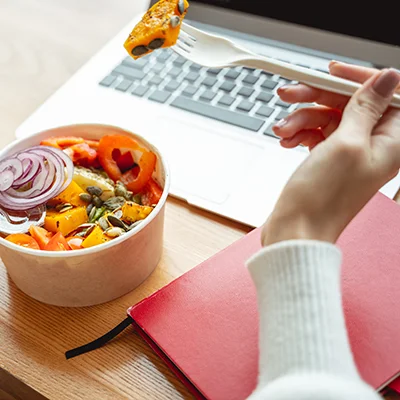
Your lunch program is a tool that can help your company outshine competition, boost morale, and improve output.
When maintaining a high-performance culture, food boosts productivity, motivation, and wellness. A quality food program ensures employees don’t have to leave campus for lunch, and reduces their need to rely on fast foods or convenience store snacks. While they taste great at the moment, heavy meals leave us feeling sluggish and unmotivated, negatively impacting performance in the afternoon.
Additionally, the afternoon brings the “3:00 o’clock slump.” According to StudyFinds, 45% of American workers polled say they eat a snack in the afternoon, and 64% of respondents report healthy foods keep them motivated in the afternoon. Access to nutritious snacks ensures mood and production levels stay consistent, resulting in a happier workforce and higher quality work.
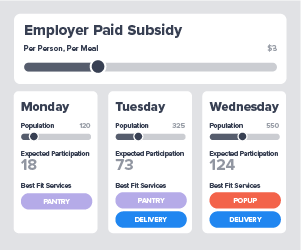
Naturally, business leaders will prioritize expenses and the ROI of a food program. While pricing can vary, traditional cafeteria and food vendor systems can cost teams of 300-500 around $7,000-$30,000+!
Compared to conventional providers, Fooda helps businesses cut costs for their workplace meal programs. We’re the best workplace food service provider, offering solutions for businesses of any type and size. See how we stack up against traditional aggregators here!
When calculating pricing, you need to know:
Meals from Fooda usually cost between $8-12 per meal (varies based on restaurant and subsidies) and are never more than the restaurant’s menu price. When food programs are treated as an overall people strategy (and not just an expense), they consistently outperform their costs.
Ready to get started? Design your food program here and see how much you can save with Fooda
When working towards standing apart from competitors across all aspects of your business, don’t let planning for lunch eat up your time. Running a quality meal program is difficult without the right support. A workplace meal provider like Fooda can help you build a custom lunch program for your team.
Fooda’s differentiator? Flexibility. Our process accommodates varied shift patterns, team sizes, restaurant partners, and more. Our menus are fluid, but our standards, timing, and quality are rigid.
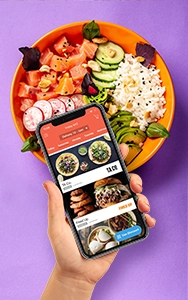
Whether in 1-1 meetings with their managers, or at lunch, your workers want to be heard. You can involve them in the restaurant selection process. Plus, employees can leave comments on that day’s meal via the Fooda App - perfect for weighing sentiment and identifying new opportunities.
We make it easy to regularly revisit and optimize your lunch programs, so you can create the perfect program for your team. Don’t just take our word for it: 80% of employees polled rank Fooda as one of their favorite workplace perks!
Let’s dive into some of the ways we can help your business maintain your competitive advantage.
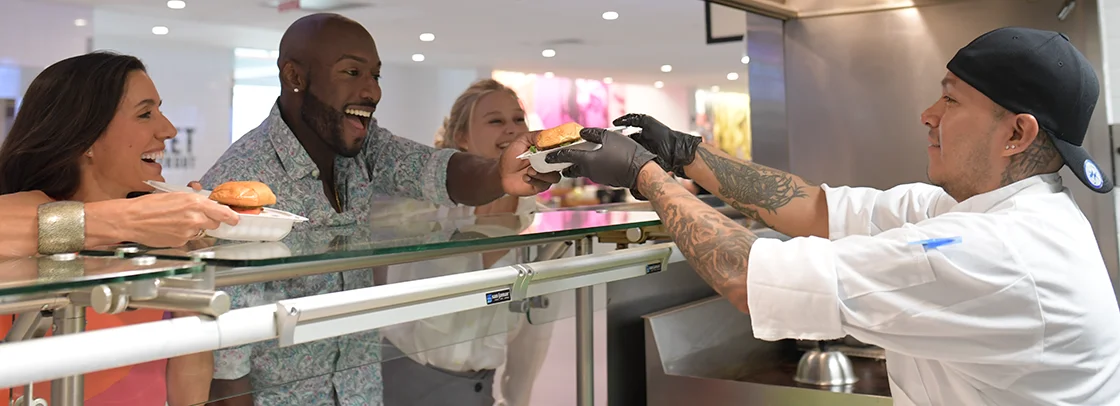
Our cafeteria and Popup restaurant system brings local eateries directly to your business. Plus, partnering with local businesses is a significant trust signal: it showcases your support for the community while boosting the local economy.
We’re confident our 2,500+ partner restaurants and independent chefs will wow your team in one way or another since our program is centered on variety and you can explore different cuisines every day of the week. Additionally, we streamline traditional cafeteria services, helping our clients create clean footmaps, reduce wait times, and maximize break periods.
If your team has a favorite restaurant, we can help you arrange resident partnerships. Rather than serving food for one day, this eatery can serve lunch on a permanent basis.
How you schedule resident restaurants is up to you: they can serve lunch 5 days a week or only on days you expect heavy office presence. You can also choose how long you want to work with them: in perpetuity, for a week, quarter, one year, it’s up to you.
Even more, if your space allows, you can opt for a rotating restaurant station, a resident restaurant, a build-your-own salad bar, and coffee or drink service! Fooda’s cafeteria service is completely customizable and will meet the specific needs and wants of your workplace.
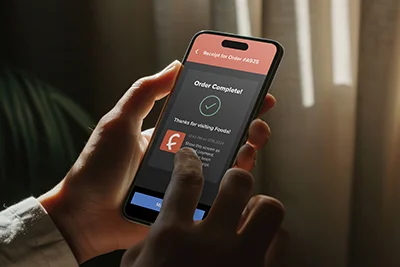
Perfect for businesses without a traditional cafeteria space, or for those who want to introduce even more variety, Fooda’s meal delivery system is one of the most convenient ways to feed your team.
Your employers can choose from 6-8 different restaurants daily, place orders by 10am, and let us take care of the rest. We make lunch fun: your employees can place orders at multiple eateries - such as a sandwich from restaurant A, and a cookie from restaurant B.
After 10am we consolidate and organize the orders, pick up the meals, and ensure they’re all delivered within the same window every time. Even more, your company will be assigned a regular Fooda delivery team member, meaning you and your building’s security will know who to expect.
Your team can build their schedules around reliable delivery times and maximize their break periods since they won’t have to leave campus for lunch. This gives them more time to socialize, relax, or prepare for afternoon meetings!
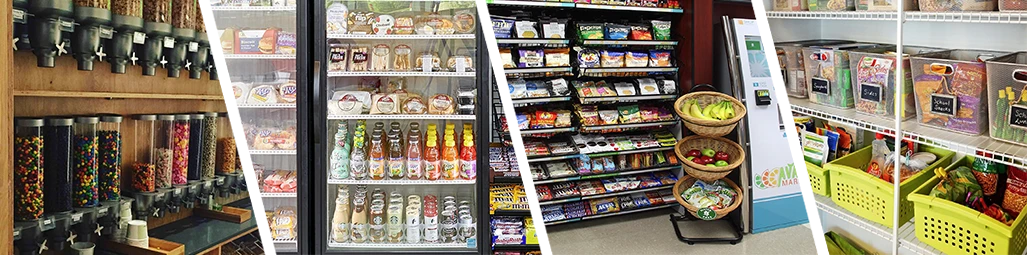
Many businesses provide their teams with snacks. But usually, these are bland, boring, and unhealthy. Granola bars, cookies, and old bags of pretzels get old fast - literally and figuratively.
Fooda Pantry sparks life into otherwise boring food scenes. Our micro markets highlight fresh and dynamic options, like grab and go salads, sandwiches, and fresh fruit.
Admins will have access to the Fooda For Business Portal, so you can review reports, invoices, and can customize your inventory to match your team’s habits. Micromarkets are attended to by Fooda, meaning we’ll take care of restocking and issue resolution.
Your team will benefit from consistent energy levels and mood, avoiding mid-morning or late-afternoon energy crashes.
Competitive advantage relies on a variety of factors, but it doesn’t always have to stem from flashy initiatives. Food in the workplace sits at the intersection of wellness, morale, and your company’s brand. It’s more than an amenity, it’s a strategy that directly improves your team’s lives each shift.
The flexibility of Fooda makes it easy to build and manage food programs that are miles above what your competitors can offer. Lunch and snacks are more than feeding employees - it’s an investment in your future talent, current workforce, and business’s output.
If you’re ready to rise above your competitors and give back to your team, book your call with the Fooda team today!
Costs vary based on team size, participation, and program type. Traditional cafeterias can be costly due to staffing, equipment, and maintenance.
Fooda’s model reduces overhead by partnering with local restaurants and eliminating on-site cooking, with meals typically costing $8–$12 and optional employer subsidies.
Yes! While food alone won’t eliminate turnover, it contributes to a sense of appreciation, belonging, and daily support. Food programs are a meaningful benefit, reducing meal costs, improving convenience, and encouraging social connection.