There's a familiar feeling that comes with ordering food for the office. Whether it's daily, weekly, or for office event catering, you try to plan ahead so everyone has something they enjoy. Even then, half the food still ends up in the trash while a few people quietly sort lunch out on their own, like they always do.
That's what happens when dietary restrictions in the workplace get overlooked.
Roughly 4 in 10 U.S. households include someone with a dietary restriction, which means most offices have several. Food allergies, religious diets, lactose intolerance, and personal preferences all show up in the lunchroom. Yet office food is still planned as though everyone eats the same way, on the same schedule, every time.
Food is social by nature. Lunch is where people gather and where natural conversations happen. When the meal doesn't work for someone, the team rarely hears about it. People bring food from home, eat at their desks, and quietly drop out of the gathering.
The longer dietary needs go unaddressed, the more inclusion erodes. Productivity, engagement, and retention follow it down.
Before solving for them, it helps to align on the language.
A dietary restriction is any limit on what a person can or will eat, whether the cause is medical, religious, ethical, or personal. Common examples include food allergies, celiac disease, lactose intolerance, halal or kosher requirements, vegetarian and vegan choices, and physician-guided plans for conditions like diabetes or hypertension.
The dietary accommodations meaning, in a workplace context, is the practical organizational response: menus, labeling, sourcing decisions, and ordering systems that let employees with restrictions eat alongside everyone else. Accommodations turn a restriction from an exclusion problem into a logistics problem you can solve.
Food at work is both personal and public. You can keep quiet about clunky software, but you can't quietly skip lunch. When the menu doesn't work for someone, it's visible to the team.
More employees have dietary needs than they used to. People can't gamble with food when their health or beliefs are on the line, so when workplace meals miss the mark, the pattern is predictable:
The cost goes well beyond food waste. Employees who skip meals lose focus and energy, which compounds across an afternoon of meetings. Long, busy days contribute to burnout when teams can't count on a meal that works for them.
Companies also carry real risk. Food allergies are medical conditions. Religious dietary practices are legally protected. Repeated exclusion creates HR and compliance exposure on top of cultural damage, since employees who feel overlooked tend to disengage long before they speak up.
At some point, the question stops being about the menu. It becomes whether the workplace was built for the people you employ or for an idealized version of them.
Decision makers often get defensive about their food program, pointing out that they offer options and unfortunately can't accommodate "everything." Most employees just want awareness of their needs and at least one option that lets them participate without explanation.

About 6.7% of U.S. adults have a food allergy according to the CDC, with reactions ranging from mild discomfort to anaphylaxis. That stake is why labeling and cross-contact protocols matter so much. Intolerances (gluten, dairy, soy, and others) rarely get announced because explaining your digestive system to coworkers feels exhausting, so silent avoidance becomes the default.
Where this category breaks down is usually an afterthought rather than malice. A missing label, a shared serving spoon, or a quick "it should be fine" has spoiled more office lunches than bad catering ever has.
Skipping pork or shellfish doesn't cover religious dietary practice in full. Preparation matters. Cross-contact matters. Trust matters most of all, because employees following religious rules rarely argue when something looks off; they skip the meal and move on.
Over time, that quiet avoidance sends a message about who the office was designed for and creates discrimination exposure no business wants to face. Inclusive workplaces give employees honest information about how a dish was prepared, not just what's listed in it.
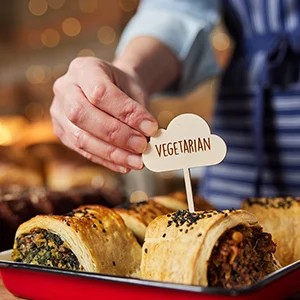
Plant-forward eating is well established. Gallup's most recent reading puts 4% of U.S. adults at vegetarian and 1% at vegan, with a much larger flexitarian group that looks for occasional meatless meals.
You can tell when a plant-based option was added late: salad-only fixes land as an afterthought. The bar for a real vegetarian meal is intention, not invention. A full lunch beats a side salad every time.
Some employees follow specific diets for weight management, while others avoid certain foods for heart health, diabetes, hypertension, or other medical reasons. The mistake offices often make is asking people to explain why they need something different. Pressuring disclosure undermines inclusion and pushes employees away from group meals, which defeats the point.
A better approach uses anonymous intake and lets each person flex their own order, so employees can pick what fits without narrating their medical history. Programs that offer individual ordering from local restaurants handle this category well, since the choice happens at the employee level.
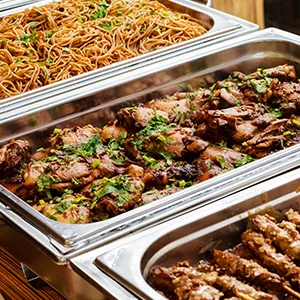
Traditional catering should work, and for some offices it still does. You pick a restaurant, lock a headcount, food arrives, everyone eats.
The model strains as soon as hybrid work enters the picture. Attendance varies week to week. Tuesdays look busy while Fridays look empty. Some employees come in for meetings, some for lunch, some to run an errand. Locking a headcount 24 to 48 hours out becomes guesswork, and dietary accommodations break down with it.
Traditional catering also assumes uniformity: one menu, one delivery, one big order meant to cover everyone. That fits a workplace many companies have moved past.
What tends to happen instead:
That's how office managers end up worn down by RSVP chasing, Slack pings, last-minute changes, and apologies when lunch doesn't stretch. The model keeps failing because it was built for a workplace that no longer reflects how teams gather.
Most offices struggle because they patch problems instead of fixing the structure. A useful program builds dietary accommodations into how meals are sourced, ordered, and delivered.
Dietary needs are personal, sometimes medical, sometimes religious, and sometimes simply not material for a team Slack channel. Gather information with care:
The goal is for someone to share once and not have to relive it at every meal. Technology can shoulder the tracking so employees aren't asked the same questions repeatedly.
Treat dietary needs as the norm rather than the exception. If you plan menus assuming someone in the room needs gluten-free, dairy-free, vegetarian, or allergen-aware options, you'll almost always be right. A few habits that help:
When dietary accommodations are part of the original menu plan, they stop feeling like last-minute favors.
Labels are a trust signal. If a teammate has to ask three questions before eating, the program has already lost them. What helps:
Reliable labeling is one of the smaller details that makes or breaks an inclusive food program. People relax when they can trust what they're looking at.
Someone will forget to share a restriction. Someone new will show up. Someone's needs will change. Plan for it with a few universally safe options or a simple grab-and-go pantry backup. Rigid catering models struggle here, while flexible programs absorb the variation.
Skip the quarterly focus group. A short pulse check covers it:
Patterns surface quickly when you go looking. If the same issue keeps appearing, the system needs adjusting, not the people.
Most food programs fail because they ask one person to guess correctly for everyone else. Fooda works differently, removing the guesswork from the equation.
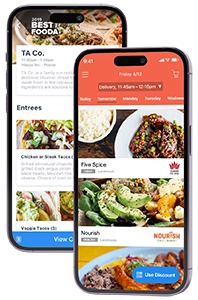
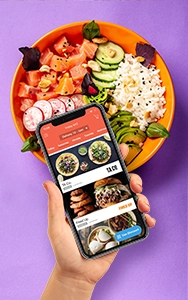
With our office lunch delivery program, each person orders for themselves and picks what fits their diet, appetite, and day.
No one has to remember who eats what, and no employee has to explain their needs in public. Admin work drops because the technology tracks the details that matter.
Hybrid schedules make headcount unpredictable, which traditional catering handles poorly.
Fooda has no minimums. Meals come from the restaurants you want, based on real orders, and arrive without any hassle. If 19 people order, food is made for 19 people, not 30 "just in case." That fit-to-attendance model is why the program slots into hybrid offices and dietary accommodations that need to flex.
Rotating local restaurants put different cuisines in front of employees each week. Variety naturally widens dietary coverage across vegetarian, vegan, halal-friendly, gluten-aware, and dairy-free preferences without anyone engineering the perfect menu.
Fooda has over 4,500 local restaurant partners and can design a rotation that meets the variety your team wants. The best part? More than 75 cents of every dollar spent flows directly back to the local restaurant owner, paid out weekly and impacting the community you work in.
Fooda runs on normal days and messy ones, on full weeks and anchor days, on standing programs and office event catering. It scales up and down without rigid schedules to babysit, which matters when you're keeping things inclusive without adding to anyone's workload.
Ready to get started? Get connected with Fooda today and let us help you design a workplace food program that meets your wants and needs.
Dietary accommodations refer to the practical steps employers take so employees with dietary restrictions can eat alongside everyone else. That includes asking about needs in advance, offering allergen-aware and religiously appropriate options, labeling ingredients, separating utensils to prevent cross-contact, and giving employees a way to choose for themselves rather than relying on a one-size-fits-all menu.
It depends on the cause. Religious dietary practices and medically necessary diets generally fall under Title VII of the Civil Rights Act and the Americans with Disabilities Act, which require reasonable accommodation when an employee makes a request. Personal preferences (such as choosing to eat vegetarian) usually aren't legally protected, though offering options for them still supports inclusion and retention. Confirm specifics with HR or employment counsel for your jurisdiction.
Use an anonymous intake survey when someone joins the team or when a new food program starts, and include an optional write-in field on every event RSVP. Make sure managers know one-on-one conversations are welcome and treated with care, rather than as a hassle. The aim is to let employees share once and trust the information will be used, so no one has to repeat themselves before every meal.
A food allergy involves the immune system and can trigger severe reactions, including anaphylaxis, from even trace exposure, which is why cross-contact and ingredient transparency carry such high stakes. A food intolerance involves the digestive system and tends to cause discomfort rather than a medical emergency. Both deserve accommodation, but allergies require stricter handling protocols, separate utensils, and clear labeling.
The most common categories are food allergies (often peanut, tree nut, milk, egg, wheat, soy, fish, shellfish, and sesame), gluten and dairy intolerances, religious diets (such as kosher, halal, and Hindu vegetarian), plant-based diets (vegetarian, vegan, pescatarian), and medically guided plans for conditions like diabetes, heart disease, or hypertension. Planning for these categories upfront covers most office needs without bespoke menus for every meal.