Monday feels like a scramble. Tuesday, you wonder if anyone’s actually in. Wednesday, people are dragging chairs around looking for somewhere to sit. By Friday, half the office is gone, and the fridge is crammed with food nobody’s excited about anymore.
If you’re responsible for office food for hybrid workers, that pattern probably sounds painfully familiar. It’s why so many teams are quietly asking the same question lately: “Who specializes in hybrid office catering?” Because whatever worked years ago clearly isn’t cutting it now.
Hybrid schedules didn’t just change where people work. They changed when people show up, who’s around at lunch, and whether ordering food feels like a smart investment or a gamble.
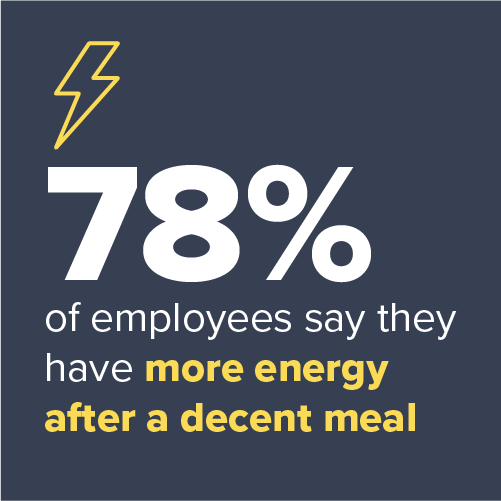
Food still carries weight, though. Around 78% of employees say they’ve got more energy after a decent meal, and 42% say their work improves when food’s involved. That’s where things get messy. Teams want hybrid team meals that feel intentional and steady. Office managers are stuck guessing headcounts, stretching budgets, and babysitting logistics that change every single week.
This is why flexible office catering models like rotating restaurants, individual ordering, and cafeteria replacements, are starting to make a lot more sense than fixed trays and minimums.
Traditional catering worked for a long time. When people came into the office five days a week, headcount was boringly predictable. If you were working, you were there. Standard meal systems and cafeterias made sense. They don’t always anymore.
Most catering setups are still built around assumptions that just don’t hold up anymore. Fixed headcounts. Advance notice. Minimums. One big order meant to “cover everyone.” That model wasn’t designed for catering for a hybrid workplace, where attendance changes by the hour and half the team decides whether to come in based on what’s happening that day.
Managing food for hybrid workers isn’t the same as feeding a “traditional” in-office team. Companies end up wasting money, and food because of:
Hybrid office catering only works when it feels practical instead of like a scheduling headache with leftovers at the end of the day. The old system of “pre-order 48 hours ahead for everyone” simply doesn’t align with how teams actually use office space now.
Now, teams want food that feels worth the office trip, but managers want a system that doesn’t make their week harder.
If most people are in on Monday and Wednesday, but attendance dips to a handful by Friday, the catering approach needs to shift too. 52% of US employees now work on a hybrid schedule, meaning attendance varies not just day by day but worker to worker.
Flexible office catering lets you plan around real participation. That avoids wasted trays of food and budget that disappears on days few people show up.
People need some predictability. Not certainty, just a reliable rhythm they can count on. Structured schedules, like offering food on a couple of common office days each week, or during team building activities and events, give people something to plan around without forcing orders for days when most people stay home.
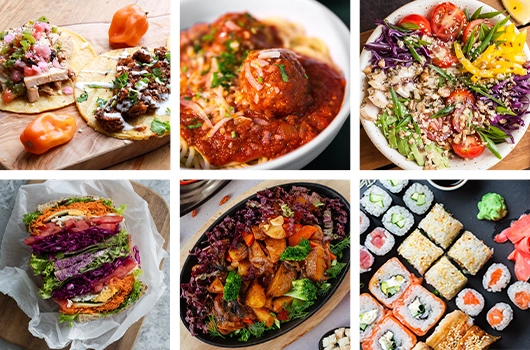
Repetition is the enemy of excitement. If every week is the same vendor with the same food, enthusiasm drops fast. Employees notice. Fun fact: research from Cornell University shows workplace meal programs can boost focus and concentration simply because people don’t waste mental energy figuring out lunch or skipping it entirely.
Food shouldn’t be another project on someone’s plate. Good hybrid catering systems let people self-order, simplify billing, and cut out chains of emails about dietary restrictions. Finding out who specializes in hybrid office catering usually means finding a company that can help with the admin.
Some people come in three times a week, some once. Hybrid catering works best when everyone feels included, whether that’s through ordering flexibility, a mix of menu styles, or days that respect varied schedules.
Once you stop trying to force hybrid attendance into a five-day catering mindset, the landscape looks very different. The question becomes less “What’s the best food?” and more “What still works when half the office decides at 9:30 a.m. whether they’re coming in?”
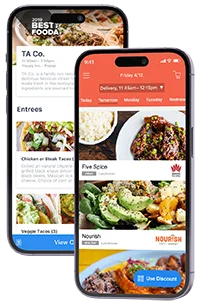
Picture this: it’s 3 p.m., a project runs long, and eight people realize they’re not leaving anytime soon. Individual delivery apps make sense here. Everyone orders what they want, food shows up quickly, problem solved.
Now imagine that same setup happening three times a week. Fees start stacking up. Orders arrive at different times. Someone’s food shows up cold while another order never arrives. There’s also zero shared moments; people eat alone between meetings. That’s when group catering makes sense.
This model shows up in offices that want food to feel planned without being rigid. For example: food is available every Tuesday and Thursday. Different local restaurants rotate each time. Employees order individually by a cutoff that morning.
If 18 people order, food is made for 18 people. If 43 order, it scales. No minimums. No trays “just in case.” This is why rotating programs fit hybrid office catering so well.
Most offices don’t choose one model forever. They mix.
A common setup looks like this:
That balance keeps catering for a hybrid workplace flexible.
When food ordering lives in spreadsheets and inboxes, everything feels fragile. Modern programs rely on tech that handles ordering, dietary preferences, billing, and participation quietly. Office managers don’t chase people. Employees don’t wonder if food is coming.
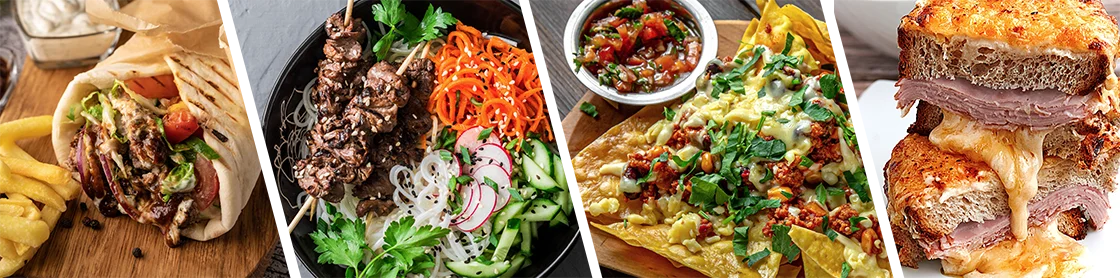
Most food programs fall apart because they ask offices to predict things they can’t predict. How many people will show up. When they’ll arrive. Whether a “quiet day” suddenly won’t be quiet anymore. Fooda sidesteps that problem instead of wrestling with it. We deliver a sytem that adapts to real behavior, whatever that looks like in your office.
Most importantly, Fooda builds around your office, rather than asking you to fit an existing mold. The setup flexes as schedules shift. Summer looks different than fall. This quarter looks different than the last. The food program moves with it instead of fighting it.
Most hybrid office catering programs fail because someone tried to make the office behave a certain way instead of watching how it already behaves. Here’s how you can avoid that:
Once you’ve dealt with that, the next step is measuring success. You don’t need metrics right away. Listen instead. Are fewer people complaining? Is food disappearing instead of sitting untouched? Are people asking who’s coming next week? That’s how you know it’s working.
Food is one of those things that shapes how an office feels every day. When it’s done well, nobody talks about it much. When it’s done badly, it becomes a daily annoyance. That’s why hybrid office catering ends up carrying more weight than people expect.
Hybrid work didn’t just change schedules, It broke the old rules around office food. Fixed headcounts, minimum orders, and “we’ll just guess” planning don’t survive contact with real attendance patterns.
Hybrid schedules aren’t going anywhere; it’s time to rebuild your food strategy around them. Fooda can help with that. We offer programs that adapt to the unpredictable nature of the office. Individual ordering, rotating restaurants, predictable service days, and systems that don’t need babysitting.
For office managers, that usually means fewer last-minute scrambles and fewer apologies. For employees, it means office food for hybrid workers feels like a genuine perk.
If you’re tired of wasting food, juggling headcounts, or hearing “lunch ran out” for the third time this month, it’s worth seeing what a catering program looks like when it’s built for a hybrid team from the start. Learn more about how Fooda works here.
Specialists in hybrid office catering, like Fooda, assume attendance will change week to week and design everything around that. That usually means individual ordering, no minimums, and systems that don’t panic when only nine people show up on a Friday.
The one that fits your team. For most offices, that means flexible office catering with set food days and optional participation. People know when food is there. Managers aren’t stuck over-ordering. Rotating restaurant programs usually win here because they handle variety and attendance swings.
You let people tell you whether they’re eating. That’s it. Catering for a hybrid workplace works when food is made based on actual orders, not estimates. Individual ordering with a short cutoff window removes most of the risk.
Nothing, if everyone’s actually there. The problem is that traditional catering assumes consistency. Hybrid offices don’t have it. Minimums force waste on quiet days, and advance ordering means you’re always wrong by the time lunch arrives.
Waste drops when hybrid team meals stop being ordered “just in case.” When people order individually, food production lines up with reality. Less food ends up untouched. Budgets stabilize, and nobody has to pretend leftovers are a win.