Free food at work has quickly become one of the most sought-after employee benefits in modern workplaces. According to USA Today, providing meal benefits for your employees can result in a 67% job satisfaction rate, and for good reason.
When done right, the advantages of employee meal benefits start to stack up quickly. What might seem like a simple perk has the potential to deliver measurable returns across multiple areas of business performance and culture.
If you're considering a fully subsidized daily meal program, understanding these benefits can help you make an informed decision about investing in your team's long-term success.
Keep reading to learn the five biggest benefits of free food at work.

One of the most notable benefits of providing free food in the workplace is the leverage it gives the hiring team when it comes to recruiting top talent. It sends a powerful message to employees that says, “we care about you and are willing to invest in your well-being.”
As the workplace evolves, employees are considering more than just salary when choosing where to work; they’re weighing the holistic employee experience. According to the Human Workplace Index, 63% of workers would leave their current jobs for a company that offers more benefits but the same, or even lower, pay.
By providing unique perks and benefits, you can make your company stand out from the crowd and attract qualified employees, even in today’s exceptionally competitive talent market, and workplace food is one of the most low-effort high-reward perks available.
Having access to high-quality meals located right in the office is a compelling perk that instantly elevates the employee experience. Make that food free, and you have a major competitive recruitment advantage.
When you provide meal benefits for your employees, you save them time, energy, and money. They get something to look forward to every day, and you get to attract and retain top talent.
The retention impact of providing free food at work is real and measurable. Research from SHRM found that replacing a single employee can cost 50-200% of an employee’s annual salary. If providing subsidized lunch at work can keep even a handful of employees from jumping ship, you’ll see significant savings.
According to Gallup’s State of the Workplace 2026 report, 77% of employees report being at least somewhat burnt out. If not addressed, employees can suffer exhaustion, mental health struggles, and difficulty concentrating. All of this can eventually drive them away. If you don’t take proactive steps to prevent burnout among your employees, you’re more likely to struggle to retain them.
Providing free food at work helps keep employees healthy and happy. They’ll have access to nutritious food every day, which will support their physical health, relieve stress, and help keep their energy levels up. By fully subsidizing their meals, you allow all employees to participate in the program without having to worry about compounding costs.
Employee meal benefits also show appreciation and care that will make employees feel seen and more enthusiastic about their work. This sense of purpose improves their overall satisfaction and sense of wellbeing, making them more likely to stay with your company even if another offer comes along.

As lunchtime approaches, your workers start to become less focused as they begin to think about the logistics of getting their next meal. What restaurant will they go to? What route will they take to avoid the worst of the lunch-rush traffic? Will they have time to dine in, or will they need to eat fast food in their car just to get back in time, only to return late anyway?
These seemingly small decisions create a ripple effect of distraction that impacts productivity across your entire workforce. When employees know their meal is taken care of, they can stay focused on their work right up until lunchtime. They can transition from work to lunch and back again without the stress of planning, driving, ordering, and waiting. This means less time away from their desks and more time spent in a productive, focused state.
According to the Fooda Price Index, employees are continually spending more and more money on food at work. Hunting for affordable meal options within a reasonable distance makes deciding where to eat even more time-consuming, adding stress and distraction and driving down productivity.
While providing free food for employees may sound expensive, the true figures are striking. Consider an employee earning $40 per hour in total compensation. If lunch logistics consume just 30 minutes before and after their break each day, that's nearly 2.5 hours per week. The table below breaks this down further:
As the table shows, even after accounting for the $3,120 annual meal cost, companies still see a net gain of $1,240 per employee annually in recaptured productivity. That's a 40% return on investment before even considering the recruitment, retention, morale, and culture benefits.
As the table shows, even after accounting for the $2,600 annual meal cost, companies still see a net gain of $1,760 per employee annually in recaptured productivity. That's a 68% return on investment before even considering the retention, morale, and culture benefits.

Food has the wonderful ability to bring people together. Shared meals create opportunities for relationship building that simply don't exist in formal meeting settings or at individual desks. When your team gathers for lunch, departmental silos break down and genuine connections form.
In a recent survey, Fooda found that 83% of workplace and people leaders believe food plays a significant role in office culture, yet one in three workplaces has no food program at all. If employers don’t actively encourage employees to take lunch breaks away from their desks, employees are more likely to miss out on valuable social opportunities.
Providing free food at work draws employees away from their desks and into the break room. They chat while picking up their lunch deliveries or waiting in line to be served. Fully subsidizing office meals increases employee participation significantly, as no one skips out to save money. Everyone has a reason to venture into communal spaces and form connections.
These lunch gatherings allow employees to interact with colleagues they might not otherwise encounter. Marketing teams eat alongside engineering teams. Senior leadership shares tables with junior staff. Over time, these casual interactions build office culture and the kind of trust and camaraderie that make collaboration run smoothly.
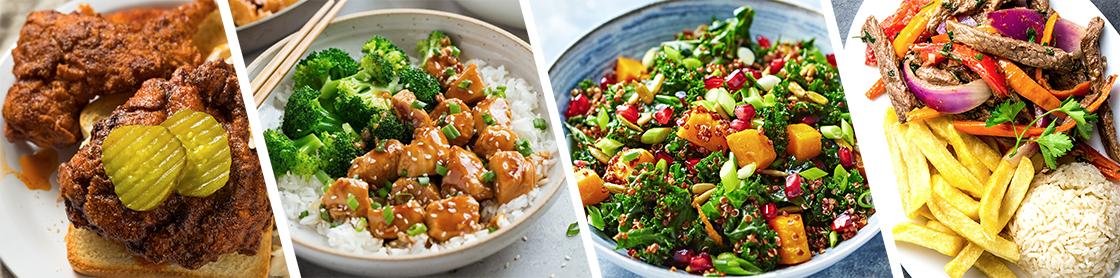
One of the biggest challenges with workplace meal programs is avoiding menu fatigue. Fooda’s 2026 survey found that 87% of workplace and people leaders believe that it’s important to have variety in workplace food programs.
Having to choose from the same stagnant selection of options can become tiring. Over time, it can lead to declining participation and diminishing returns on your investment, even if your program is free to employees.
Every employee has unique diet and taste preferences. A successful free food program needs to accommodate vegetarians, vegans, those with food allergies, and pick eaters alike. The inclusivity a varied menu provides can show intentionality and dedication to improving the employee experience. That commitment makes employees feel valued and appreciated, further improving morale and maximizing your program’s effectiveness.
Additionally, when employees don’t have to pay for their meals, they become more comfortable being adventurous in their food choices. They can try new dishes and cuisines without worrying about having to spend money on something they don’t end up enjoying. By implementing employee meal benefits, you’re giving employees a no-risk way to explore and discover new favorites.
When employees can trust that quality food options will always be available, it adds an element of positive anticipation to their workdays. This ongoing engagement is what separates a dynamic, well-implemented food program from a stagnant, forgotten perk.

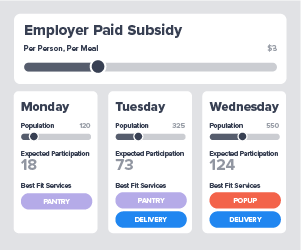
Giving your employees free food at work doesn't have to strain your budget or require complex logistics. Fooda is designed to help companies of all sizes deliver high-quality meals from local restaurants that employees love, with solutions that scale to your needs and budget.
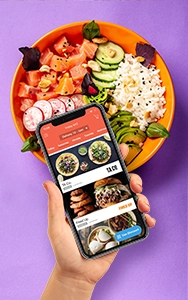
Our subsidy program makes it easy to provide fully or partially subsidized meals to your team. Our purpose-built technology handles all the payment processing and tracking, so your team simply orders what they want while you maintain full visibility and control over program spending.
We partner with over 2,500+ local restaurants to bring the quality and variety that keeps free meal programs engaging long-term. With new options daily, your employees get access to authentic, chef-prepared meals without ever leaving the building.
Our programs are designed to fit your needs. Here’s a quick overview of what we have to offer:
The benefits of free food at work are proven. With Fooda, you can deliver these benefits to your team without the complexity of managing vendors, logistics, and payments on your own.
We make providing free workplace meals simple, allowing you to meet employee expectations. Ready to explore how Fooda can help you implement a free food program? Contact us today to learn more.
What percentage of companies currently offer a workplace food program?
Two out of three companies (67%) already offer some kind of food program, according to Fooda's 2026 Workplace Lunch & Food Program Survey. That means roughly a third of companies are still without one, even though the same survey found leaders overwhelmingly see food as a culture driver.
How is the average price of workplace lunch tracked?
Fooda publishes the Fooda Price Index (FPI), which calculates average lunch prices by dividing total transaction value by total transactions across 270 cities, using point-of-sale data updated quarterly. The Consumer Price Index also tracks food prices in general, including average costs of groceries and eating take-out and at serviced restaurants. Both are updated periodically, and they’re useful benchmarks that can help with budget and subsidy planning.
Can a workplace food program help with return-to-office attendance?
Employee meal programs are one of the more effective levers companies are using. Companies that are seeing success with ROI initiatives in 2026 are treating workplace food as an operational necessity rather than an occasional perk, pairing it with structured in-office days rather than one-off pizza parties.
What's the difference between a meal stipend and a subsidized meal program?
A stipend hands employees cash or a fixed credit to spend however they choose, with little employer visibility into use or participation. A subsidized program (like Popup restaurants or office lunch delivery) covers some or all of the cost directly at checkout, giving the employer control over budget, participation tracking, and restaurant variety while still leaving employees free choice over what they order.
How do you know if your workplace food program is suffering from menu fatigue?
The main metric to track is participation. Declining order volume or attendance at the same recurring restaurants, even when the program is free, signals fatigue and waning interest. 83% of leaders say variety is important or extremely important in their food program, and programs that keep serving the same rotation tend to see engagement drop off over time, regardless of how affordable it is.