Quiet quitting, polyworking, hybrid creep, and now… coffee badging – we’ve seen a number of workplace buzzwords emerge over the past few years to define new trends and phenomena. If your office has been hit by a bout of employees coming into work just to stay for a little while, you might want to take a closer look at what coffee badging is and how it can impact your operations.
Low engagement. Declining motivation. Poor collaboration. If you don’t recognize them early, these are just some of the problems you might end up with from these employee habits that ultimately eat away at your bottom line and office culture.
In this post, we break down everything about the phenomenon – from coffee badging meaning to practical strategies for addressing it. Let’s get started.
So what is coffee badging at work? And how did it come to be?
The term refers to the practice of employees showing up at the office and only staying long enough to be seen. It’s called “coffee badging” because they’ll typically come in to swipe their badge and grab a coffee before they leave to work remotely for the rest of the day.
It’s a phenomenon unique to hybrid work cultures with strict return-to-office mandates, where employees are required to physically come into work on certain days. And workers will keep finding creative ways to meet those minimum requirements if they don’t enjoy being in the office or have a good enough reason to stick around.
An Owl Labs study even found that 43% of hybrid employees coffee-badge.
Fooda’s “What’s Happening in the Workplace Now?” survey also found that only a small fraction of workers come into work voluntarily. Company policy is the biggest factor that drives on-site attendance, with 37% of workers coming into the office because of it.
So if people are coming into work only because they have to and not because they want to, you’re likely to see more coffee badgers sprouting up in your organization.
So how is coffee badging affecting your office culture and why should office managers be concerned about it?
Here are some of the ways it might have an impact on your organization.
Employees who punch in only to meet the minimum requirement tend to be disconnected from the company culture. They may not engage meaningfully – whether it’s with their work or their colleagues. This creates a culture of minimum effort that spreads quickly if it’s not handled, where employees aren’t fully engaged.
When people aren’t engaging meaningfully, they’re not putting in enough effort to collaborate, solve problems, or create new initiatives that help hit goals.
Plus, when people technically “show up” but aren’t actually available, it disrupts the collaborative process. Imagine trying to get people together for an emergency meeting only to find that half of them have gone home for the day.
Lack of engagement and poor collaboration are a recipe for disaster, particularly impacting productivity. When people aren’t giving their best, their work will also suffer. And let’s not forget the waste of productive hours with employees leaving the office when they should technically be working.
What employers need to know about coffee badging is that it’s a symptom of a deeper problem – one where the office value proposition just isn’t strong enough. Distracting workspaces, bland and boring food, poor amenities…whatever the reason may be, employees are simply not seeing why they should spend the entire day working on site.
So your return-to-office strategy will only work if it’s built to withstand the risk of coffee badging. This will take more than just enforcing policy. It involves getting to the root of the problem and creating an in-office experience that’s purposeful, meaningful, and enjoyable.
Here are a few ideas:

A successful return-to-office strategy doesn’t work if your solution is just asking employees to come in on specific days. It gives employees a good reason to come into the office and want to stay for the whole day, which prevents coffee badging in the process.
In-office days are curated around events and activities that offer value through face-to-face interactions. So employees feel like they’re getting more when they’re physically present.
For example, you could curate the in-office experience with:
Sometimes, it’s not just policy that brings employees into the office but the connections they have. In fact, 74% of workers in the Owl Labs study consider office friendships and relationships to be the most important factors in their working lives.
People could be excited about coming into work because they look forward to exchanging witty banter with a desk mate or discussing last night’s game with a coworker.
But if someone’s badging in just to leave after 30 minutes, odds are they don’t have a lot of friends at work.
So fostering connection in the workplace could help you turn coffee badgers into employees who stay a full workday. And this means creating more opportunities for casual interactions. Give employees the freedom to connect over shared interests and talk about stuff outside of work.

You could do team lunches and after-work events to foster community in the workplace. And create designated social areas where workers can engage in casual chats over coffee.
For example, companies like BenchPrep dedicate space for a large wooden table at the center of the office where all 40 employees can sit together at the same time. And they encourage the team to eat lunch together, creating an opportunity to connect with colleagues and build a strong relationship.
Speaking of spaces, your office design and layout also play a role in whether employees stick around for a full day or leave quickly after badging in.
Look at your office space and ask yourself: Is it inviting and comfortable for employees?
If it’s just rows of desks and cubicles, don’t be surprised if folks would rather work somewhere else. The same goes for your furniture and facilities. You can’t expect employees to stay for a full workday if all they get is uncomfortable chairs and malfunctioning toilets.
If you want your employees to stay the entire day, you need to create a space that makes them want to stay.
This could look like upgrading to ergonomic chairs and desk setups. It could look like fixing up broken facilities and maintaining them so there’s minimal downtime.

You might even want to redesign your office space to create a relaxing and inviting work environment. This could play a key role in improving focus and reducing stress for employees.
The Owl Labs study even found that 71% of workers consider an attractive office environment important for their working lives.
For instance, collaborative lounge areas that are designed to feel like a social hub allows employees to exchange ideas and cooperate on tasks in a relaxed setting. Think: comfy couches and armchairs with low tables and ottomans. Or focus rooms to minimize distractions and promote concentration.
And when employees have the space to focus, it will ultimately show in their performance.
Employees could have all the basics – the nice chair, the work friends, the inviting space – but still prefer to work somewhere else.
That’s why you need to do a lot more than cover all the basics and offer more value out of the office experience. We’re talking about creating an in-office experience that’s “too good to miss.” And the right perks and amenities help you do just that. Here are a few ideas:
You know the one thing that gets almost every employee excited about working on-site? Food.

The Fooda survey found that 80% of employees are more enthusiastic about work if the company provides lunch. When asked what would make their office experience better, the top answers involved food. People wanted better snacks and drinks, as well as food that has some variety and tastes high-quality.
So food could be the very thing that gets your staff to stay for a full workday. To get people to stay - you should have:

A robust employee wellness program could make a strong case for working in the office. Give employees a better reason to come into work (and stay) with amenities that support their physical and mental wellness. Think: in-office gyms, group meditation classes, access to mental health support, nap rooms, etc…
With food perks being one of the best ways to add value to the in-office experience, Fooda’s workplace food solutions are just what you need to boost employee engagement.
Give employees something new to look forward to every day with fresh and exciting cuisines from local restaurants.
You can tap into Fooda’s vast network of over 2,500+ partners and have the best local chefs cook authentic meals for your teams. The convenience of having high-quality meals prepared or served right in the office could give employees a good reason to stay for a full workday.
And with daily rotating menus, you could offer variety and novelty to keep them coming back every day.
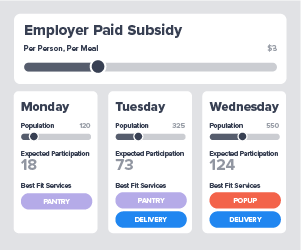
If free food is one of the perks in your RTO strategy, Fooda makes it easy to manage your employee meal subsidies. You can easily add or remove members, customize per-person allowances, and allocate funds to specific teams all in one place.
Fooda’s partnership with national and local vendors allows you to keep your office pantry stocked with a diverse assortment of healthy snacks and indulgent options. So your staff always has a rich selection of snacks to enhance their office experience.
This includes partnerships with Farmers Fridge to offer fresh and healthy grab-and-go meals and Bevi for a range of flavored and enhanced waters. Who wouldn’t like some zesty lime-flavored water with an energy boost for a quick pick-me-up in the middle of the workday?
Addressing coffee badging at work requires more than just strict mandates and vigilant managers. It involves creating an office value proposition that employees can’t refuse. And Fooda makes it possible with customizable food programs that work for your office.
Get in touch to learn more about designing a program that truly engages your employees.
Coffee badging is the practice of employees showing up at work only to badge in and grab a coffee before they leave to work remotely for the rest of the day.
Coffee badging may be associated with disengaged employees, poor collaboration, and low productivity since workers are disconnected from culture and not engaging meaningfully with their teammates.
Coffee badging typically involves employees staying for about 30 minutes, which is enough time to swipe their IDs, grab a coffee, and greet colleagues.