If you've ever worked at a highly successful company, you know that high-performance culture doesn't happen by accident. There is a strategy behind it, consisting of many working parts, including investing in great food in the workplace.
Many companies spend millions to hire the most talented people in their fields, but never consider the impact of employee performance and nutrition. Organizations will gladly invest small fortunes to implement performance management systems and advanced productivity tools in the hopes of creating a high-performance culture, and yet neglect the simple benefits of offering performance-increasing food in the workplace.

How can you expect to fuel a high-performance culture without accounting for the connection between employee performance and nutrition? By providing your team with the right options for a productivity-boosting diet, you are planting the seeds for high-performance results.
There's also something of a disconnect at some companies, with leadership expecting peak performance from their high-performance teams, while also creating a culture where meals are meant to be skipped, eating happens alone at a desk, and options are limited. It's like a "how to build high-performance culture" guide from a parallel universe.
For companies willing to take a more thoughtful approach to building their high-performance culture, there’s a real opportunity. By strategically implementing workplace food programs that respect the delicate balance between employee performance and nutrition, it's entirely possible to see real-world results.
Providing nourishing food in the workplace is only one part of the strategy, of course. The larger goal is to use workplace culture, food programs, and the power of communal experiences to nurture a high-performance culture. Done right, and your teams will bring a new level of focus and energy to their work, while also boosting their ability to collaborate. They'll work better because they enjoy working more, creating serious improvements to retention.
This article explores the science behind nutrition and performance, what high-performing companies do differently, and how to implement food programs that drive results.

Before we examine the connections between employee performance and nutrition, we should start with a more fundamental question: What is high-performance culture, exactly? Is it just creating a more efficient workplace, or are we talking about a specific kind of company environment with uniquely positive characteristics?
The goal of a high-performance culture is to create a kind of synergy between everyone who works there. This is only possible when everyone has clear goals, and if there is accountability when goals are missed. This also requires a high degree of collaboration and communication, enabling greater productivity as people pitch in to get things over the finish line. The point is to empower the team by creating a shared sense of ownership over their work, allowing everyone to maximize their results through collective innovation and agility.
From a management perspective, everyone on the team is seen as worthy of ongoing professional development, allowing for the improved retention of top performers. The trouble with establishing a high-performance culture is that it can be very difficult to maintain. The real challenge isn't "how to build high-performance culture," it's "how to keep your high-performance culture from burning out due to flagging energy, drained mental clarity, and fraying team cohesion."
Which brings us to the food.
Nothing brings people together quite like a shared meal. Chances are that you've even seen the immediate impact of food in the workplace, with a catered lunch suddenly lifting everyone's mood before they get back to the stresses of the day. It's not just a matter of pairing employee performance and nutrition, it's about the workplace culture food can create. So why does food matter to performance?
Nutrition has a real impact on job performance. Eat enough unhealthy food over a long enough period of time, and eventually you'll notice the effects. A good example of this is chowing down on too many salty snacks, which is all too easy to do if the only food in the workplace comes from a vending machine. Scarf down too many salty chips, and you may feel bloated, fatigued, and start to get a headache.
Similar issues can crop up from consuming too much sugar or caffeine, or from simply getting the wrong balance of protein, fats and carbs. In other words, fast food and snacks are not the ideal menu for a high-performance culture that balances employee performance and nutrition.
If your goal is to build a high-performance culture at your business, it's worth understanding the impact of having nourishing food in the workplace.

Optimizing a workplace for a high-performance culture should start with a little food science. Our brains run on glucose. When your body's internal supply of glucose starts to run low, your brain essentially turns on a bunch of energy-saving features. The result is trouble focusing and decision-making fog.
In a company with a high-performance culture, “brain fog” can have a serious impact. These are collaborative workplaces where everyone needs to be working together to optimize overall efficiency. If a few people are struggling because they aren't getting the right nutrition, optimal performance is impossible.
It's also worth noting that the quality and nutritional content of their food matters. If glucose were the only issue, it would be possible to create a high-performance culture fueled by nothing but candy bars. Our bodies want more than a sugar rush, and there are countless biological processes that absolutely depend on consuming a varied mix of macronutrients and micronutrients. Getting the details right matters for optimized employee performance and nutrition.
A 2019 systematic review of nearly 40 studies on the effectiveness of workplace nutrition found multiple statistically significant impacts on productivity, work performance, and absenteeism. In other words, the mid-afternoon slump is real, and largely nutrition-related.
It's not difficult to imagine the effects of poor nutrition habits in a high-performance culture workplace. Skipped meals can reduce productivity. Low-quality food can result in energy crashes. But the causes of workplace culture food problems may be less obvious.
High-performance workers may take fewer and shorter breaks. They may eat less during their lunch break, focusing instead on meeting a looming deadline. When they do eat, they may settle for fast food meals that are less-than-ideal for employee performance and nutrition.
The result? If enough of your high-performance workers are not getting great food in the workplace, their efficiency and productivity will suffer. Worse yet, you might start seeing an increase in "presenteeism," where workers are showing up, but otherwise not performing well.
But it's not just about nutrition. Over time, inconsistent or inadequate workplace nutrition quietly erodes productivity, engagement, and morale.

The most important part of a high-performance culture is the "culture" part. After all, we're optimizing for productivity and efficiency in a group of human beings. Not only do all these people need to know what they're trying to accomplish, they also need to know what the skills and limitations are of the people around them. Before they can become a team, they need to get to know each other.
What's the most effective way to do this? By sharing meals. Breaking bread together is a culturally universal technique for building trust and establishing relationships. The informal interactions during a shared meal can spark curiosity, conversation, and even collaboration.
Team bonding happens naturally around food. Even workplace culture food, like pizzas or cafeteria meals, can create the foundations of high-performance culture.
In their efforts to create a high-performance culture, some companies fundamentally misunderstand the role of food in the workplace. In this section, we'll be taking a look at some of these common mistakes.
Snacks are not meals. While many workers may appreciate having access to higher-quality or free snacks in the breakroom, this won't steer anyone in the creation of a high-performance culture. In fact, having ready access to a ready supply of unhealthy snacks may actually make things worse, as workers experience increased lethargy and energy crashes. More importantly, the social connections made over a brief snack break are minor compared to the benefits of a team sharing an actual meal together.
Most professionals are perfectly capable of getting their own lunch, so why would workers in a high-performance culture workplace be any different? That's a fair question, but it also kind of misses the point. Getting your own lunch takes time. It takes mental resources to decide on a meal, and even more if you're going out to pick it up. While there's nothing wrong with eating alone at your desk, it's also a missed opportunity to bond with other team members. Employees can absolutely "figure it out," but from a high-performance culture perspective it's far from an optimized result.
When it comes to creating a high-performance culture, consistency matters. If workers get the sense that you're not interested in providing them with a workplace experience that values them, they may lose interest in giving their all to the job. If their only onsite food options are whatever is in the vending machines, they may get the sense that employee performance and nutrition are not big priorities for the company. Even in situations where the company provides low-grade catering options, otherwise ambitious and efficient workers can start to get bored with seeing the same handful of menu items. If the menu consistently doesn't accommodate a worker's dietary needs, it can even prompt productivity-draining resentment.
One of the most common productivity hacks in the business world is to cater a meal. It's the perfect way to smooth over the increased demands of a crunch time, or to boost participation during an all-hands meeting. It's like a one-use version of high-performance culture, and it can have a real impact on productivity. Unfortunately, everyone knows that it can't last. Instead of seeing these benefits on a daily basis throughout the workplace culture, it feels like a transactional event. The benefits simply don't last.

This brings us back to our central question: What is high-performance culture, and how can leaders use workplace culture food programs to create a practical framework for implementing it in a consistent and actionable way? Let's consider some options.
What kind of "high-performance culture" is your organization really looking for? Does your company need help with a specific objective?
All organizations with a high-performance culture share certain elements that enable them to optimize for productivity and efficiency. These are:

High-performance cultures require strategic investments, and food is one of the most impactful. Why not leave this one to the experts? For more than 15 years, Fooda has specialized in providing workplace dining solutions that support performance, culture, and retention at some of the most successful organizations in the country. From small offices to large hospitals, and from corporate headquarters to university campuses, we know how to turn onsite food programs into measurable results.
Ready to see how Fooda can develop a strategic food program that will support your organization's performance goals? Talk to our team to let us show you how to build high-performance culture through great meals.
High-performance culture workplaces provide team members with clear goals, and require a high degree of collaboration and communication between team members. This increases productivity and efficiency, as workers are focused on working towards shared objectives.
It requires a significant commitment of time and effort, structuring teams and departments around achieving specific benchmarks by working collaboratively. Over time, and with the right management, the team becomes more of a "crew" working together to achieve a shared goal.
A 2019 systematic review from BMC Public Health found statistically significant impact from workplace nutrition interventions in improving productivity, work performance and workability.
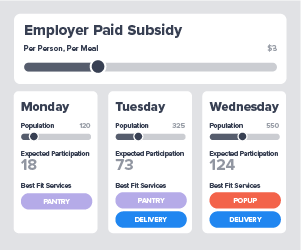
Companies offer a wide range of workplace food benefits, from employer-paid dining programs to regular boxed-lunch events. Workplace dining companies, such as Fooda, offer a variety of options suitable for locations of various physical footprints, employee headcounts, and budgets.