Managing a commercial building is becoming more complicated. It’s not just one business taking up an entire floor or building anymore; it’s dozens of different micro companies, entrepreneurs, hot desking teams, and hybrid workers, and they’re all clamoring for one thing: good food.
Sure, your tenants still want fast wi-fi, smart tech, comfy spaces, and maybe the option to bring their dog to the office from time to time, but from the moment they log into work each morning, they’re going to be thinking about one thing: where to get lunch.
It’s funny how something as ordinary as lunch has turned into a real point of comparison between properties, but that’s where we are, and honestly, most buildings aren’t ready for it.
A traditional cafeteria needs a predictable crowd, but hybrid work throws attendance patterns all over the map. Retail leases help a bit, but only if the mix happens to fit into what people want, which they rarely do. So landlords end up with a mismatched collection of multi-tenant building amenities, but nothing that solves the daily question of where hundreds of people will actually eat.
Meanwhile, tenants do care. A recent JLL survey found that buildings with better amenities (including dining) drive higher occupancy and rent premiums.
That’s really the point of finding the right commercial building food service: it’s about giving your property a competitive edge without turning into a full-time food services manager.
Location and smart tech are hot topics among commercial real estate professionals, but honestly, food ends up driving more real-world tenant sentiment than most amenities. It’s one of the few things every employee interacts with almost daily. We literally need to eat to live. When a building offers reliable, varied commercial property dining services, it pulls tenants in.
Here’s where food service pulls more weight than you’d expect:
Unfortunately, most “traditional” approaches still fall short.
Step into a building where a mix of companies share the same floors, and the lunch challenge pops out right away. Every group moves differently. Some eat early, some barely stop, some treat lunch like a ritual. No two teams line up the same way, and that alone makes food planning tricky.
A few realities hit landlords right away:
Put all that together, and you can see why many landlords avoid food service entirely or settle for something basic, hoping it’s “good enough.”
Sometimes, the traditional option feels like the best call. Create a cafeteria, and you’ll have a central location for food (and for tenants to mingle), and predictable meals. But it doesn’t really work that way. For cafeterias to pay off, they need consistent foot traffic, and multi-tenant buildings rarely deliver that anymore.
Besides the foot traffic issues, building your own cafeteria is expensive. You’re paying for kitchens, staff, and equipment people might not use. Then there’s the problem with the menu. It can get outdated fast, and it’s usually pretty tricky to find something that works for everyone.
Some commercial building owners assume they can “get around” the issue with a few vending machines. They might fill a gap, but there’s no real sense of hospitality or care, and the food quality is unpredictable at best. Plus, vending machines don’t bring people together.
Then there’s the food court, or “external vendor” dilemma. You might think renting space to a restaurant will help you out, but
The good news is that newer models have finally caught up, and they actually work with the flow of multi-tenant spaces.
At Fooda, we spend a lot of time reading reports about trends in commercial building food service, and honestly, when you filter through all of them, you realize that what tenants actually want isn’t that complicated. They’re really just looking for:
That’s the pattern across commercial buildings: people aren’t demanding luxury; they just want thoughtful tenant amenities, like food service, that fit around the workday.
Once you stop trying to force old-school cafeteria logic onto multi-tenant buildings, it’s a lot easier to see the path forward. Modern cafe concepts are flexible, modular, and built to handle the weird rhythms of hybrid work. Or, the best commercial building food service setup for your building might not be a fixed concept at all.
Probably the most popular option to emerge in the last few years. Instead of running a full kitchen, buildings bring in a rotating mix of local restaurants. Tenants get:
Landlords benefit too. The setup is predictable (you provide a space and the operator handles the rest), and when your number of tenants changes, your strategy can easily scale up or down.
For very large multi-tenant buildings, a full-service cafeteria or cafe can absolutely still work. The key is adapting your service model based on day of the week. Traffic patterns in multi-tenant buildings aren't uniform anymore. Tuesdays through Thursdays might see 70-80% occupancy, while Mondays and Fridays drop to 40%. Smart cafeteria operators adjust accordingly:
This approach keeps the cafeteria economically viable without forcing tenants to subsidize empty seats. You're matching labor costs and food prep to actual demand, not to what you wish demand would be.
Buildings with 500+ employees can support this model, especially when there's strong anchor tenant participation or when the landlord positions the cafeteria as a competitive amenity. The real mistake is running a cafeteria the same way every single day, regardless of who shows up. Flexibility in operations is what makes the model sustainable in the hybrid era.
This part gets surprisingly flexible once you stop thinking in all-or-nothing terms.
Here’s how buildings usually approach it:
Buildings can mix and match whatever structure fits their tenants.
This approach helps when there’s no dedicated dining room. A lot of buildings turn lobbies, lounges, or forgotten corners into shared eating spots. Suddenly, that quiet square footage becomes a place where people actually talk to each other.
You don’t need your own commercial-grade kitchen, because you can pull in rotating restaurants or catered pop-ups, and you can adapt easily for events (like tenant workshops or conferences). Plus, you’re actively promoting cross-company community, and that’s something vending machines can’t do.
This part used to be an afterthought; now it can make or break commercial building food service strategies. A little tech can make it easier to manage orders and payments, without extra admin work. It gives you access to usage data that actually makes a difference, like insights into which restaurants are most popular, serving times, and program adoption rates.
Plus, tech naturally supports hybrid schedules, giving tenants options for on-demand service, pre-ordering, and batch pickups.
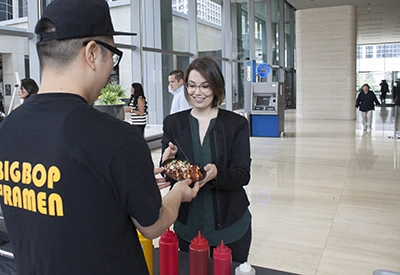
Once you see how unpredictable multi-tenant buildings are, it becomes obvious why so many food programs fall apart. Fooda was basically built to deal with that chaos, adapting to what commercial properties actually need.
You get a service with:
All that, and you end up with an actual solution for attracting and retaining new tenants. Your commercial building food service becomes a selling point for your leasing teams, differentiating you from your competitors, and keeping tenant satisfaction rates high.
Once a building decides to level up its commercial building food service, the next question is always, “Okay… how do we actually roll this out?” Here’s the part most property teams appreciate: with a partner like Fooda, the whole thing becomes a lot less complicated than it looks.
Before jumping into contracts or floor plans, it helps to take a quick temperature check.
Things worth looking at:
This early check helps you calibrate the scale of the program instead of overdoing it or undershooting demand.
Once you know the environment, the structure comes together pretty naturally.
Here’s how most successful buildings approach it:
Property teams tend to ask the same questions every time, so it helps to think through those concerns before rolling anything out.
This is also where a lot of owners realize they don’t need to bite off more than they can chew. They can start small, test demand, and build from there.
The commercial buildings with steady foot traffic, calmer tenant relationships, and faster lease-up times usually have one thing in common: people actually want to be there. Nothing inspires that feeling faster than a good commercial building food service.
As soon as you get the food part right:
Owners sometimes start by thinking food is a nice extra. Then they see how quickly it shapes the tone of the building, and they realize it’s what holds the place together.
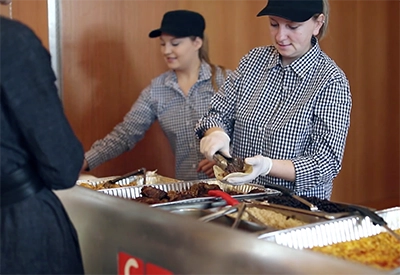
Buildings tend to succeed when the day-to-day experience feels convenient and healthy. Food has a way of anchoring that feeling. When a commercial building's food service is predictable, varied, and close at hand, the whole place feels more appealing.
Fooda fits neatly into this because it doesn’t require a construction project or a high-stakes gamble on a cafeteria model. The service adjusts to headcount shifts, unpredictable attendance, and the mix of companies sharing the space. Rotating restaurants bring energy. Reliable scheduling brings calm. Property teams don’t have to manage cooks, equipment, or long-term vendor headaches.
The results can be seen in steadier renewals, stronger tours, fewer grumblings about lunch options, and a building that feels more welcoming than it did the month before.
Ready to choose the right commercial building food service? Learn more about how Fooda works, and build the strategy that works for you.
Flexible setups tend to perform best like rotating restaurants, cafeteria replacement programs, shared dining areas, or pop-up service. These approaches handle uneven foot traffic and hybrid schedules better than traditional cafeterias.
Either can. Some buildings include food as part of the amenity package, some employers subsidize meals for their teams, and many properties choose a simple pay-as-you-go structure. The setup depends on the building’s strategy.
Food is consistently near the top. After that: outdoor space, fitness options, comfortable common areas, and anything that makes the workday feel less rigid. Practical amenities usually win over trendy ones.