When a company chooses Fooda or Orange by Fooda for its workplace dining program, something bigger than lunch happens.
Workplaces are able to put real money into the hands of real people. Specifically, local restaurant owners who hire local employees, pay local rent, and reinvest in the neighborhoods where they've built their livelihoods.
That's by design: Fooda’s model was built from the start to route corporate food spending back into the communities where organizations operate.
By choosing a locally rooted food program, your organization becomes a direct investor in the community.
Workplace dining is often framed as a perk, a convenience for employees and a retention tool for HR. And it is those things and more. But Fooda's model adds a layer that most food programs can't claim: 100% of the food program supports locally owned businesses.
Every participating restaurant in the Fooda network is a community stakeholder, not a national chain collecting a check from a corporate headquarters somewhere else. That distinction matters because where dollars flow determines who gets to grow.
The financial mechanics reinforce why this works. 75% or more of every dollar a company spends on Fooda flows directly back to the local restaurant owner, paid out weekly. For a small business owner, that kind of predictable, recurring revenue is transformative.
It's the difference between surviving the slow season and planning for growth, payroll stability, and the confidence to hire another person, buy better equipment, or finally sign a lease on a permanent space.
Fooda also provides monthly reporting on local community impact, so organizations can show stakeholders exactly what they've contributed.

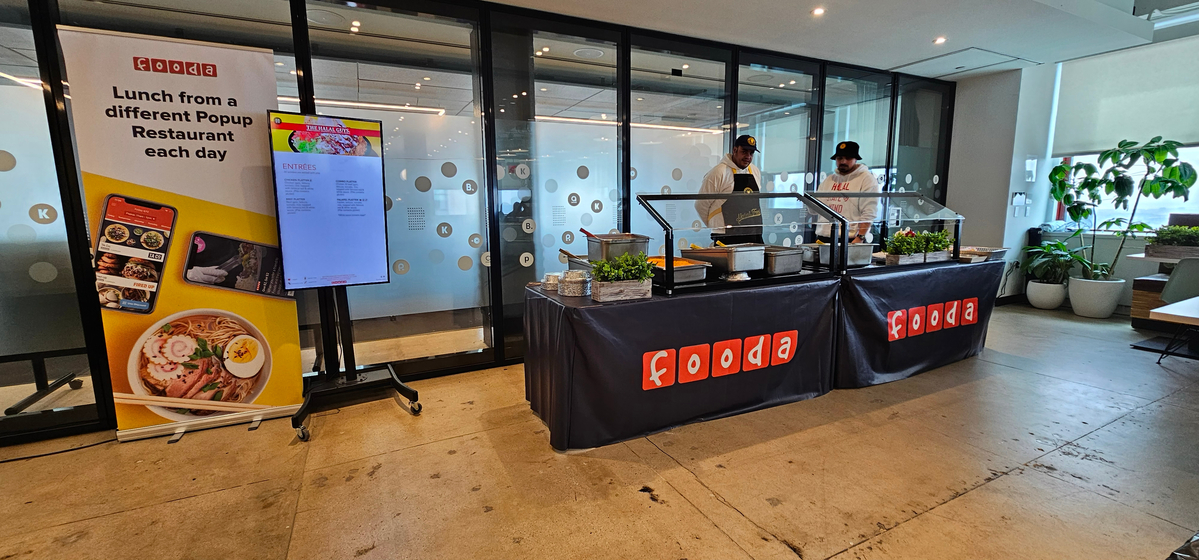
One of the reasons Fooda's community impact scales so broadly is that the program is built for large, complex environments, not just the sleek downtown office. Fooda serves corporate offices, manufacturing facilities, multi-building campuses, hospitals and college campuses, warehouses and distribution centers, and more!
That reach matters because it means the community benefit extends well beyond a single zip code or industry. Whether your workforce is spread across a single office or multiple campuses, Fooda brings local restaurant partners into environments that most food programs were never designed to reach.
To understand why this model creates real community impact, it helps to look at what it produces in practice. Consider a quarterly snapshot from a large employer with 800 employees using Orange by Fooda.
In a single quarter, that organization generated $101K in total food sales, supported 41 local restaurant partners, executed 125 catering events, and sent $42K in net catering sales directly to local partners.
Of the total $101K in sales, 80% flowed straight to local restaurants, roughly $81K, while 20% covered operations. The program engaged 29 local restaurants through Popup partnerships and 12 through catering.
That's not an abstract figure. That's $81K in a single quarter flowing to local restaurant owners who used it to pay wages, restock kitchens, and build toward their next milestone. Multiply that across an organization's full year, or across the hundreds of employers Fooda works with nationally, and the community investment becomes substantial in a way that's hard to replicate through any other workplace dining model.

The Fooda restaurant network is locally focused in both spirit and data. Based on 2026 Fooda national restaurant network data, the numbers tell a clear story about who these partners are:
These are chef-owners, family operations, and first-generation entrepreneurs who built something from scratch, without national marketing budgets or private equity backing. When Fooda brings them consistent corporate volume, it gives them what no amount of social media followers can reliably provide: steady income that fuels real growth.
The supplier diversity picture is equally compelling. More than a quarter of Fooda restaurant partners, 27.2%, hold at least one formal diversity certification.
Certifications across the network include:
For procurement teams and sustainability officers, that's measurable, reportable impact tied directly to a business decision your company is already making.
Behind every statistic is a real story about what consistent revenue from a Fooda partnership can unlock. Three stand out.
These stories reflect what consistently happens when corporate spending is deliberately routed through local, independent businesses rather than national chains.
The money circulates rather than leaving the community. Restaurant owners pay local suppliers, hire local workers, and spend locally themselves. That multiplier effect is exactly why economists point to local business investment as a powerful community-building tool.
Fooda and Orange by Fooda exist in a category that's rare in the food service industry: a program that solves a real operational need for organizations through workplace dining, while simultaneously generating meaningful, trackable community impact. Companies don't have to sacrifice convenience or quality to do the right thing. They just have to choose a food program that was built with their community in mind from the start.
When you choose Fooda, you're feeding your team and investing in the restaurants, the families, and the neighborhoods that make your city worth working in.
Ready to help support your local community, employees, and entire organization? Reach out to Fooda today.