Hybrid work has reshaped the demand for office space, with many companies offering flexible hours that bring in a smaller portion of their teams to the office. This creates new challenges for commercial property managers, who are under more pressure than ever to give tenants a reason to renew and show up every day.
That’s where food amenities come in. The right workplace food program offers a high-impact solution from day one to directly boost employee satisfaction and in-office attendance.
This post explores how commercial property managers can use food to improve the tenant experience and drive renewals. Let’s get started.
Physical offices aren’t going anywhere and organizations are currently facing the challenge of making them worthwhile and impactful as they implement in-person work policies.
In an HqO survey, 92% of landlords recognized that employees want more from their buildings. And properties that meet those expectations will ultimately see higher tenant satisfaction.
Here are four ways improving the tenant experience makes a difference for commercial real estate management.

When tenants are satisfied with your property, they’re more likely to renew their leases. A large-scale survey of 2,900+ office buildings and 39,000+ tenants found that a 1-point higher overall satisfaction among tenants is related to:
Moving offices is hard, expensive, and time consuming. As a property manager, if you can provide the space that keeps them happy, retention will go up.

Commercial buildings with the best amenities provide a top-tier tenant experience that attracts more renters, especially through referrals.
In the survey mentioned above, a 1-point higher overall satisfaction among tenants is also associated with an 11.52% higher likelihood to recommend the property to prospective tenants.
At their core, amenities increase the value of your property and allow you to charge a premium rent. When organizations inside your building feel like they're getting their money’s worth, it benefits everyone.
According to the survey, a 10% higher overall satisfaction at the building-level is related to a 0.17% growth in gross rents and a 0.59% growth in effective gross rents.

As you add more amenities to improve tenant experience, it helps you stand out in the crowded commercial real estate industry.
With the recent return-to-office wave, everyone is vying for new business. When you have workplace perks (like a food program) it ultimately gives you an edge over the other commercial buildings in the area trying to win over the same tenants.
Now we can all agree that improving the tenant experience is vital for successful commercial property management. But what role does food play in all this?
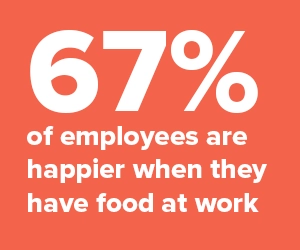
For one, food directly improves the employee experience from the day a program is implemented. According to Fooda’s “What’s Happening in the Workplace Now?” survey, food perks are the top factors that would improve the office experience for employees. And your tenants are happy when their employees are happy.
Food is also a key driver of attendance, with 80% of employees feeling more enthusiastic about work when their company provides lunch. So a food program could bring employees into the office and if you’re considering a corporate cafeteria it can boost general foot traffic for your property.

Additionally, food builds culture and community for your tenants, which ultimately contributes to their overall experience. According to the latest Fooda Workplace Lunch & Food Program 2026 Survey, food has an impact on workplace culture for 83% of companies. In fact, it’s a core part of culture for 41% of companies.
Successful commercial property management goes beyond simply offering food at your property. Here are some practical best practices to help you set up food programs that actually add to the tenant experience.
People don’t want to waste half their lunch hour finding food outside of the office. At the same time, convenience often comes at the expense of quality, with workers having to grab ready-to-go meals that don’t always taste the best.
Addressing these concerns is the first step to improving the tenant experience. They want to be able to easily choose or order their meals.
Make it easy for tenants to access high-quality food without having to leave the office premises. You could:
Between varying schedules and diverse employee preferences, a handful of menu items and rigid cuisine options won’t cut it for multi-tenant commercial buildings. Variety should be central to your food program, with each tenant getting to choose meals and cuisines that work for them.
According to the Fooda Workplace Lunch & Food Program 2026 Survey, 83% of respondents say variety is important in their food program.
Here are some ideas to help meet that demand:

Implementing an in-house food program can be costly since it has potential to involve new infrastructure or buildouts. But with a flexible food service partner, it doesn’t have to be expensive or complicated.
Food service providers like Fooda offer rotating Popup Restaurants, consolidated delivery, corporate event catering, and more that don’t have any special requirements.
For large commercial buildings with high traffic or an unused cafeteria, Fooda offers full cafeteria solutions that let you bring in top-rated restaurants to cook on-site. Fooda handles all the staffing, logistics, and equipment needs, so there’s minimal investment on your end.
All of these solutions are highly flexible and operate on a consumption-based model. So daily food prep scales according to daily demand. This makes them perfect for multi-tenant buildings where tenants have fluctuating daily attendance, especially under hybrid work setups.

Tapping into your local restaurant network allows you to harness the best local chefs while directly supporting the small businesses in your neighborhood. This ultimately contributes to your tenant experience, as tenants and their employers want to give back to their local communities. According to the Fooda Workplace Lunch & Food Program 2026 Survey, 87% of respondents say supporting local restaurants is important in their food program.
Plus, channeling the expertise of local restaurants makes it easy to rotate between diverse cuisines and menu selections. Tenants get to enjoy authentic flavors and explore dishes from various cultures right where they work.
Not every food amenity adds to the tenant experience. Some programs may see little use, resulting in high costs and low returns. Meanwhile, certain cuisines may pull a lot more weight than others.
Measuring the usage and impact of your food amenities is key for building a successful food program. You can use the data from your POS systems and provider technology to track important performance metrics. Combine the data with qualitative insights from tenant surveys and employer tools.
Ask questions like:
Use these insights to measure the ROI of your food program and fine-tune your strategies.
Fooda offers flexible and diverse workplace food solutions to improve the tenant experience, minus the heavy investment. Commercial property managers can choose from options like:

Bring in a daily rotation of chef-driven restaurants with the Office Building Popup service. Restaurants prepare the food in their own kitchens, so there’s no cooking on site. You can bring the restaurant experience into your building without the need for costly buildouts or special constructions.
The restaurants temporarily set up in your building in a 12 x 7 ft area and clean up once lunch ends. So this option has a small footprint, with the flexibility to repurpose the space when lunch isn’t served.

For properties with more limited space, Fooda’s Office Lunch Delivery is a great way to make high-quality food accessible to your tenants.
They can choose their own orders, mix and match items from different restaurants, and have their meals delivered together by a dedicated Fooda staff member.
Fooda assigns a dedicated driver who’s pre-approved and specifically trained to work inside your building, meaning they’ll bring the boxed lunches directly to tenants’ offices. This streamlines the process of getting meals delivered instead of requiring tenants to pick up their orders from the lobby.
.jpg)
Fooda Pantry empowers your tenants to bring elevated snacking experiences to their offices. You can tailor the product mix for each tenant based on the unique consumption habits and preferences of their employees. So while one tenant needs healthy, grab-and-go meals in refrigerated vending machines, another might want to keep their shelves stocked with gourmet potato chips and imported chocolates.
Smart vending solutions allow you to get real-time updates on inventory needs and system issues. This ensures faster restocking and timely fixes to keep tenants satisfied across properties.

Orange by Fooda lets you take commercial property management to the next level, bringing you a selection of the best local restaurants straight to your tenants. It features a blend of resident restaurants with a rotating lineup of guest restaurants that serve fresh and authentic flavors daily.
Tenants get to choose from a variety of options with daily rotating cuisines, so food is never boring. You can use Fooda’s proprietary tech to track consumption habits and top-rated dishes. This helps you make data-backed decisions, allowing you to bring in tenant favorites at the right time.
Class-A office buildings like McKinney & Olive have been able to enjoy a 95% tenant occupancy because customers have almost everything they need in one place - including restaurants and fitness centers. Property managers started using Fooda’s services to offer low-cost, convenient lunches on site, which further boosted tenant satisfaction.
Ready to elevate your tenant experience with food amenities by Fooda? Get connected with a workplace food program expert today.

How much does it cost to add a food program to a commercial office building?
The cost of a workplace food program depends on the model. Traditional in-house cafeterias often require six-figure buildouts plus ongoing subsidies, while flexible providers like Fooda operate on a consumption-based model with little to no upfront infrastructure cost. Commercial property managers can offer popup restaurants, office lunch delivery, or smart pantries without significant capital investment, since restaurants supply their own equipment and staffing. This makes food amenities accessible even for mid-size or Class B buildings.
Who pays for a workplace food program: the property manager, the tenant company, or employees?
Cost structures vary by building. Some commercial property managers cover food programs as an included amenity to drive lease renewals, while others run it as a paid service where employees purchase their own meals. A common hybrid model has the property manager subsidize Popup Restaurants and pantries while employees pay for individual orders. Fooda's consumption-based pricing means you only pay for what's actually used, which makes shared or hybrid funding models easy to set up.
How long does it take to launch a food program in a commercial building?
A flexible workplace food program can typically launch in a few weeks, since there's no construction or new infrastructure required. Fooda handles vendor sourcing, scheduling, logistics, and staffing, so property managers don't need to coordinate individual restaurants. By contrast, a traditional corporate cafeteria buildout can take six months to over a year due to permits, construction, and hiring.
How do food amenities compare to other office amenities like fitness centers or conference space?
Food is one of the highest-frequency amenities in a commercial building because tenants use it daily, whereas fitness centers and conference rooms are used less often by any individual employee. According to Fooda's workplace survey, food perks are the top amenity employees say would improve their office experience, and 80% of employees feel more enthusiastic about work when their company provides lunch. This makes food a uniquely high-impact amenity for driving daily attendance and tenant retention.
Can small or mid-size commercial buildings offer food amenities to tenants?
Yes. Flexible providers like Fooda are specifically designed for buildings without commercial kitchens or large amenity floors. Office lunch delivery requires no in-building space, popup restaurants need only a small 12 x 7 ft footprint, and Fooda Pantry can be installed in any breakroom or common area. This allows mid-size buildings to offer the same food experience as Class A properties without the infrastructure investment.