According to Gallup, 52% of remote-capable employees are currently working hybrid schedules. This ongoing trend represents a significant shift in how companies structure the workplace and support the employee experience.
In Chicago, the way employers handle this shift is critical. Harsh winter weather, long commutes, and competitive talent markets all contribute to why it’s important to make employees’ in-office days feel rewarding and satisfying.
Though it can be difficult to keep employees engaged and productive when managing a hybrid workforce, there are plenty of ways to encourage on-site attendance. One of the most effective is through food.
But providing food for hybrid teams can be challenging. Shifting schedules make it difficult to coordinate orders or nail down accurate headcounts. There are, however, ways to navigate these challenges, allowing you to provide food for your hybrid team without the administrative headache.
While return to office initiatives are being pushed across all relevant industries, hybrid work models are still commonplace. But in hybrid offices, the time your employees spend on-site can be the difference between finishing a project or pushing it to next week.
And now more than ever, the office experience needs to work at an individual level. If it doesn't, collaboration and productivity wane. When that happens, the benefits of having an on-site location are lost, leaving you paying for space where employees don’t want to be.
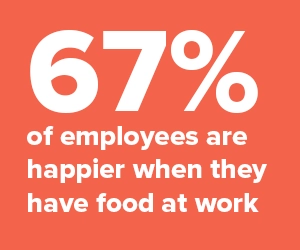
When you have a workplace food program, it makes an impact on day one by: building community, saving employees time and money, and acting as a powerful incentive to come into the office.

In hybrid workspaces, employee satisfaction is directly tied to the daily workplace experience.
If it feels meaningful and rewarding, employees are less likely to view in-person work as an inconvenience. Workplace food programs show that you care about your employees’ day-to-day experience, not just their productivity.
Food is an immediately-visible perk. It integrates convenience into their workday, reducing overall stress and prevents decision-fatigue.
Most importantly, it creates relaxing, meaningful breaks. Easy access to good food can be a powerful motivator. It allows employees to fully enjoy their lunch and gives them something to look forward to on in-person days.
When employees spend limited time in-office, how they use that time matters. Having a well-implemented food program can boost productivity on in-office days.
Access to readily-available food means employees won’t waste time walking to and from restaurants, hunting down deliveries, or waiting in long lines. When they have adequate time to enjoy their meals, they’re more likely to return from breaks on time.
This efficiency creates routine. Consistency is valuable, especially in variable hybrid workspaces. When lunch is a predictable, established part of the workday, employees don’t lose time wondering when or where they should take their break.
According to Gallup, 28% of employees feel less connected to their organization’s culture with a hybrid work model. This isn’t all that surprising. Less time in the office means less opportunity to interact with coworkers outside of business contexts.
Hybrid work models have a hard time finding ways to build community when coworker interaction is limited. As a result, employees feel disconnected from their colleagues, fewer ideas are sparked, and meaningful collaboration stalls.
When the work environment doesn’t present meaningful team-building opportunities, they need to be intentionally created. One of the simplest ways to do this is through lunch breaks.
With the right workplace food program, you can encourage employees to eat together rather than in isolated groups off-site or alone at their desks.
Robin’s Return to Office Report found that 44% of employees cited office perks, including catered lunch, as a motivating incentive to come to work in-person. Especially in a hybrid model, where employees have more say in when and why they show up, these tangible benefits have a big impact on on-site attendance.
Having convenient, cost-effective food available creates convenience that staying home doesn’t offer. It serves as a practical incentive and proves that you care about their in-office experience. This centers attendance around perks people are excited to use rather than mandates.
Chicago has a rich culinary history and a thriving restaurant scene. Food is a huge part of the city’s culture, making it an especially important factor in employee satisfaction and on-site attendance.
Fooda’s 2026 Workplace Lunch & Food Program Survey found that 83% of companies feel that variety is important in their workplace food programs. With a wide range of culturally diverse cuisine, Chicagoans are used to variety. Their standards are high. And this makes it even more important to make sure your food offerings are diverse, exciting, and ever-changing.
Living and working in Chicago also poses a unique challenge to encouraging in-person work: the commute.
According to a Chicago Health Atlas survey, Chicagoans face longer average commute times than the rest of both Illinois and the United States. This makes making your employees’ journey to the office worth it even more important. And providing convenient, high-quality, and exciting food options is a great incentive.
Hybrid offices thrive on flexibility that many workplace food programs don’t provide. This clash can make providing food for hybrid teams feel like a waste of resources.
Although many employees value the flexibility hybrid work schedules provide, it can make coordinating day-to-day office operations challenging. Employees show up on inconsistent days of the week and expected headcounts don’t account for last minute changes.
When ordering for the office, it’s almost impossible to reliably estimate how much food you’ll need. The last thing you want is to under-order. The only real option is to anticipate higher than expected attendance and hope for the best. More often than not, you’ll end up with food left over.
Now do that five days a week. That adds up to a lot of wasted food. Not only does it pose an ethical problem, but it wastes time, money, and effort, for both you and your vendors.
Especially in larger companies, teams aren’t likely to sync their schedules. Different teams have different needs. Their in-office routines will all be adjusted to best suit them. That flexibility works well for them, but it makes coordinating food programs even more challenging.
Because of this, their experiences with food programs can be wildly different. Some might have food available every day they’re in the office. Some may almost never have access to it. Some may only get it 50% of the time.
This creates an unreliable experience. Many employees will start packing or ordering their own lunches just to ensure they have something to eat. The perk loses its value, and your hard work goes to waste.
In addition to fluctuating headcounts, ever-changing hybrid schedules present other challenges. For one, it can make budgeting extremely difficult. Oftentimes, you’re going to have to adjust the amount of food you’re ordering shortly beforehand. Estimated costs are almost never going to be accurate.
And then there’s the logistics of coordinating with vendors. Many don’t have the ability to adjust order volumes last-minute, leaving you with either too much or not enough food. All this creates a labor-intensive operational nightmare. Managing hybrid workforces is hard enough. The last thing you need is to add more complexity for your administrative team.
There are a lot of different forms workplace food programs can take. All have pros and cons, and the best choice depends on your individual business needs.
Fooda’s model is built for hybrid complexity and designed to suit your organizational needs regardless of event or headcount. Employees opt in each day, meaning meals are prepped for those who plan to eat. Everyone gets what they want, and food waste is no longer a concern.
Fooda Office Delivery and Fooda Popup Restaurants are both great ways to feed offices with highly variable attendance, because they are built with hybrid models in mind. Attendance doesn’t determine the success or failure of lunch that day. Low headcounts don’t drive up prices, and high demand doesn’t break the system. Everything is adjusted and accounted for in real time.
Fooda partners with over 4500 beloved local restaurants. Fooda’s rotating options keep the lunchtime experience fresh and exciting, all while supporting local restaurants in Chicago.
This city has so much great food to offer and Fooda makes it easy to bring the city’s best features to your employees every day.
When you partner with Fooda, we take the administrative burden of running a food program off your plate. All logistics are handled by us. No more worrying about coordinating with vendors, negotiating menu options, or keeping track of orders.
One of the best examples of this is Orange by Fooda. This modern dining solution gives the traditional corporate cafeteria an update. It provides the same variety and flexibility as Fooda’s other services on a larger scale. Running a traditional cafeteria is expensive and requires a lot of administrative oversight, but Orange is a cost-effective solution that is entirely managed by us.
Contact Fooda today to see what we can do to support your hybrid workforce.

Can Fooda accommodate different dietary needs and preferences?
Absolutely! Fooda works with over 4000 restaurant partners, many of which accommodate dietary preferences and restrictions. Gluten free, vegan, and allergy-conscious diets can all be accounted for, meaning nobody gets left out.
Can Fooda work within our budget?
Fooda’s programs are designed to work with any budget. You choose what perks you want to offer, how often, and how much you want to subsidize per employee.
Can workplace food programs work in small offices or satellite locations?
Yes. All of Fooda’s services are scalable, with flexible options for any size team. For smaller locations, delivery is a great option. It allows you to order for exact headcounts, meaning everyone is always accounted for. Fooda pantry is also ideal for smaller staffs, giving employees access to food and beverages all day long.