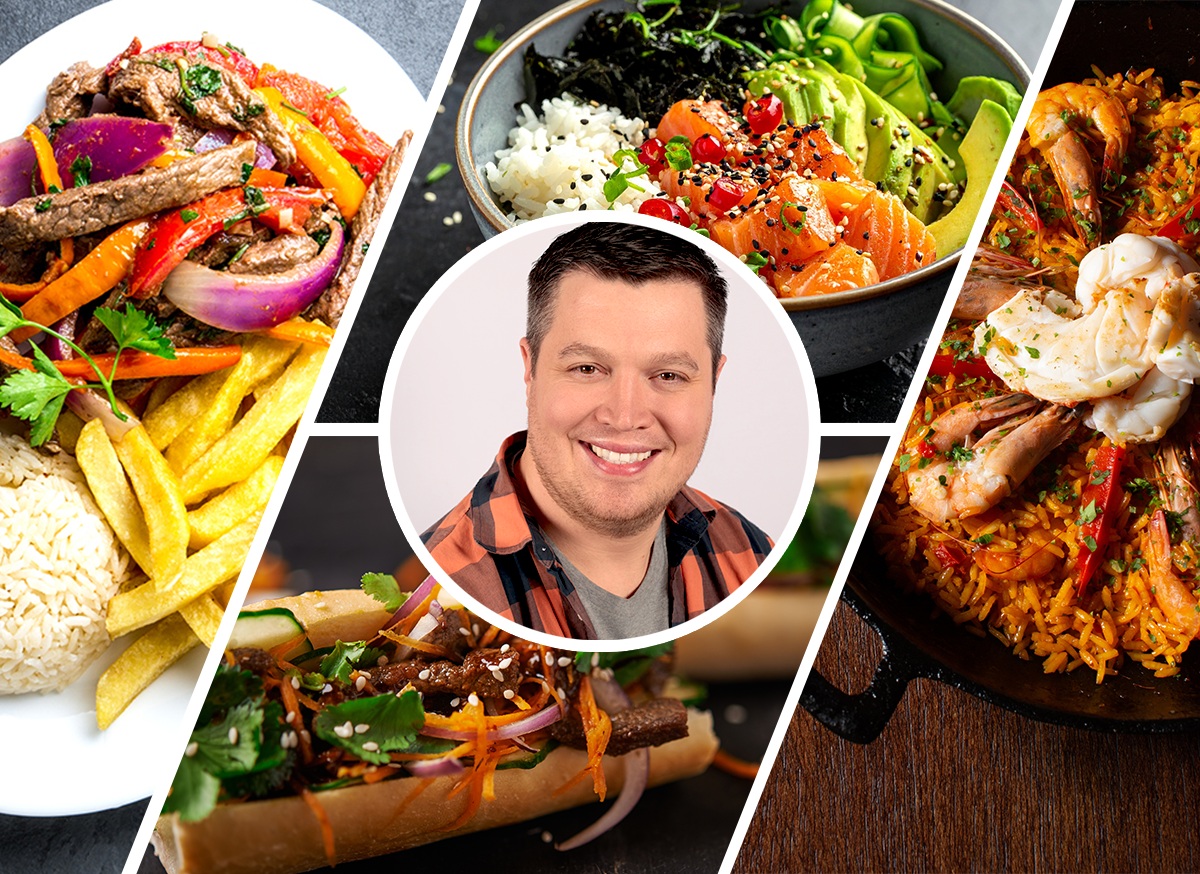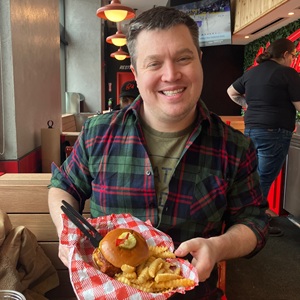
"Working at Fooda has taught me to stay hungry, stay curious, and be comfortable thinking on my feet," says Jacob "Jake" Mangan, Fooda's Director of Enterprise Restaurant Sales. "The world is always changing, you can't stop improving just because you're ahead of the curve. You always need to be looking for new opportunities."
That mindset started to take shape early in Mangan's career. A native of Sycamore, Illinois, Mangan joined Fooda in 2013. He was among the company's earliest hires, coming onboard shortly after its expansion into the New York market. As a graduate of the University of Iowa with a bachelor's degree in History, he was something of an unlikely candidate for a high-stakes sales position. Luckily, he had a great personal reference.
"My sister Molly worked with Fooda's founding team at Echo Global Logistics," he says. "When they started looking for help, she told them that her kid brother was just out of college and looking for a job. Her recommendation is what opened the door for me. I've made the role my own over the years, but there was definitely a little nepotism at the start."
Now 13 years into his career at Fooda, Mangan has long been a key player on the company's sales team. He credits much of his success to the coaching he received from the founding team, as well as his lifelong comfort with striking up conversations with complete strangers.
"My fiancée likes to joke that I'm like a human golden retriever," Mangan says. "You could put me anywhere in the world, and before long I'd find someone to make friends with. I've always found people fascinating, and restaurant owners are some of the most eclectic people you'll ever meet. Talking to them keeps my job interesting."
This natural curiosity and ability to quickly connect with people has played a huge role in his career, Mangan notes. He genuinely wants to learn more about the people he's talking to, and to understand their vision for their businesses. This makes it much easier to explain how Fooda can help them reach their goals.
"I'm not trying to sell them on anything, I'm just being honest about how we can work together," he says. "It also helps that I got over my fear of cold calling and rejection very early into my career. This job becomes much easier once you realize that the worst outcome you'll ever face is a restaurant owner telling you to go kick rocks because they're not interested."

When Mangan joined the team in 2013, Fooda was still very much a startup. The company had only formally existed for two years, and it was still unclear how well the concept would work outside of the Chicago region. It was a promising business with a great idea, but operating in an unproven niche.
"During my first year at Fooda, bringing on a new client was an all-hands-on-deck thing," he says. "The sales team would come in every morning and immediately start making cold calls. At 10:30, the entire company would all hop into Ubers to pick up food and set up stations. We'd work the lunch, just to make sure everything went smoothly, and then rush back to the office to get back on the phones."
While many of Fooda's early employees had some sales experience, he notes, few of them had backgrounds in the restaurant or hospitality industries. This often made it challenging to explain the concept to restaurant owners, and difficult to train new hires on effective sales strategies. Instead, the sales team often simply made it up as they went.
"We were building something that had never existed before," Mangan says. "There were no best practices that we could copy-and-paste from a similar industry. All we could do is try new things, and learn from our mistakes. We took what worked in New York, and adapted it for Boston. Then we took that, and adapted it for Atlanta, Dallas, and every other market that we grew into."
As Fooda grew and evolved, that "run-and-gun" approach was steadily replaced by a more thoughtful and organized company culture. Today, the company's sales team has a wealth of resources to help them understand the quirks of their markets, the needs of their customers, and the priorities of their restaurant partners. Mangan credits this success to Fooda's leadership, providing the team with a clear vision for the future.
"Our leadership understands the importance of trust and transparency," Mangan says. "We all know what kind of company we're trying to build. When we face a serious challenge, like the rough time we had throughout the pandemic, we're able to work together and adapt. That's a big part of why I'm still at Fooda, and why I'm still so excited by and engaged with our work."
It's no secret that the pandemic was a tough-yet-transformative time for everyone at Fooda. For most of his sales career, Mangan's focus was working with restaurant owners doing on-site Popups in break rooms and other common areas. When the large offices that they typically worked with suddenly shifted to a work-from-home model, Fooda was forced to reinvent itself by focusing on larger organizations with more complex food programs.
"COVID-19 was a rough time, and our willingness to adapt is a big part of why we're still here," Mangan says. "We diversified, and we built back better. Today, we're operating at a scale that I could not have imagined when I first started here."
Mangan also had to adapt, joining the Orange By Fooda team and shifting his focus to restaurants capable of meeting the demands of hospitals, distribution centers, colleges, and large corporate campuses. Orange by Fooda is Fooda’s fully managed Enterprise cafeteria program.
"Orange By Fooda is one of the most exciting things we're doing," he says. "We're working with huge organizations, some with campuses in multiple states. Organizing all of this is a huge team effort, but it's worth it. In a post-COVID world, a great lunch program is no longer just another amenity. If you're going to have your team on site, it's a necessity."
While the scope of his work has changed, Mangan notes that the core of the job has remained the same.
"We're still building relationships with restaurants," he says. "Some of them are a better fit for what we're doing at Orange By Fooda, while others are better for the Popups that we've always done. We stay in contact with everyone, and if someone doesn't work out at one of our campus stations, we have some great restaurants waiting in the wings."
As he looks back at his 13 years at Fooda, one of the things that Mangan finds most striking is how much he's changed as a result of his time at the company. When he started at the company, for example, he was anything but a foodie.
"I was a very picky eater before joining Fooda, and the only things I would eat back then were tacos, sandwiches, and Italian food," Mangan says. "Meeting with all these restaurant owners really expanded my horizons. Now, I'll try pretty much any meal at least once, because I know that there's a lot of great food out there."
His ever-present curiosity also resulted in Mangan teaching himself how to cook, something that would have been unthinkable to his 23-year-old self. These days, he describes cooking as his "love language," regularly cooking and baking for friends and family.
"That change also coincided with meeting my fiancée," he says with a laugh. "She's a lot prettier than me, and I realized that I needed to learn how to cook if I wanted to keep her around."
His many conversations with restaurant owners have also helped to shape his approach to life. In addition to being hardworking and ambitious, he notes, they also approach their work with a combination of pride and integrity. Some of that perspective has clearly rubbed off on him, allowing him to turn a post-graduation sales job into a true career.
In other words, he's pretty happy with how things worked out.
"My life is vastly different from when I started at Fooda," Mangan says. "My student loans are paid off. My fiancée and I own a house in the Chicago suburbs, and we're getting married next year. It's a very fulfilling life, and a lot of it was only possible because of Fooda."