.jpg)
"While I was the first person to ever monetize our Popup Restaurant program and I am part of the founding team, I enjoy spreading the word about Fooda," says Dustin Lasky, a founding member of Fooda.
"My job is to spread the word! I love learning about people's food needs and providing creative solutions while helping restaurants generate revenue and marketing exposure.”
This year marks Lasky’s 15th with the company. As part of the founding team, he has played a crucial role in Fooda’s growth from a what-if concept into a national company providing onsite corporate dining solutions to some of the largest employers in the country.
Even though he has been with Fooda since its launch in 2011, Lasky is still occasionally surprised at just how rapidly the company has scaled over the past decade and a half.
"In the early days, we reached out to family and friends to share the idea of Fooda. For instance, my close friend’s dad worked at a large bank and my Aunt Betty worked at an accounting firm – they ended up being our first customers.” he says.
"One part of our culture that has remained since day one is staying curious. We observed how people were interacting with our Popup Restaurants early on and it led to our evolution. For instance, at my aunt’s accounting firm, we saw a woman buying 15 meals at our popup. We asked her what she was doing. She said she was catering a meeting – shortly thereafter, we hired a catering manager and started facilitating catering for meetings and events.”
Long before helping Fooda become a national company, Lasky and the rest of the founding team were simply trying to solve a problem that frustrated them every day at work: finding a decent lunch.
Before Fooda, Lasky worked briefly as "the worst real estate agent in Chicago,” according to a close friend of his who worked at Echo Global Logistics, one of the country's largest freight brokerage firms.
His friend suggested he apply for a sales role at Echo. Not only was the job a much better fit for Lasky's talents, it would also introduce him to a group of aspiring entrepreneurs with a hunger for success. Literally.
"Echo was located in this hulking old warehouse building that covered two city blocks," he recalls. "There were a handful of places to eat near the office, but it didn't take long to get bored with their menus."
Over 4,000 people worked at the building and some of the businesses in the building had their own onsite cafeterias, Echo, which accounted for about 400 people at the time, did not. After a couple of years of the same routine lunches, Lasky and friends came up with an unlikely solution. What if they could bring their favorite restaurants to their building?
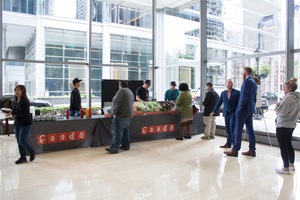
“Time was money for us as a sales organization, so having a convenient lunch was meaningful. It kind of killed two birds with one stone. It was an easy sell to leadership because they saw productivity gains too.”
"We started calling restaurants to see if they would be interested in serving lunch to the office," Lasky says. "We convinced a few of them to give it a try, and it was an immediate success. Then it went viral."
Within a few months, workers from other companies in the building were sneaking into Echo's offices just to grab lunch.
"It takes a significant level of conviction to walk a full city block and tailgate into another company’s office just to get a decent barbecue sandwich," Lasky notes. "People were really excited by what we were doing. One day, the guy behind us in line turned out to be the facilities manager for a business in the building that had its own cafeteria. He snuck in because he liked our food better. That's when the light bulb went on for us."
"There was a void in the marketplace that needed to be filled, but we had a lot to learn." Lasky says.
The early days at Fooda were "creative, scrappy, and stressful," he notes. While many potential customers were intrigued by the idea and understood its potential, it was clear that the startup still had a few kinks to work out.
"Everything we had done at that point was in a giant warehouse building," Lasky recalls. "Most office buildings are not built like that. In our first operation outside of Echo, the building had the most complex loading dock that I had seen, and the office was like a secure labyrinth. This was our first real test of our idea, and to be completely honest, I remember being in a panic during that walk-through. I thought we had made a big mistake.”

Each new location presented the team with a fresh challenge, and over time Fooda became experts in solving even the toughest logistical issues and it forced Lasky and the team to “put on our logistics hats again. It also tested our resilience.” He notes.
"The early days were a roller coaster, and there were plenty of times when it seemed like the company was going to fail," Lasky says. "But it was also fun. We were having meetings all over the city, talking about this new idea. We'd get a big win maybe once a month, and that would carry us for the next few weeks.”
Lasky credits CEO Orazio Buzza with much of Fooda’s growth and success as his decisive, analytical leadership helped elevate the company to the national stage.
"One of the things that we've all learned from Orazio is that when our solution is a win for our clients and restaurants then it will be a win for Fooda," he says. "He also made us realize that we needed to build-to-scale from the start. I learned from Orazio that there are no shortcuts to success. We listened, tested, measured, and then went all-in when things worked or back to the drawing board when they didn’t. We knew we had a great idea, but had Orazio not taken an interest in what we were doing, we would be collecting money in a shoe box.”
While Fooda thrived throughout the 2010s, the COVID-19 pandemic presented the company with a true existential challenge. Many large employers shut down their offices, ending their onsite meal programs. It was a bleak time, Lasky notes, particularly given his sales-focused role at the company.
"Now that we're through the pandemic, it's easier to see a bright future for us," he says. "What didn’t kill us certainly made us stronger. We're a much more focused, efficient, and organized team than we were at the beginning. We get more wins and can compete for much bigger, more complex accounts than we used to."
After more than a decade helping grow Fooda, Lasky says the experience has reshaped how he thinks about sales, and its impact.
"Wanting to help people is a big part of why I'm at Fooda," Lasky says. "I think that a lot of the people I work with would be kind of shocked to learn that. I have a reputation for being completely focused on sales but that has never been my only motivation."
Sales can be perceived as a "very self-centered kind of job," Lasky notes, but it can also have a hugely positive impact on businesses, workers, and the community. He recalls one of the earliest restaurants he signed up for Fooda, a small cafe in Lincoln Park that he and his now-wife Leah used to visit every Saturday.
"We both adored the owner of the place, and he made these incredible croissants and pastries." Lasky says. "But the cafe was in a bad location, and it was always slow there during the week. I really didn’t want the place to close, and when we started Fooda I was suddenly in a position to help them. I didn't have to convince hundreds of people to have lunch at a cafe in Lincoln Park, I just had to convince the owner to make 150 meals and bring them down to our office to sell them."
Like Fooda itself, he's providing a service that connects great restaurants with hungry workers. It's rewarding work.
Lasky says “I have never been a ‘great salesperson’ or smooth talker. Thankfully, Fooda has a really strong value proposition so I don’t have to be all that good at sales. I just need to get in front of a lot of people."
I believe very strongly in the words of a dear friend of mine’s grandfather. He once said, ‘the harder you work, the luckier you get’. Those words are never truer than when you work at a company that provides real value to its customers and partners.”
"I've been called the 'poster child for incentive-based compensation,' and I think that's fair," Lasky says, laughing. "I'm hyper-motivated to get deals done because I'm trying to make money for my family."
It's a tough job sometimes, and the pain of losses is still much more intense than the joy from the wins. Maybe that's what keeps me going. I have to win three times as much as I lose to keep myself sane and happy.
But at the end of the day knowing that I am helping create a better experience for people at work - while helping generate revenue for business owners around the country - is satisfying and I am really thankful for the opportunity that has been presented to me and for the folks that pick up my calls. If you’re reading this and end up sitting next to me on a plane I want to apologize in advance because you’ll probably have to hear it all over again.”