Picture launch week of a new lunch program. The announcement email is out, the first restaurant is setting up in the lobby, and you're watching the elevators, hoping people come down. Anyone who has signed a workplace food vendor knows that mix of hope and nerves, and it's why so many HR and facilities leaders read reviews before they commit.
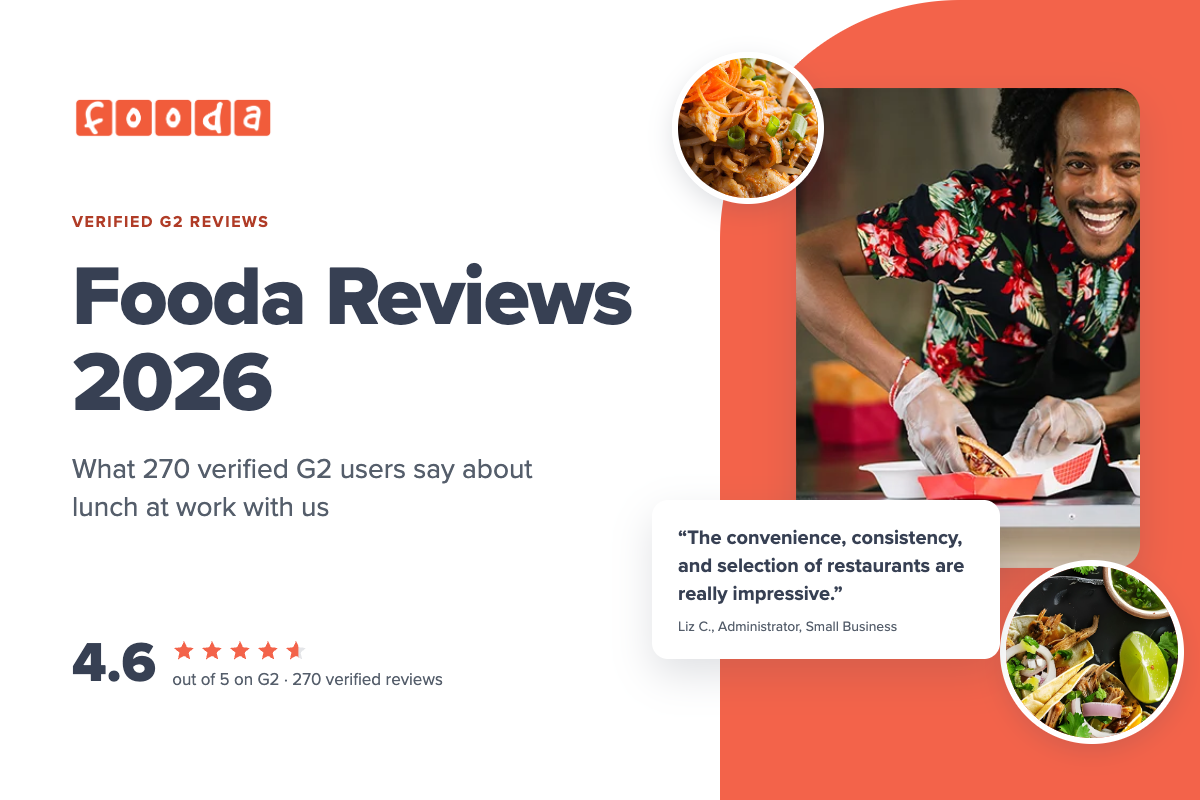
Fooda holds a 4.6 out of 5 rating across 270 verified reviews on G2, written by the admins who run programs and the employees who eat from them every week. A sales deck shows how a program should work. Reviews show how it holds up on a rainy Tuesday in month eight, after the novelty fades and lunch either still feels worth the trip downstairs or it doesn't.
Below, we've gathered what those reviewers say about setup, pricing, variety, and the day-to-day experience, critiques included, so you can decide for yourself whether Fooda fits your office.
Recent reviews run even higher than Fooda's overall score. In the latest batch of 30 approved reviews, 26 gave five stars and the rest landed between 4.0 and 4.5, a sign the experience is holding steady as the program grows.
Volume matters as much as the score. A strong rating from a dozen reviews could come from one happy office; hundreds of reviews from different companies, roles, and cities make the pattern much harder to dismiss. G2 also ranked Fooda #1 in its Relationship Index for Summer 2026, which scores vendors on how customers rate working with them day to day.
The detail in the reviews is what makes them useful. People write about setup speed, menu variety, portion sizes, and app performance, which gives HR and facilities teams something concrete to hold up against their own office.
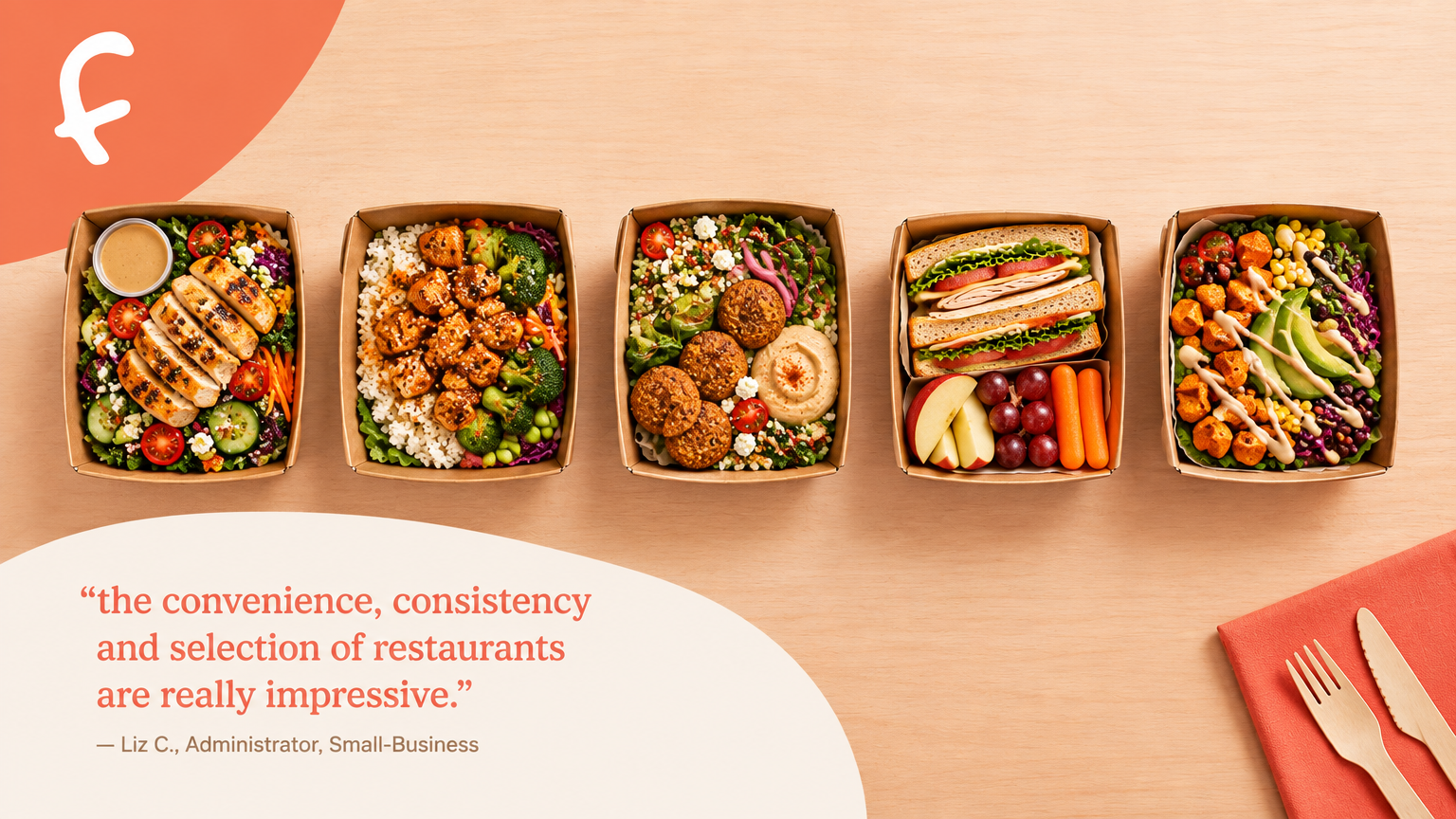
"The convenience, consistency, and selection of restaurants are really impressive."
— Liz C., Administrator, Small-Business
Fooda's reviewers fall into two groups who experience the same program very differently. Program administrators manage the restaurant calendar, headcounts, and billing, and they judge Fooda on whether lunch runs without daily firefighting. Employees care about one thing at 11:45: what's for lunch, and how quickly they can get it.
Both groups show up in roughly equal numbers, and their feedback tends to reinforce each other. When the admin side runs smoothly, employees feel it as a dependable lineup and short lines. When employees keep ordering, admins get the participation numbers that justify the budget at renewal.
The companies behind those reviews range just as widely. Reviewers work at small businesses, mid-market firms, and enterprises including PepsiCo, Amazon, T-Mobile, and Philips, along with a federal agency and a nonprofit medical association. Industries span logistics, manufacturing, tech, entertainment, government benefits administration, and lab science, which suggests the program adapts to very different workdays.
"Different varieties of foods are available, with different price points."
— Imran S., United States Department of Labor
For the people running the program, the theme that repeats most is time handed back. Without a managed partner, feeding an office means sourcing restaurants one at a time, placing separate orders, and chasing deliveries, work that can quietly eat an afternoon every week. Admins describe moving all of it onto one platform and getting that afternoon back.
G2's own data puts numbers to that relief. Reviewers report an average of one month to implement Fooda and three months to see a return on the investment, according to G2's pricing insights. One office administrator added that setup carried no out-of-pocket cost, which makes the conversation with finance far easier. Another customer has stayed with Fooda for more than five years because the team adjusts as the office changes, from headcount swings to new in-office days.
Employees feel the return in a different way. One reviewer estimated the app saves about two hours a week they'd otherwise spend driving offsite or waiting in line. Spread that across a 200-person office and you're looking at hundreds of hours a week that go back into work, or into a conversation with a coworker, instead of a parking lot.
"From a ROI perspective, Fooda helps streamline what would otherwise be a very manual process of sourcing, ordering, and coordinating with multiple vendors."
— G2 reviewer
Pricing is where reviewers are most candid. The most common critique in the feed is that some meals feel expensive for the portion size, and a handful of reviewers say certain options run pricier than they'd like.
That frustration has a backdrop every office shares. The Fooda Price Index puts the average workplace lunch at $13.90, up 1.68% year over year, and employees paying full price feel each increase at checkout no matter who runs the program.
Admins in the reviews close that gap with subsidy. Some build an employer contribution into every meal, while others offer Fooda only on in-office anchor days to keep spend predictable. Fooda's client data shows what that looks like in practice:
Fooda client data, January to September 2026.
Popup employers typically split the cost with their people, while Delivery usually works as an employer-paid lunch. Either way, the price an employee sees is a choice the employer makes, which is why reviewers frame pricing as something to design around rather than a reason to walk away.
A reviewer who uses Fooda for catered events made a similar point, describing the higher cost as the trade for local caterers and a fully managed experience instead of a basic drop-off. Plenty of everyday users land comfortably on the value side
Price isn't the only critique worth knowing before you sign. A few reviewers mention a restaurant canceling at the last minute, which leaves people who planned their day around that lunch scrambling. Others at smaller sites want more variety in the rotation, and some say coworkers in their building still don't know Fooda is there.
These come up far less often than the praise, but they point to good questions for any evaluation: how backup vendors are handled when a restaurant cancels, how large the rotation will be for an office your size, and how the program gets promoted to employees at launch.
Two words come up more than any others in Fooda's reviews: convenience and variety. Nearly every reviewer mentions the relief of not leaving the building for lunch, and a clear majority credit the rotating restaurant lineup for keeping them ordering week after week.
Several admins connect that convenience to their in-office policies. When a good lunch is waiting downstairs, an anchor day feels less like a commute someone required and more like a day worth showing up for. One reviewer described weekly in-office lunch as the thing that pulls the team together, especially on days when the weather makes going outside the last thing anyone wants.
Variety keeps that feeling from wearing off. Reviewers talk about trying cuisines they'd never have chosen on their own and finding local restaurants they wouldn't have discovered otherwise. With more than 4,500 restaurant partners across the country, Fooda can keep a rotation fresh long after a single caterer's menu would start to feel like a rerun.
"I really enjoy the variety and culinary diversity of restaurants that Fooda brings in."
— Russell W., Dole Fresh Fruit
Across company sizes, industries, and roles, the story in Fooda's G2 reviews stays remarkably consistent. Admins describe hours reclaimed from vendor sourcing and coordination. Employees describe a better middle of the day: a meal they look forward to, without the drive or the line. The critiques are specific and familiar to anyone who has run a food program, led by price relative to portion size.
That consistency shifts the real question from whether Fooda works to how you set it up. Choose a subsidy level that fits your budget, plan the restaurant rotation around how often you'll run the program, and decide early which days matter most for attendance. The companies that get those pieces right describe partnerships that last for years.
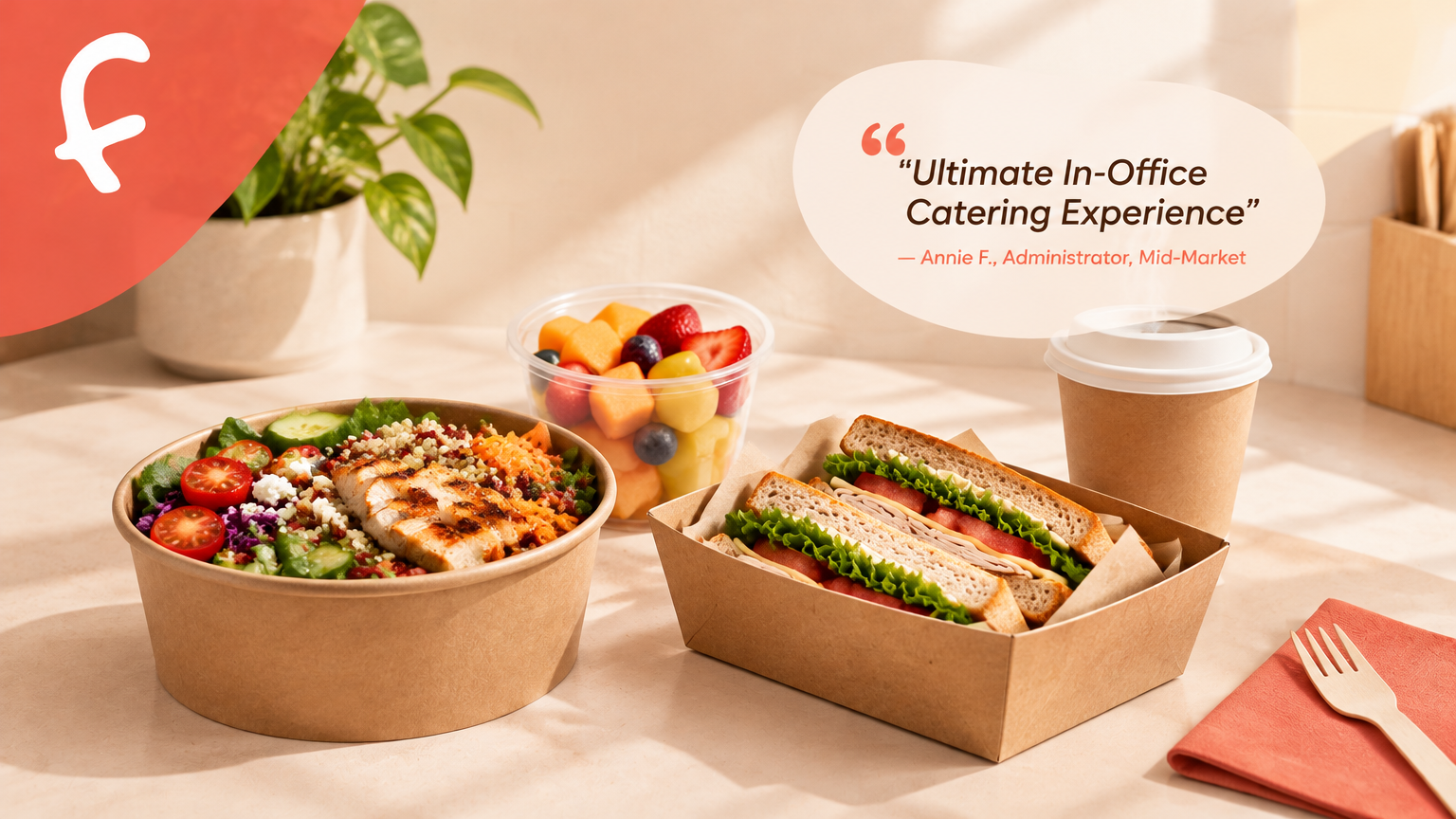
"Ultimate In-Office Catering Experience"
— Annie F., Administrator, Mid-Market
Every Fooda program runs on local restaurants, and you can mix them across offices with one platform and centralized billing.
Curious what a program would look like for your team? Try the food program calculator or talk to our team about building one that fits your office, your budget, and your people.

For offices that want convenient, varied lunch without running a cafeteria, reviewers say yes. Admins point to time saved on sourcing and coordinating vendors, and employees value eating well without leaving the building. The value depends most on program design, especially how much the employer subsidizes each meal.
Employees pay menu prices set by each local restaurant, and employers decide how much of that to cover, from nothing to the full meal. Total cost depends on the program type, headcount, and how many days a week you run it. Fooda's food program calculator gives a starting estimate for your office.
The most common critique is price relative to portion size. Less often, reviewers mention a restaurant canceling at the last minute, less variety at smaller sites, or coworkers not knowing the program exists. Most of these can be addressed through subsidy, rotation size, and launch communication.
Reviewers describe setup as quick and low-effort, with no upfront cost to get started. Popups and Office Lunch Delivery launch fastest because they need no construction or kitchen. Larger programs like a managed café take more planning, and timing depends on your site and scope.
No. Popups serve from a table in a lobby or breakroom, delivery and catering arrive ready to eat, and Pantry micromarkets need only floor space and an outlet. Orange by Fooda is the option for campuses that want a full café experience.
Yes. G2 verifies that reviewers are real users before publishing their reviews. Buyers can filter Fooda's reviews by company size, role, and industry to find feedback from offices most like their own.

Anthony Vattimo is the Content Marketing Specialist for Fooda. With experience marketing for financial services, SaaS companies, and now corporate food service - he has built and scaled successful content programs across both B2B and B2C industries. He enjoys being able to break down complex topics and explain the details around them in ways that are easy for everyone to understand.