Investment banking firms operate in competitive, high-pressure environments. Employees work long hours trying to stay ahead of demanding deadlines and personal wellness is often put on the back burner. If employers aren’t careful, employees burn out quickly, leading to productivity loss and high turnover rates.
That’s why employees consider more than just salary when deciding where to work, and major players in the industry already know this. For example, in early 2026, Business Insider reported that Goldman Sachs “agreed to boost its nightly dinner allowance from $30 to $35 for employees working past 8 p.m. in the office.” Perks like these can serve as a huge motivator when looking for work. Most firms can’t offer shorter hours, but they can make those hours less taxing. These are the employers workers are going to seek out.
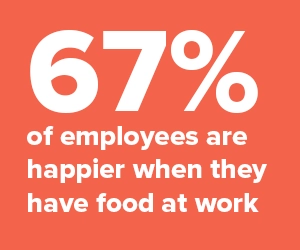
Workplace perks, like investment banking meal programs, can relieve stress and support wellbeing. Employees stop skipping meals or scrambling to find whatever’s readily available. They don’t have to sacrifice quality for convenience. This in turn attracts talent, supports retention efforts, and encourages productivity.
Workplace food programs are mutually beneficial for both employees and employers. When employees feel cared for, they show up, do their best work, and they stay.
Investment banking employees have to balance demanding hours with their own wellbeing, making workplace food, an afterthought in most industries, a powerful retention and satisfaction tool. Here’s why:
In the current competitive talent market, investment banking employees have plenty of options when searching for employment. With expectations surrounding the workplace experience evolving, potential candidates are looking at more than just raw salary. They’re taking benefits and perks into strong consideration.
A Glassdoor survey found that 60% of employees heavily weigh perks and benefits before accepting a job offer, and 80% say they would prefer additional perks and benefits over a salary increase.
These expectations make it increasingly important to examine employee benefits through a holistic lens, and food is a big part of that. If built intentionally, investment banking meal programs can be a powerful attractor, promising to ease the burden of long hours and demanding deadlines.
.jpg)
In challenging fields like investment banking, burnout is common. A survey of first-year analysts at Goldman Sachs found that employees worked, on average, 95+ hours a week, with busier seasons seeing upwards of 100 hours per week.
That kind of stress quickly takes its toll, and employees are likely to get overwhelmed. If they become dissatisfied with their working conditions, they’re likely to look for employment elsewhere. That kind of turnover is expensive. Replacing just one employee can cost 50-200% of their annual salary. That’s a significant, and very preventable cost.
Implementing an investment banking meal program is an easy and cost-effective way to prevent this. Convenient access to affordable food options can relieve a significant amount of stress. Fewer employees will skip lunch altogether and run themselves into the ground. Most importantly, providing food shows that you care about their wellbeing, making them feel more appreciated and supported.
Without an investment banking meal program, employees have few options when it comes to mealtimes:
With such demanding schedules, most investment banking employees simply don’t have time to leave the office to grab lunch. They have to walk or drive to a nearby restaurant, wait in line to order, wait for their food to be prepared, and walk back to their desks. This takes up a significant chunk of their day, and most employees won’t be willing to sacrifice that time.
When working well over 12 hours a day, employees are going to spend what little free time they have catching up on life and getting much-needed sleep. They’re rarely going to spare extra hours meal prepping. The only viable option is to prepare for the entire week over the weekend, but it’s an alternative few are likely to commit to.
Ordering delivery is the most convenient way to take care of lunch, but it still comes with significant downsides. Mainly, the costs and quality of food. Food deliveries come with inflated prices and hidden fees that add up quickly, especially when they’re in the office for both lunch and dinner. Although it keeps employees in the office, it’s simply not a sustainable long-term solution.
Ultimately, all three of these options are subpar and distracting. They take up time, energy, and brainspace. Employees are preoccupied thinking about what they’re going to eat and how they’re going to get it. They lose precious time either in or out of the office, and their productivity plummets.
If employees aren’t willing to deal with the disruption of being responsible for their own food, they’re left with one choice:
This is, unfortunately, a common choice. A survey by Talker Research found that 55% of U.S. workers skip lunch on busy days. In high-pressure investment banking environments, every day is busy.

A study of 20,000 employees at Brigham Young University found that workers with unhealthy eating habits were 66% more likely to perform poorly at work. People need food to function properly. Without it, they become irritable, tired, and unfocused. This creates an unfortunate paradox. Employees skip meals in an attempt to be more productive, but the lack of proper nutrition makes it difficult to do their work. This wears them down over time, making it harder for them to stay meaningfully engaged.
Neglecting their health has further consequences, leading to more frequent health issues, forcing employees to choose between powering through or taking the day and pushing harder to make up for lost time once they return to work. Both options lead to further wellness decline and poorer quality of work.
Without investment banking meal programs, employees and employers both lose. Employees experience rapid declines in satisfaction and quality of life, while employers face financial repercussions from frequent turnover, disengagement, and decreased productivity.
Although investment banking meal programs can be powerful, supportive perks, they can also work against you if not implemented thoughtfully. If they don’t appeal to employee preferences and suit your company’s needs, they can suffer from low participation rates and add unnecessary strain.
Here are five qualities to look for when implementing a workplace food program:

A quality investment banking meal program won’t be one-size-fits-all. It needs to work with your company’s size, schedule and budget to achieve maximum ROI.
Certain workplace food models can come with unpredictable costs, making them difficult to budget for and leading to unexpected expenses. Adjustable subsidies, consistent overhead costs, and easy monitoring make workplace food programs worthwhile.
Many programs also lack flexibility, leading to frequent over-ordering, significant waste, and unnecessary costs. If your employees work a hybrid schedule, this problem becomes even more significant, with headcounts being difficult to predict.
Workplace food programs with flexibility built in can help you avoid this issue. They allow you to scale operations based on attendance patterns, minimizing food waste and making your food program more sustainable long-term.
But your investment banking meal program doesn’t just need to work for you. It has to work for your employees, too. If the food doesn’t cater to their preferences, employees will be less likely to use it. If they do participate, they’ll likely be dissatisfied, and it won’t meet its full potential as an attraction and retention lever.
The best way to appeal to employees is by taking stock of their expectations and finding a meal program that exceeds them. Fooda’s survey of over 100 companies found that 87% of workplace leaders value leveraging local restaurants in their meal programs, and 83% value menu variety.
Partnering with local restaurants gives employees the chance to experience the best food your city has to offer. Authentic, chef-curated menus elevate office food and provide the quality and character that employees crave.
Working with real restaurants also creates more flexibility, allowing you to easily rotate through new meal options. This prevents menus from growing stale and keeps employees engaged.
Other important things to consider are affordability and convenience. If your investment banking meal program isn’t accessible, it won’t provide any significant benefits over other meal options.
Employees are significantly less likely to use expensive food programs. According to the Fooda Price Index, the average employee spends upwards of $14 on lunch every day. As of 2026, that’s a nearly 5% increase year-over-year. These prices trend even higher in major metropolitan areas. If employees buy food every day, that adds up to over $250 per month.
Subsidies are the best way to provide more affordability. They’re easy to implement and manage and can be built into your food program’s point-of-sale system. This makes them easy to use on both ends. Stipends are another popular way of financing lunch, but they present operational challenges. Employees are still responsible for finding their own lunches, creating inconvenience rather than relieving it.
To make your food program worthwhile, it has to provide in-office convenience. That way, employees can quickly grab food and return to their desks. They can relax knowing lunch has been taken care of for them, dedicating more mental energy towards their work rather than worrying about what they’re going to eat that day. The less time that process takes, the more employees will get out of it.
Having food readily available provides valuable proximity, but long wait times undermine that. Service needs to be streamlined to avoid eating up unnecessary time that would deter employees from using it. Tech-enabled point of sale systems and pre-ordering capabilities can speed up the process, alleviating time constraints.
It’s not just the analysts, associates, and executives with a lot on their plates. Human resources, admin, and office support staff all juggle heavy workloads, especially at larger companies. They don’t have time to run high-maintenance workplace food programs. Managing budgets, coordinating with vendors, keeping track of large orders, and monitoring performance can all require a significant amount of work. The employees responsible for maintaining these programs end up viewing them as a source of stress rather than as a perk.
But providing workplace food services doesn’t have to pull so many resources. Partnering with a food provider that handles the logistics for you is the most effective way to prevent productivity drain. Employees can get the benefits investment banking meal programs provide without putting the weight on other people’s shoulders.
All of Fooda’s programs are designed to deliver quality, affordability, and ease of operation. Here’s how we do it:
While all of Fooda’s programs have these strengths, we have a number of options to choose from, each offering unique benefits:
Ready to learn more about how Fooda can help you build the perfect investment banking meal program? Speak to a sales representative today to get started.
What is the difference between a meal stipend and a subsidized meal program?
Meal stipends give employees a set amount to spend on food. They are still responsible for sourcing their own meals and often have to submit receipts to get reimbursed. Subsidized meal programs bring food into the office, with employers contributing a certain amount to each meal. These are usually applied automatically through point-of-sale systems, making them easier to use and manage.
Are corporate meal programs tax deductible for employers?
Sometimes. Employer-paid meals can qualify for tax deduction depending on where they’re served and how they’re structured. Meals provided on-site are often deductible. Taxation policies have shifted in recent years, so employers should consult a tax advisor for clarification and guidance.
How much do companies typically spend on employee meal programs?
Overall cost depends on a number of factors, including subsidy level, office size, and location. Employers can manage budgets by setting subsidies, predicting participation rates, and choosing programs with consistent operating costs.
What food program options work best for large financial services offices?
Large offices should consider programs that are designed to handle high volumes without long wait times. Cafeteria solutions with multiple restaurant stations and streamlined checkout processes can provide sustainability long-term. Daily delivery programs are also a great option, as large orders can be delivered simultaneously.