Fooda is a workplace food company that brings a daily variety of meals from local, independently owned restaurants directly into offices and workplaces.
The company traces back to 2010, when a group of logistics professionals at a Chicago firm grew tired of losing half an hour round trip every time they wanted a decent lunch. Instead of leaving the building, they asked restaurants to come to them.
That’s when the Fooda Popup Restaurant was born.
Bringing the restaurant to the worker rather than the worker to the restaurant, became Fooda Popup in 2011 and remains the foundation underneath every product the company has built since.
Fooda reached its first hundred clients in Chicago, expanded to New York in 2014, and operates today in more than forty cities. Along the way it moved beyond traditional offices into hospitals, higher education, retail locations, distribution centers, and more. Offering a wide range of workplace food solutions for any type of organization.
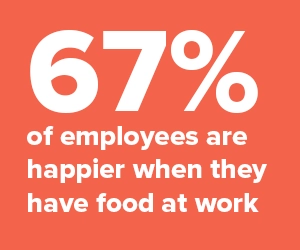
Across all of its services, Fooda now serves upward of ten million meals per year, and roughly eight in ten employees count it among their favorite workplace perks.
That last figure matters more than it first appears, because a benefit only delivers a return when people use it, and participation is the clearest signal that a food program is working.
This guide walks through every Fooda product, what each one costs and requires to set up, and how it compares to alternative companies in the same space. If you’re evaluating food services for your workplace, the aim is to help you match the right workplace food program to your headcount, budget, office layout, and the outcomes you care about most.
Before going deep on any single offering, the table below maps the full product line so you can see where each solution fits. Use it as a shortcut to the sections most relevant to your workplace, then read on for the detail behind each one.
A useful way to read this table is by outcome:
Most mature programs end up combining two or three of these, which is covered later in the section on choosing the right mix.
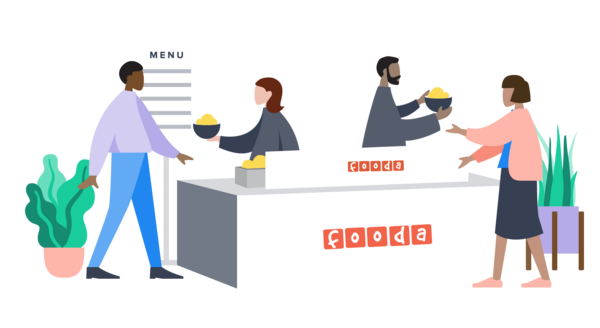
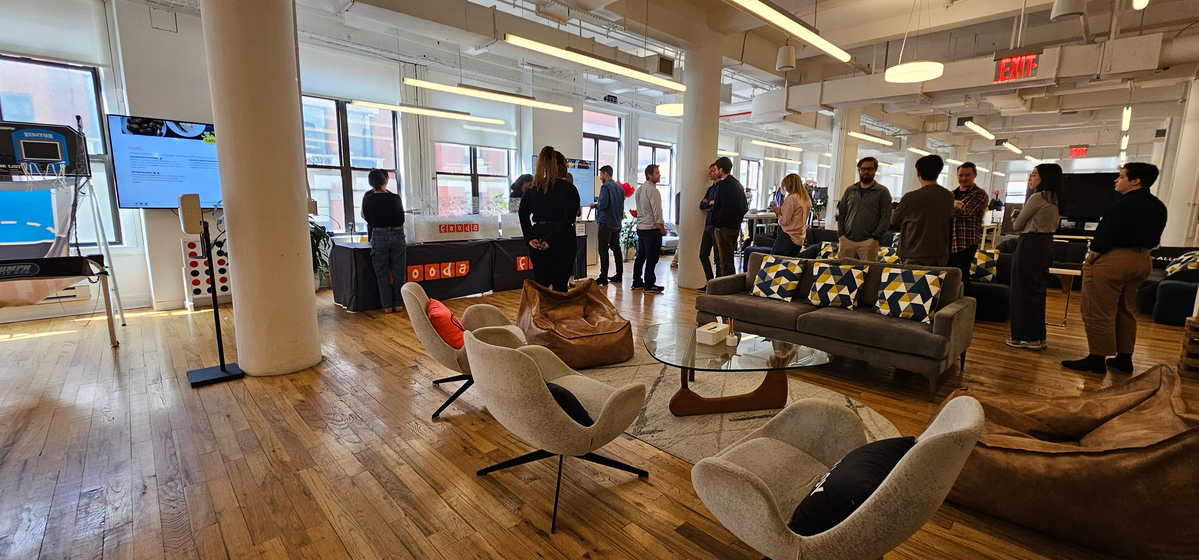
Fooda Popup is the company's core product and the one with no true direct equivalent in the market. A different local restaurant arrives at your workplace each day, sets up in a breakroom, lobby, or common area, serves fresh made-to-order meals for roughly two hours, then packs up and leaves. Your team does nothing operationally. Fooda curates the lineup, schedules the rotation, manages restaurant logistics, and handles employee communications.
The daily rotation is the heart of why Popup draws people in. A static menu, even a good one, eventually feels too repetitive and won’t get people excited to eat on-site.
But seeing a local restaurateur, excited to serve their food, keeps lunch genuinely novel. Which is what sustains the social gathering effect that makes the program valuable in the first place.
From day one, Fooda has made it their goal to help support local restaurants and provide great food made with high-quality ingredients at an affordable price. Meals generally run under fifteen dollars and are the same as what the restaurant charges in its own storefront, so employees never pay a workplace markup.
Popup works on a per meal basis, paid by the employee at the point of sale, with an optional employer subsidy layered on top (more on Fooda subsidies below).
The model depends on consistent volume, because restaurants need a worthwhile sales day to keep returning. As a rule of thumb, a site needs to clear roughly 70 meals per day.
If you’d like to start running Popups through Fooda, you need to consider how many employees are onsite on a given day and whether you offer a subsidy. The setup is light and most workplaces have the ability to go live within a week or two, because Fooda already has the restaurant network and the scheduling technology in place.
Because Popup is a category of one, the honest comparison is against the workarounds companies reach for when they want onsite variety, not any direct competitors.
The distinguishing combination is that Popup brings a real local restaurant physically into your space, on a managed rotating schedule, with no coordination required from your team.
That blend is what turns lunch into a workplace experience worth commuting for rather than one more thing to order.
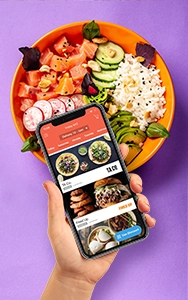
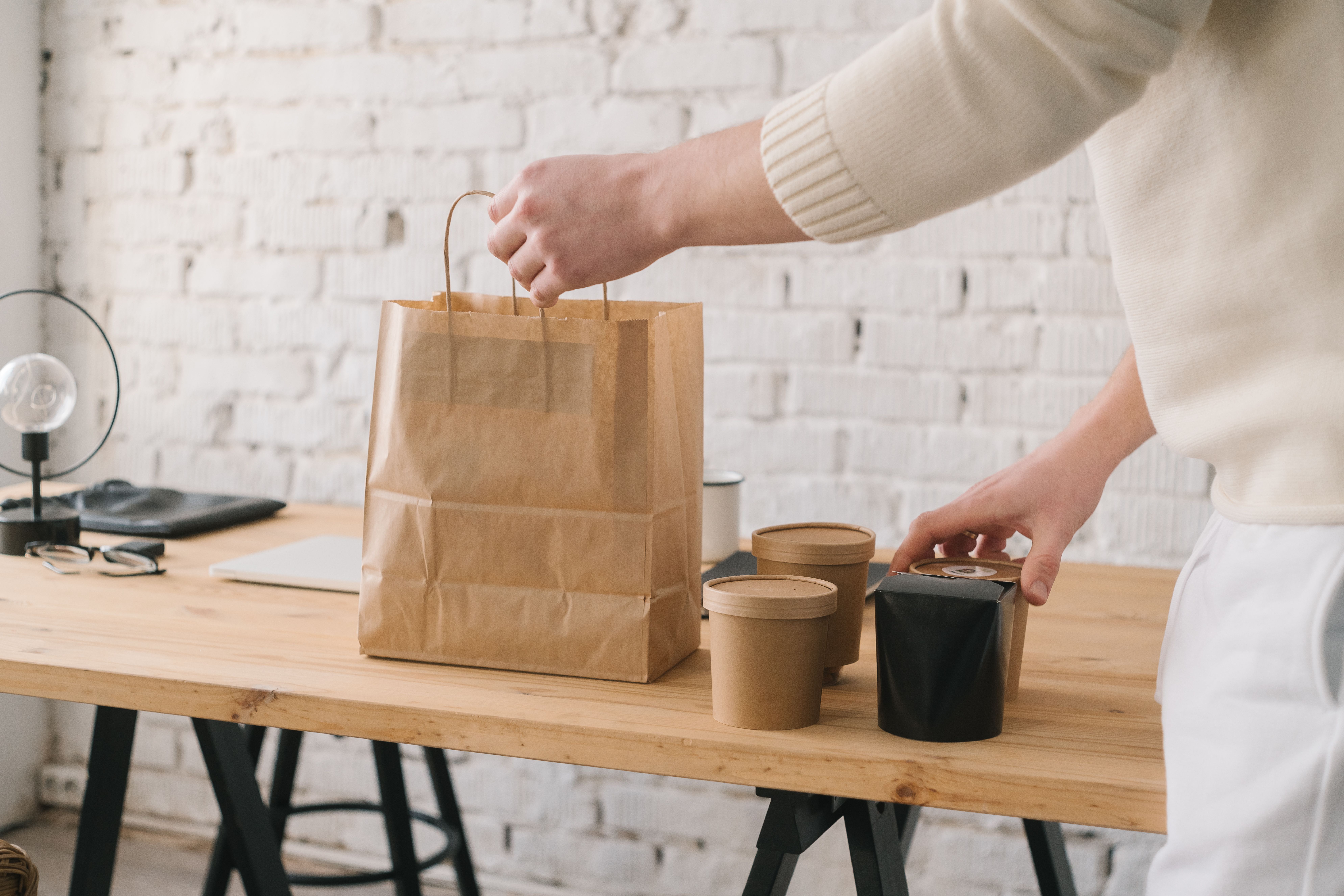
Fooda Office Lunch Delivery suits teams whose attendance shifts day to day. Employees place their own individual orders from a rotating set of local restaurants, and every order arrives together in a single delivery handled by a dedicated Fooda staff member who is pre-approved to enter your building.
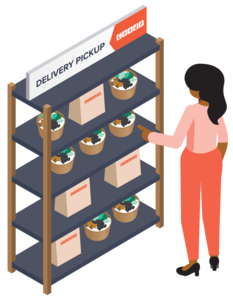
The result functions like a virtual food hall: An individual orders a kale salad from the day's Italian spot, grabs two tacos to supplement, and a dessert from a local bakery, all at no extra cost for mixing and matching.
The following design choices by us have separated this from ordering on a consumer delivery app.
According to a Fooda survey of more than one hundred companies, 83% of employees say variety in workplace food matters to them, which is the appetite this product is built to satisfy.
Delivery is priced per individual order, with employers free to subsidize any portion they choose. Because the platform and restaurant relationships already exist, a program can often launch in as little as two to three weeks, and it scales across multiple cities with centralized billing.
The practical payoff shows up in time. One client, the education technology startup BenchPrep, estimates the program saves each employee around 30 minutes a day by removing the logistics of going out for lunch, time that returns to eating together as a team.
Orange by Fooda is our enterprise cafeteria offering, built for high-headcount sites that want a managed café with high participation and an above and beyond hospitality focus. Orange combines a small number of embedded resident restaurants with a rotating lineup of visiting local favorites, so the space feels fresh daily while keeping enough familiarity that regulars always have an anchor.
Fooda also has its own cafeteria POS system and guests can pay by scanning a QR code from their phone or through a self-checkout kiosk, earn rewards on every order, and rate meals in the app so the team can address quality issues in real time.
The contrast with legacy contract food service is where Orange makes its case. Traditional cafeterias tend toward variable food quality, limited menus, and a fixed cost structure that punishes the swings in attendance that hybrid work now guarantees.
Orange flips the economics: visiting restaurants bring their own ingredients and staff, so a slow day does not leave you paying for trays of unsold inventory. Adaptive scheduling uses ordering data to send the right restaurants on the right days, which keeps the lineup matched to what your population wants.
Pricing is structured to align everyone's incentives, with no hidden fees, inflated pass-through costs, or purchasing rebates, so Fooda earns when your people dine and your restaurants sell, not from supplier kickbacks.
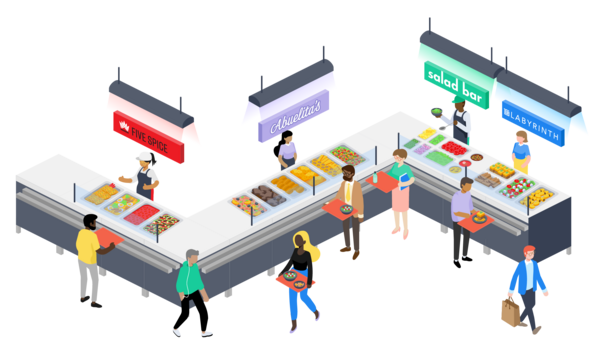
Orange uses a transparent, consumption-based pricing structure, and a dedicated onsite team runs the operation, including a catering manager who knows your team's tastes and handles event planning. Fooda also manages setup, retrofitting an existing cafeteria or designing one where none exists. Timelines vary with the scale and condition of the space, and Fooda handles the full transition to minimize disruption.
A representative example is Northern Trust, which was running a food hall for its 8,000-plus Chicago employees that almost no one used, because the food could not compete with the restaurants a short walk away.
After upgrading to Fooda, employees came back to the space, executives saw people gathering at lunch again, and local restaurants gained a steady new stream of customers.
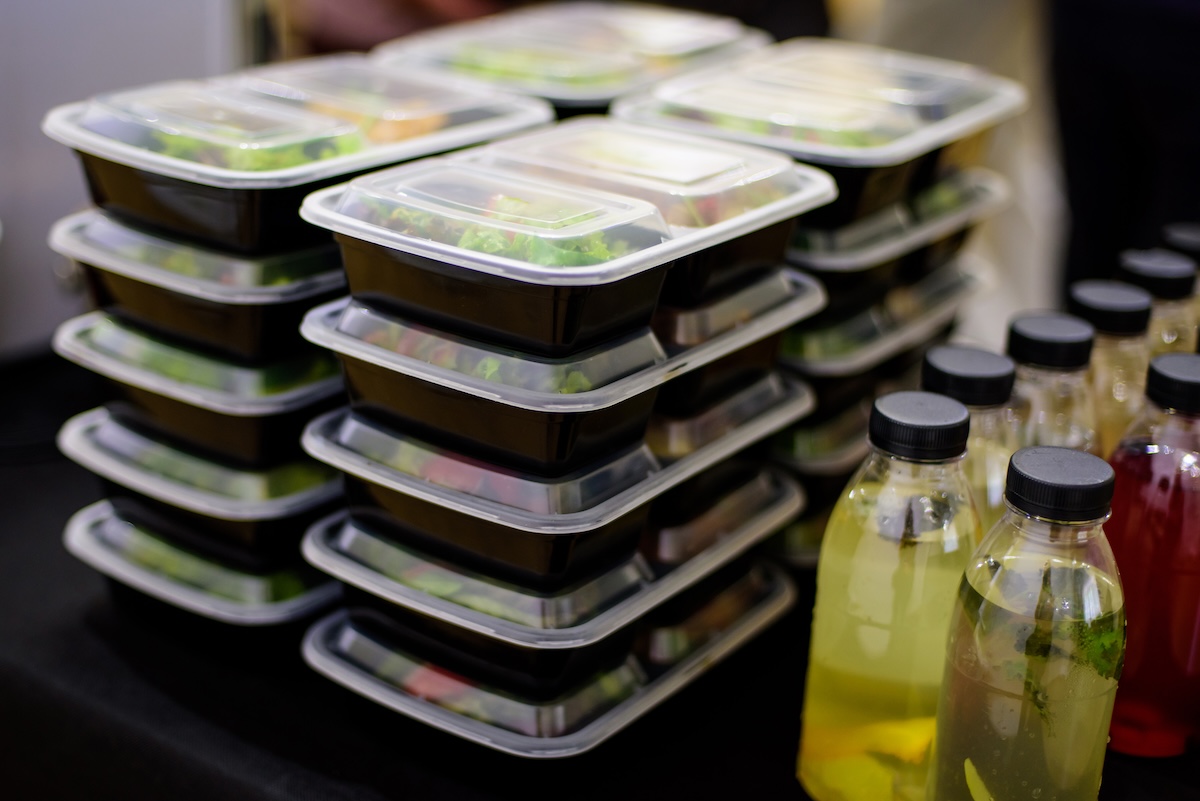
Fooda Corporate Event Catering covers everything outside the daily lunch rhythm: board meetings, happy hours, holiday parties, staff meetings, and more. It’s served as either traditional drop-off catering or individually packaged boxed lunches. The same local restaurant network that powers Popup and Delivery supplies the food, which means the variety and quality carry over to your events rather than defaulting to generic platters.
What sets the catering service apart is the human layer wrapped around the technology. You can browse menus, prices, and dietary filters and order directly from Fooda's catering site, yet every order is still reviewed by a dedicated account manager who confirms timing, logistics, and payment.
That concierge model is why the service maintains a 99% on-time track record, the single metric that matters most when a board lunch cannot be late. As one client running multiple orders a day put it, the value is in always receiving priced-out proposals and reliable execution rather than being left to coordinate the details alone.
Catering is priced per order with restaurant options spanning budgets, and there is no standing infrastructure to install. You engage it as needed, and the account manager handles scheduling, tracking, and billing.
The reason concierge support changes the experience is straightforward: catering goes wrong in the details, and a marketplace that hands you a long list of vendors still leaves the coordination, the dietary checks, and the day-of risk on your desk.
Fooda Pantry keeps the workplace stocked between meals with coffee, grab-and-go food, beverages, snacks, fresh fruit, micromarkets, premium water, and vending, all managed by a dedicated team.
It is the all-day complement to the lunch products, keeping the right items on the shelf without billing surprises or service gaps.
The difference from conventional pantry and vending providers comes down to whose interests drive the product mix. Legacy vendors are often steered by supplier incentives, which means the snacks on your shelf reflect a distributor's margins more than your team's preferences.
Fooda builds the assortment around consumption data and direct requests, adding a new SKU quickly when employees ask for it and retiring items that underperform. Real-time dashboards show live spend and item-level movement, which lets the team prevent stockouts and cost spikes before they happen rather than explaining them after the fact. Coverage is handled by local attendants positioned within roughly a 15 minute radius of each site, so even a satellite office gets fast restocking and repairs.
Pantry runs against a budget you set, with predictable costs maintained through quarterly business reviews and proactive SKU adjustments. Invoicing can be consolidated across every location and every Fooda service you use, which simplifies administration for multi-site organizations.
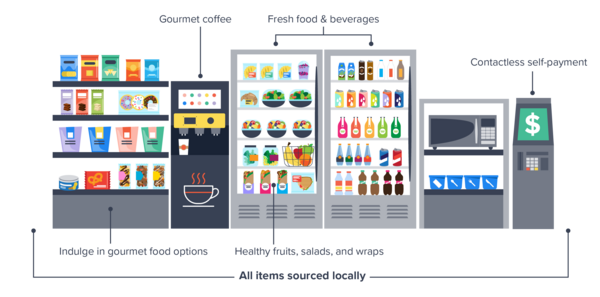
This data-first approach is also why Fooda Pantry pairs naturally with the dining products. The same visibility that prevents a snack stockout tells you which sites have the appetite to support a Popup or a fuller program.
Fooda Subsidies covers part or all of an employee's meal.Fooda's version runs on a per-use basis, meaning you pay only for the team members served on a given day. That structure is what makes subsidies beneficial: there is no fixed cost for people who stayed home, and you can raise or lower the amount as attendance patterns shift week to week.
Mechanically, they are light to administer. Employees verify their benefit by showing a QR code in the Fooda app at checkout, or have it applied automatically on a mobile order, and admins set eligibility and amounts in real time through the Fooda for Business portal.
The reason this matters for return-to-office goals is that a subsidized meal turns a commute into something with a tangible daily payoff, and shared meals rebuild the in-person connection that remote work erodes.
The table below shows representative weekly costs by office population and subsidy level, which illustrates how participation and per-meal contribution interact:
The financial logic is well supported. Research from the McKinsey Health Institute and the World Economic Forum estimates that investing in employee health and well-being could generate up to 11.7 trillion dollars in global economic value, with the benefits of free food showing up as higher productivity, retention, and engagement.
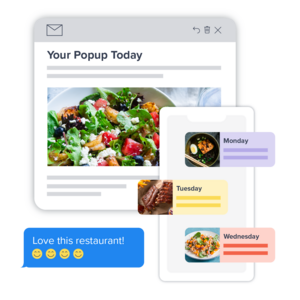
A recurring theme across these products is that Fooda builds its own software rather than assembling off-the-shelf systems, and that choice is what allows the operation to run at scale.
The platform has three pillars worth understanding.
Together these pieces form the Fooda flywheel: digital engagement generates data, data improves scheduling and prep, better scheduling raises satisfaction and participation, and higher participation generates more data. Tens of thousands of users rate the consumer app a perfect 5 stars, which is the downstream evidence that the loop is working.
The restaurant network truly is the product behind the products and we sincerely couldn’t operate without them.
Fooda works with more than 4,500 restaurant partners across the country, and over 70% of them are independently owned, which is what gives the rotation its authentic local character rather than the uniformity of a national chain menu.
Curation is deliberate rather than open enrollment. Fooda scouts: hidden-gem mom-and-pops, established favorites, and dedicated caterers, food trucks, and even trendy spots. Every partner is taste-tested and held to quality and health standards before serving.
A restaurant does not need its own dining room to qualify, but it does need access to a commercial-grade kitchen and the proper health certifications for its region, and the operational footprint to serve onsite reliably (a 12x7 space, a standard outlet, running water, and Wi-Fi for card processing). That screening is why diners can trust an unfamiliar name on the schedule: the vetting has already happened.
The partnership is built to be lucrative for restaurants, which is what keeps quality operators coming back. Roughly 1.4 million potential customers see a Fooda Popup each month, partners can increase store sales by about 20% with an average opportunity north of 200,000 dollars in annual revenue, and the exposure compounds:
Fooda serves organizations of nearly every size and shape, from a 20 person startup in a single office to a multi-thousand-person enterprise spread across cities and industries. The right starting point depends on three questions:
A few patterns hold reliably:
The strongest programs rarely rely on a single product. A Popup builds the midday gathering, Delivery covers the days a department works late or attendance dips, Pantry handles the in-between hours, Catering elevates the events that matter, and a subsidy ties the whole thing to your return-to-office and retention goals.
Because everything runs on one platform with one bill, layering services adds value without adding administrative weight.
Getting started with Fooda is light on your team, because the restaurant network, the scheduling technology, and the operational playbook already exist before you sign on.
The exact timeline depends on the product. A Popup Restaurant program can go live within a week, Office Lunch Delivery often launches in two to three weeks, and Orange runs longer because it may involve retrofitting or designing a physical café.
The onboarding sequence is consistent across products. Fooda assesses your space and daily population to confirm fit, sets your subsidy structure and eligibility in the Fooda for Business portal, coordinates the restaurant lineup and building access, and communicates the launch to employees so participation starts strong.
A deliberate kickoff, an introductory meal, or a clear in-app announcement drives first-time use, and from there the platform's data loop refines the rotation around what your people choose most. Throughout, a dedicated account team owns the logistics, quality control, and vendor coordination, so the ongoing burden on your staff stays close to zero.
The case for Fooda is easiest to read in outcomes, both for the workplaces it serves and the restaurants it partners with.
On the workplace side, Fooda is recognized on G2 with badges including Momentum Leader, Leader, Users Love Us, Best Support, and Best Relationship in on-demand catering, which reflects verified customer reviews rather than self-reported claims.
Client voices reinforce the ratings: the VP of HR at Tractor Supply's headquarters ranks Fooda alongside the company gym as a top reason employees value the workplace and brings job candidates to the Popup during interviews, a vivid signal that the program works as a recruiting asset rather than a line-item perk.
On the restaurant side, the model produces growth stories that explain the loyalty of the network. A Chicago-based empanada truck expanded to five storefront locations with the help of Fooda revenue, and a Boston-based halal concept generates 1.3 million dollars with Fooda on a rolling 12 month basis.

Whether you are weighing your first Popup, rethinking an underused cafeteria, or building a multi-service program across locations, the next step is a short conversation about your headcount, your space, and the outcomes you want.
Talk to the Fooda team to map the right workplace food solution to your organization.

Start with your daily onsite count and how predictable it is. Popup rewards consistent volume and shines when enough people are in to create a social gathering, while Delivery fits unpredictable or lighter days because you pay only for individual orders placed. Many hybrid offices run both, using Popup on anchor days and Delivery on the rest.
Yes. Fooda coordinates programs across many cities at once while maintaining centralized billing and administration, and invoicing can be consolidated across every location and every service you use. That structure lets a small team manage food for a large, distributed organization without juggling separate vendors.
The largest variable is how much you choose to subsidize, not the food itself. Programs run on a per-use or per-order basis, so you control spending by setting the subsidy amount and adjusting it as participation changes. A partial subsidy that brings an employee's out-of-pocket cost close to zero tends to drive the highest participation.
Yes. Because multiple restaurants are available each day across the Popup, Delivery, and cafeteria models, menus can include vegan, gluten-free, protein-forward, allergy-conscious, and religiously observant options without leaving anyone out. Individual ordering makes it especially easy for each person to select what fits their needs.
Remote and hybrid staff are typically covered through a meal stipend or food allowance, which extends the same benefit to people who are not onsite. This keeps the program equitable across your workforce while the onsite products handle the in-office experience.