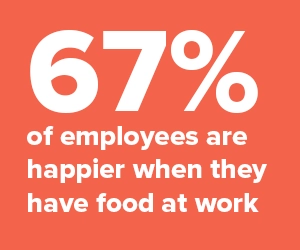
Providing food in the workplace is one of the easiest and most effective ways to shape how employees feel about coming to work.
While occasional event catering can be nice, its effects on attendance and morale can be limited, and planning typically takes a fair amount of time, pulling administrative attention from other projects. Recurring employee meal programs, on the other hand, show continual support that can build satisfaction, engagement, and culture over time.
Designing and implementing these programs doesn’t have to be complicated. By choosing the right partner, you can create maximum impact without requiring excess labor. Keep reading to learn how you can design a successful, sustainable employee meal program tailored to your company’s needs.
Every workplace is different. There is no effective one-size-fits-all solution. If you want your employee meal program to successfully enhance the employee experience and deliver on ROI, you need to pay attention to your office’s unique needs.

Beyond the unique factors you have to consider, there are a few universal traits you should look out for when selecting an employee meal program provider. Partnering with a company that incorporates all of these aspects will give you the biggest ROI in terms of employee satisfaction, retention, and productivity, as well as in saved labor costs.
No matter how good the food is, employees will eventually grow tired of having to choose between the same handful of options over and over. Fooda’s 2026 survey of 100+ workplace and people leaders found that 83% feel that variety is important to have in their workplace food programs. By switching up the menu every day, you can prevent menu fatigue and keep them engaged, ensuring your employee meal program is successful in the long term.
Building your employee meal program around real local restaurants allows you to bring authentic flavors into the office. 83% of leaders feel that it’s important to support local restaurants. Employees can enjoy the food they eat in their personal lives, giving them something to look forward to each day.
According to Fooda’s survey, only 10% of leaders describe their food programs as “experience-driven.” The best way to elevate your program is by creating a holistic experience. It shouldn’t just be about the food; it should provide employees with an opportunity to relax and truly enjoy their meals. A positive atmosphere and friendly, reliable service can truly complete your program.
Fooda’s 2026 survey also found that 83% of leaders believe food has a moderate to significant impact on workplace culture. Implementing a robust employee meal program can support that by creating new lunch behaviors. Putting time, effort, and money into workplace food shows that you want employees to take advantage of their breaks, encouraging them to step away from their desks and interact with each other.
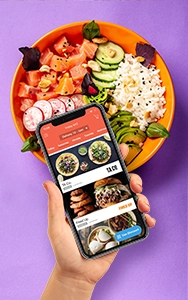
If your technology isn’t user friendly, employees will be reluctant to use it, and participation in your employee meal program will drop. Employees know that it’s possible to create a streamlined ordering and checkout process, and their expectations are high as a result. If you don’t deliver, they’ll become frustrated, and your program can end up working against you rather than for you.
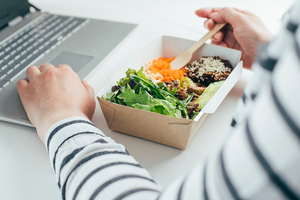
Employee meal programs can be a heavy lift, requiring significant coordination, budget management, and frequent adjustments. The best way to mitigate this is by choosing a partner that handles the logistics for you, allowing your team to focus their attention on other projects.
Choosing a fully-managed solution doesn’t mean you have to be entirely out of the loop. Transparency is key to a successful partnership. Look for partners that offer easy access to performance and budgeting metrics, allowing you to keep tabs on your program and request changes as needed.
Growth and change are inevitable. If your food program isn’t built with this in mind, it will quickly become unsustainable as your company evolves, leaving you to either hurriedly try to salvage it or start from scratch. To avoid this, partner with an employee meal service provider that makes making adjustments simple.
Accurate data reporting is incredibly important, but how you use that data matters even more. It’s not enough to know how your meal program is doing, you have to use that information to make active, meaningful improvements. By examining participation and spending patterns, you can tailor your meal options and volumes to maximize impact while minimizing waste. Look for a partner that is built to support continual, data-driven evolution.
If your employee meal program exceeds your budget, it won’t be able to deliver meaningful ROI, no matter how successful it is. Many food service models are inefficiently designed, leading to unpredictable costs and making them more expensive than necessary. By partnering with a provider designed to minimize overhead, you can get the most out of your budget, whatever it happens to be.
Fooda’s employee meal programs are designed with all ten of the above elements in mind to create an experience that’s rewarding for employees, cost-effective, and easy to manage.
Fooda offers a variety of recurring employee meal programs. All of them are designed to suit different needs. By working with our team, you can design a program that suits your office size, employee headcount, and budget. Everything is built custom to your business. Here’s a quick rundown of what we have to offer:
With our network of 4,500+ restaurant partners, we bring in rotating selections of quality, chef-curated menus. This approach makes lunch memorable and keeps employee participation high in the long term.
Our programs are also built to encourage social interaction and culture building among employees. When everyone gathers to grab their lunch deliveries, get a meal from that day’s Popup, or head down to the cafeteria, they spark casual conversation that extends beyond business. This connection allows them to collaborate more effectively and creates a valuable sense of belonging.

When you work with Fooda, dedicated account and dining managers work with you to create a customized meal program that fits your company’s needs. You have full control over the final product, with support and guidance throughout the entire process.
Our team will work with you to determine which programs are the best fit for your office, and you can even mix-and-match services to perfectly meet your needs. If you have fluctuating headcounts, you can scale operations up and down based on attendance patterns.
After initial implementation, Fooda’s team handles all ongoing operations, from vendor coordination to streamlined invoicing and service staff management. It’s a low-effort, high-reward food solution that doesn’t force you to relinquish agency.
Fooda’s low-cost solutions appeal to executives and make it easy to get them on board. Detailed data reporting shows growth metrics that demonstrate clear ROI.
While our point-of-sale system makes ordering and payment simple, it also gathers participation data, one of the most straightforward ways to demonstrate success. AI-powered insights help inform ongoing adjustments that increase these numbers over time.
Ready to learn more about what Fooda has to offer? Contact one of our sales associates today to get started.
How much does a recurring employee meal program cost per employee per day?
Pricing heavily depends on subsidy level and program type. Partially subsidized programs can run anywhere from $5-10 per employee per day. Fully subsidized programs are typically $15-20. Additionally, if you choose a delivery solution, you’ll likely pay a flat rate, while full cafeteria programs will have higher overhead costs.
Can a small office support a recurring meal program?
Yes. Smaller teams are generally best suited to delivery models and office pantry services since they don't require dedicated staff or large amounts of space. The main adjustment for smaller headcounts is frequency. Starting with two or three meal days a week rather than daily service keeps costs proportional to a smaller team.
How does a recurring meal program work for hybrid teams with fluctuating attendance?
Programs built around fixed meal days tend to work best for hybrid schedules, since tying subsidized meals to specific in-office days gives employees a concrete reason to come in and makes attendance easier to forecast. Providers that track participation data can help you adjust portion volumes and frequency as attendance patterns shift over time. You can also offer higher-volume models on peak days, and then scale down the rest of the week to minimize waste.
How do employee meal programs accommodate allergies and dietary restrictions?
Rotating-restaurant models offer more built-in flexibility here than a fixed cafeteria menu. Wider pools of restaurant partners makes it easier to consistently include vegetarian, allergen-free, or religious-diet options across the week rather than relying on one kitchen to cover every need.