Offering subsidized meals to employees may sound counterintuitive, but as the old saying goes, you have to spend money to make money.
Believe it or not, providing subsidized meals does that: you spend money on your employees and their food, and in return, you’re greeted with improved productivity, engaged employees, and a better daily experience for everyone in your workplace. .
According to research done by Mckinsey Health Institute and the World Economic Forum, investing in employee health and well-being could generate up to $11.7 trillion in global economic revenue. On top of that, organizations that focus on employee health and well-being commonly see improvements in productivity and heightened employee retention and engagement.
However, these subsidies are more than a financial perk. They represent a commitment to employee health and happiness, providing a much-needed break and cutting back on out-of-pocket expenses for meals.
By integrating subsidized meals into their benefits package, businesses create a nurturing and productive work culture that benefits both employees and the organization.
Employers can provide subsidized meals, meal allowances, food stipends, and food subsidies to help their employees cover the cost of their meals. This allows companies to be more efficient and cost-effective while taking into consideration what is best for employee well-being and productivity.
Before deciding if you should implement a subsidized meal program for your office, it’s important to understand what a meal subsidy actually is.
A meal subsidy is a financial benefit employers provide to help cover the cost of their employees' meals, either partially or in full. Rather than leaving workers to manage lunch costs on their own, companies that offer meal subsidies take on some or all of that expense. This can be through a daily stipend, a discounted on-site cafeteria, a corporate meal program, or a prepaid meal card.
Meal subsidies are distinct from one-off catered lunches or company events. A true meal subsidy is an ongoing, structured benefit that employees can count on day to day.
The mechanics vary widely. Some companies offer a flat monthly food allowance that employees can spend however they choose. Others partner with a workplace dining provider to bring subsidized food directly into the office, so employees can grab a high-quality meal without leaving the building or spending money out of pocket.
What all meal subsidy programs share is the underlying goal of reducing the financial and logistical friction around eating well at work. This allows employees to stay focused, energized, and satisfied throughout the day. For employers, that translates directly into higher performance, stronger morale, and a more competitive benefits package, especially as more companies compete for top talent with perks that go beyond base salary.

Not all employee meal programs are created equal. When evaluating options, it helps to understand where subsidized lunch benefits end and full meal programs begin. The two serve different needs, budgets, and workforce types.
A subsidized lunch benefit focuses specifically on the midday meal. It's typically the most common entry point for companies new to meal benefits, and for good reason. Lunch is the meal employees are most likely to purchase near or during work, and it's the one that most directly affects afternoon energy and focus.
Subsidized lunch programs can take several forms:
These programs are often straightforward to administer and easy to scale. A company might start by subsidizing $5-$10 off each employee's lunch and adjust from there based on participation.
The tradeoff is scope. A subsidized lunch benefit doesn't address breakfast, snacks, or dinner. This matters for employees working early shifts, late hours, or hybrid schedules that don't always align neatly with a traditional lunch window.
A full employee meal program goes further, covering multiple meals or offering an open-ended food benefit employees can use throughout the day. This can be:
Full meal programs are more common at larger companies or organizations with employees working long or irregular hours (think tech campuses, healthcare facilities, or call centers running multiple shifts). They're also a stronger recruiting signal, particularly when competing for candidates who've come to expect robust perks.
The higher cost is the obvious consideration, but full programs don't have to be all-or-nothing. Many companies phase in coverage over time, starting with a subsidized lunch program and expanding to breakfast or snacks as participation grows and the ROI becomes clear.
Companies are increasingly providing meal subsidies or meal stipends to their employees as a benefit, seeing the positive effect on employee retention and company culture. Such subsidized meals can raise morale levels and job satisfaction while preventing burnout in employees, making it easier for companies to retain existing staff members and attract new ones.
Companies are increasingly offering subsidized meals to employees as a core part of their benefits package, and the impact on retention and satisfaction is hard to ignore. A structured employee meal program signals that the company genuinely invests in its people's daily wellbeing, not just their salary and PTO.
Employees who feel valued are less likely to look elsewhere, and subsidized food at work is a tangible, daily reminder of that investment. Whether it's a discounted subsidized lunch, a flexible meal stipend, or a rotating Popup restaurant in the office, meal benefits consistently rank among the perks employees notice and appreciate most. The result is higher morale, stronger team cohesion, lower turnover rates, and a workplace community that's easier to recruit into (and harder to leave).

Food perks can have a significant impact on employee morale as they enable companies to retain workers, improve relationships between staff members, and contribute to greater engagement. The presence of meal subsidies shows appreciation for personnel, which in turn increases job satisfaction and motivation among them. This also provides relief from having to buy food elsewhere. Subsidized meals play an important role in fostering a positive atmosphere within any company environment.
Companies providing a food allowance can prove to be a great attraction when competing for top talent in the job market. Offering meal allowances or free food is often indicative of an organization’s commitment to the well being and satisfaction of its employees, resulting in an optimistic work environment.
By accommodating different dietary requirements with healthy food options, they become even more attractive prospects to potential hires. This ultimately leads to strengthened productivity as these companies benefit from having knowledgeable workers on board that value their contribution making them feel appreciated.
As companies navigate the landscape of hybrid working, one of the key challenges they face is encouraging employees to return to the office. Subsidized meals emerge as an effective strategy to incentivize this transition.
Whether that be through corporate catering, free snacks, or even a cafeteria program, providing meals at the workplace goes beyond mere convenience. Subsidized meals serve as a compelling reason for employees to come into the office, fostering a sense of community and collaboration that is often missing in remote settings.

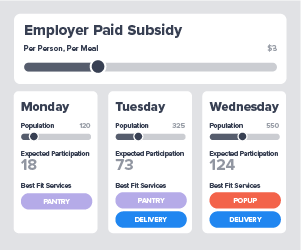
A key advantage of implementing subsidized meal programs is their inherent flexibility, allowing companies to scale the subsidies up or down based on employee participation and engagement. This scalability ensures that the program remains cost-effective while adapting to the actual usage by the staff. For instance, a company could start with a modest subsidy and increase it as more employees return to the office and participate in the program.
This dynamic approach allows organizations to manage their resources efficiently while still offering a valuable benefit to their employees. Importantly, it also provides a tangible way for companies to respond to employee needs and preferences, reinforcing a culture of adaptability and attentiveness to employee welfare.
Building an employee meal program doesn't have to be complicated, but it does require some upfront thinking to make sure the program actually gets used and stays sustainable. Here's how to approach it step by step.
Before choosing a format or setting a budget, get clear on what you're trying to accomplish. Are you trying to bring employees back to the office more consistently? Improve retention and benefits competitiveness? Boost energy and focus during the workday? Reduce time lost to off-site lunch runs? Your answer will shape everything from the type of subsidy you choose to how you measure success.
The right meal program for a 40-person startup in a single office looks very different from the right program for a 2,000-person company spread across multiple locations. Consider:
These factors will help you narrow down which meal subsidy format makes the most sense before you start comparing vendors or setting a budget. To see what a subsidy program could look like for your company, try our program calculator.
Meal subsidy costs vary depending on your model and coverage level. When building your budget, think in terms of per-employee, per-day cost rather than total annual spend. It makes it easier to model different participation scenarios and adjust over time. Factor in things like the subsidy amount per meal or per day, administrative or platform fees if using a third-party program manager, and tax treatment.
Pro tip: Start conservatively. It's easier to increase a subsidy once employees are engaged with the program than to scale it back after expectations are set.
Unless you're running a simple stipend entirely through your payroll or expense system, you'll likely work with a vendor to manage the logistics. Look for a provider that can handle scheduling and coordination, variety and dietary accommodations, and participation tracking and reporting.
A meal program only works if employees know about it and understand how to use it. Plan a deliberate launch: announce it in advance, explain the benefit clearly, and make the sign-up or access process as frictionless as possible. Consider a kickoff event or a free introductory meal to drive first-time participation.
Once the program is running, track participation regularly and solicit employee feedback. Key metrics to watch include participation rate, satisfaction scores, retention and engagement trends, and cost per participant. Use that data to refine the program over time to adjust subsidy amounts, rotate vendors, expand meal coverage, or trim what isn't working. The best employee meal programs evolve alongside the company and the workforce they serve.
Even with all of these steps mapped out, it can still be difficult to start an employee meal program. If you're ready to bring a meal program to your workplace, but don’t know where to go from here, Fooda makes it simple. With a variety of services and account executives dedicated to your needs, we work to create an employee meal program that works for you.
While there are plenty of benefits that come with subsidized meals to employees and implementing employee meal programs, the logistics can be overwhelming. This is where Fooda comes in.
From subsidized Popup Restaurants that rotate local favorites through your office to fully managed employer-paid programs, Fooda offers flexible solutions that fit any budget, headcount, and office setup. Some of the services that Fooda can help you establish in your office include:
Employees get fresh, restaurant-quality meals they actually look forward to while you get a benefit that drives real results in retention, engagement, and return-to-office attendance. Talk to our team today to find the right program for your company.
Want an example of a company that successfully subsidized meals to employees with the help of Fooda? Check out our work with BenchPrep!
Starting in 2026, employers can no longer deduct the cost of most meals provided to employees (even meals that were previously considered tax-free de minimis benefits or provided for the convenience of the employer). This is a change from previous years when companies could typically deduct 50% of those meal costs. While there are a few narrow exceptions, the general answer is no.
Yes, and increasingly, companies are designing programs with remote workers in mind from the start. A meal stipend or food allowance is the most common solution, giving remote employees the same benefit as their in-office counterparts without requiring them to be on-site. Some platforms also offer meal delivery integrations that give all employees access to this benefit, regardless of where they are working from.
There's no universal rule, but a helpful way to think about it is in terms of what removes friction for the employee without overcomplicating your budget. A partial subsidy that brings the employee's out-of-pocket cost to roughly $0-$5 tends to drive the highest participation. When employees feel like the meal is essentially free or close to it, they are more likely to use the benefit.