Work has shifted a lot in the last few years. Some of those changes have been good. Better technology opened the door to hybrid schedules. Teams can hire people who live far beyond the office. But still, something small slipped along the way.
Even employees who show up to the office every day sometimes describe work as strangely disconnected. Lots of meetings online even when they’re in the office. Endless messages. Not many chances for real interaction.
Organizations usually try to fix this with new initiatives. Recognition platforms. Culture committees. Team building workshops. The intention is reasonable but the outcome rarely lives up to expectations.
Community doesn’t usually grow from organized programs. It grows from constantly repeated bonding moments that people share naturally. Sitting down for lunch. Talking while waiting for coffee. Short conversations that slowly turn coworkers into people who actually know and care about each other.
Food has been at the center of culture and connection for centuries, supporting those moments. Yet in many workplaces today, the simplest gathering point in the day goes unnoticed.
A surprising number of workplace problems look operational on the surface. Small things like missed handoffs, projects that stall halfway through, and teams that technically collaborate but still seem to work in parallel rather than together.
It seems, at a glance, that something functional has gone wrong. Teams don’t have the right tools or processes. When in reality, they’re usually missing something deeper.
Work feels different when the people around you aren’t strangers. Deloitte looked at this and found something simple but telling. Employees who feel they belong at work perform about 56% better than those who don’t.
You can watch the difference in real time. In teams where people know each other, questions rarely sit unanswered. Someone overhears something and jumps in. A quick conversation clears things up before confusion spreads through the group.
In offices where those relationships never quite form, the opposite happens. Questions move slowly. People hesitate before reaching out. Conversations stay stiff even when they don’t need to.
That’s why companies keep searching for ways to strengthen building community in the workplace without turning it into another awkward activity. Some start with structured efforts like employee recognition programs that highlight contributions and reinforce shared values.
Others begin somewhere much simpler: creating more opportunities for people to sit down together and eat.
Take a look at where people gather when food shows up. Dinner tables at home. Holiday meals. Restaurants where two colleagues keep talking long after the plates are cleared. The pattern repeats in culture after culture. Anthropologists have pointed this out for years. Food gives people a reason to sit in the same place for a while. Conversation fills the space that follows.
Researchers use the word commensality to describe this phenomenon. The term refers to the social bond created when people eat together. The behavior appears in almost every society that has been studied, and it tends to produce the same effect: conversation becomes easier.
Something about the setting changes how people interact. Conversations drift into stories. Someone interrupts with a memory halfway through another discussion. Laughter breaks the rhythm of whatever topic started the exchange.
Those moments rarely look productive on the surface. Yet they quietly build familiarity between people, which is exactly what supports workplace community building later on.
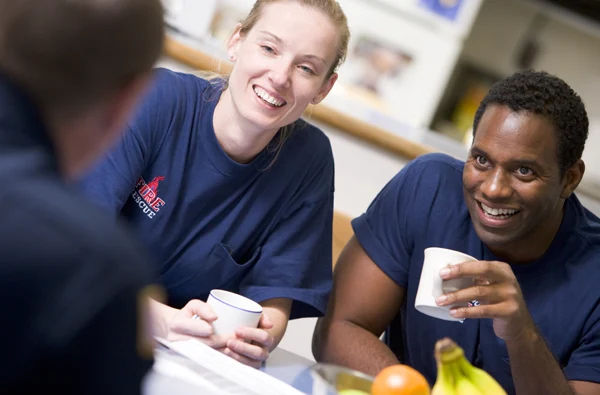
There’s actually an interesting case study from Cornell that helps to demonstrate just how valuable food can be for building community, and culture in the workplace. Over fifteen months, researchers studied firefighter crews across 50 firehouses in a large American city.
The department included 395 supervisors; each of whom was asked to rate the performance of the teams they had worked with. At the same time, the researchers looked at how often crews ate meals together during their shifts. The connection between food, and performance was obvious.
Teams that regularly shared meals received stronger performance ratings from supervisors. Crews that rarely ate together tended to score lower.
Inside the firehouses Cornell researchers studied - dinner had a routine. Someone cooked. The rest of the crew waited until the meal was ready. Then everyone sat down together.
One firefighter explained that when his shift started later in the evening he sometimes ended up eating twice. First at home with his family. Later again at the station. Skipping the crew dinner never felt right.
The researcher leading the study eventually called those meals social glue. Time around the table helped firefighters become familiar with each other. That familiarity mattered once the calls started coming in.
There is also a more practical reason food influences the workday.
The brain requires a steady supply of glucose to function well. Long gaps without decent nutrition have an impact on concentration. Reviews covering dozens of studies have found links between meal quality, energy levels, absenteeism, and job performance.
Other reports have shown how food can reduce stress in the workplace, minimize the risk of burnout, and improve every aspect of the work experience for team members.
Organizations that make food easier to access often notice a secondary effect as well. Lunch keeps people nearby. Employees who might not normally cross paths during the day end up sharing tables or standing in the same line.
The conversations that happen in those spaces rarely resemble formal meetings. Still, those informal exchanges contribute quietly to building community in the workplace, strengthening the relationships that shape collaboration later.
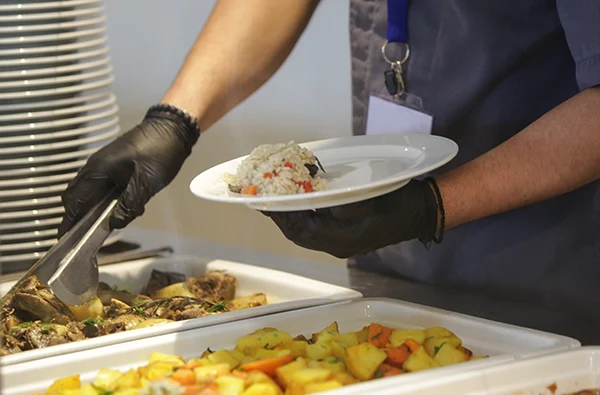
Most companies already try to strengthen the workplace community. Internal newsletters highlight employee milestones. HR teams run engagement surveys. Managers organize the occasional team event.
Yet many employees still describe work as socially thin. Collaboration happens constantly, but the relationships behind that collaboration stay fairly shallow.
The gap usually has less to do with effort and more to do with how community actually forms.
Most workplace culture efforts appear only occasionally.
Employees might see a catered team activity once a month. A lunch and learn session another month. Maybe a holiday gathering at the end of the year.
Outside those moments, the work calendar stays largely unchanged. Meetings, deadlines, regular routines. Even when those events are enjoyable, they occupy a very small portion of the year people spend working together. If connection depends entirely on occasional events, it occupies very little of the actual work experience.
Sociologists studying workplace networks have repeatedly found that strong professional relationships depend on frequency of interaction, not just intensity. Regular contact builds familiarity. Infrequent contact rarely does.
Work has become more scheduled than it used to be.
Calendar data published by Microsoft shows the average employee now spends a significantly larger share of the week inside meetings than workers did ten years ago. Messaging platforms increased communication, but much of it now happens through text instead of conversation.
The result is a workplace where employees interact all day without necessarily getting to know each other very well. Gallup’s global workplace research reflects that disconnect. Engagement remains close to 21% worldwide, despite years of investment in culture initiatives.
Ultimately, people don’t have enough space in the day to pursue relationships in their own time, and when interactions don’t happen naturally, community and workplace engagement levels break down.
Many workplace community initiatives fail for a simple reason. Employees recognize when the interaction is being orchestrated.
A meeting invite labeled “team bonding” lands in everyone’s calendar. An activity asks participants to share fun facts or personal stories. Someone from HR explains the purpose before the exercise begins. It’s well intentioned. It also feels unnatural.
People tend to guard themselves in environments where they know they’re expected to perform socially. Conversations stay polite. Participation becomes surface level. Real relationships rarely grow under those conditions.
Community tends to form in settings where nobody is trying to manufacture it. When interaction isn’t the objective, people relax. Conversations drift. People reveal small pieces of themselves without feeling like they’re participating in an exercise. That difference explains why many well-intentioned culture programs struggle to create lasting workplace belonging.
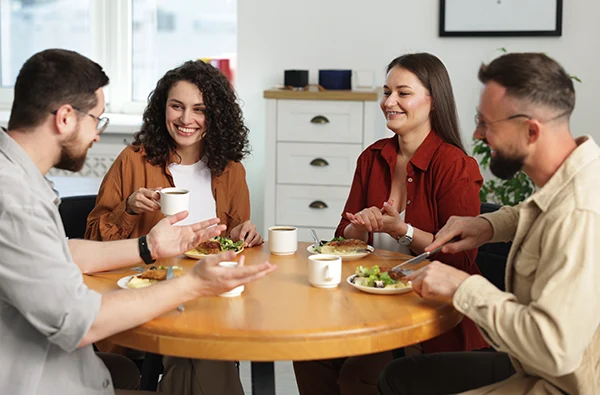
Food already exists in the workday.
The difference between a quick desk lunch and something that strengthens workplace community usually comes down to how the environment around that meal works.
In some offices, lunch barely registers. People grab something, eat while checking messages, and move on.
In others, lunch becomes a short pause where coworkers actually see each other. People gather at the same tables. Conversations start that have nothing to do with the next meeting.
That second scenario rarely appears by accident. It usually comes from a few practical choices about routine, menu variety, and the space where people eat.
Routine matters more than spectacle.
A catered event once every few months doesn’t do much for building community in the workplace. A simple lunch rhythm that repeats every day does far more.
Once lunch becomes predictable, habits start forming. People know roughly when food will appear. They plan their break around it. Coworkers begin heading toward the same tables most days. Small groups form almost without anyone organizing them. New hires usually notice it within the first week and feel much more comfortable joining a new workplace community.
The interesting part is who ends up sitting together.
Departments that rarely overlap during projects suddenly share tables. A product manager might sit next to someone from finance. A warehouse supervisor could end up comparing notes with someone from marketing.
Meals also flatten hierarchy in ways conference rooms rarely do. Standing in the same lunch line puts everyone in the same position. Conversations feel easier when the setting isn’t tied to a formal meeting.
Those small interactions accumulate. Over time they strengthen the relationships that support real workplace community building.
Food programs fall apart quickly when employees feel like the menu doesn’t include them.
A typical workforce has a wide range of dietary needs. Allergies. Religious food restrictions. Vegetarian or vegan diets. Medical considerations.
If lunch options ignore those realities, participation drops fast. People bring their own meals and skip the shared space.
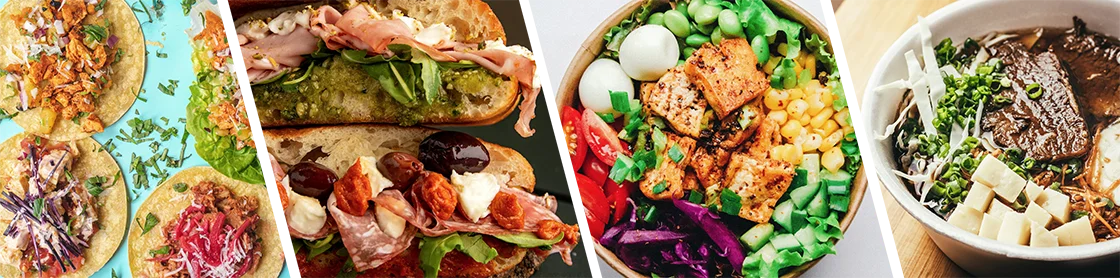
Rotating food options tend to work better. One day the office might see a Mediterranean restaurant. A few days later it could be tacos. Another week might bring Korean food. Dietary needs matter too - vegetarian dishes need to be visible and vegan or gluten free options should appear regularly.
Feedback also plays a role. When employees suggest a restaurant and it appears a few weeks later, they notice. When dietary requests start appearing on menus, participation usually grows.
Those signals matter because shared meals only strengthen workplace belonging when people feel comfortable joining.
Good food won’t bring people together if the room itself pushes them back to their desks. Many offices still rely on small breakrooms designed mainly for microwaves and coffee machines. A few chairs sit against the wall. Maybe there’s a narrow counter for setting down a plate. Most employees grab their lunch and leave within a minute or two.
That setup works for quick refueling. It doesn’t encourage people to stay long enough for conversation.
A dedicated cafeteria space or food hall gives people space to connect. Dining spaces designed for shared meals feel different immediately.
Larger tables make a big difference. Groups can sit together instead of spreading out across small surfaces. Clear walkways keep food lines from blocking the room. Natural light and comfortable seating make the space feel somewhere people can pause for a few minutes.
Location matters as well. Cafeterias placed along busy hallways or near common work areas draw far more activity than dining spaces hidden at the edge of the building.
Once a comfortable place to gather exists, lunch becomes visible again. People run into coworkers they wouldn’t normally see. Conversations stretch a little longer.
Over time those repeated encounters help support building community in the workplace.
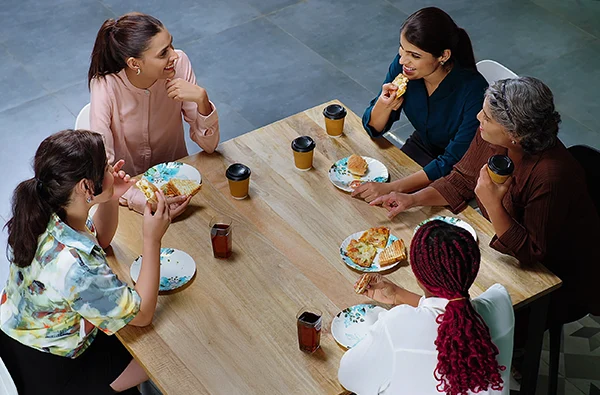
Most workplaces already know shared meals help people connect. The hard part isn’t the idea. It’s the logistics.
Someone has to coordinate restaurants. Someone has to manage orders. Dietary restrictions need attention. After a few weeks the same catering menu shows up again and participation drops. Lunch becomes another task someone inside the company has to manage.
That’s the gap Fooda was built to fill.
Lunch looks different in every workplace, so we design it specifically around each company's wants and needs.
Some offices want something simple. A reliable meal option each day so employees don’t have to leave the building. Others mostly need food for meetings or large gatherings. That’s usually where we begin the conversation. What does lunch already look like here?
From there we build something that fits the environment. Instead of relying on a single cafeteria menu, we bring different local restaurants into the office throughout the week. The lineup changes often, which keeps things from feeling repetitive.
Some companies want a structured program, like a full-service cafeteria that has resident and rotating restaurants with employer sponsored meals. Others prefer flexibility. For them we offer consolidated lunch delivery, boxed catering, or grab-and-go pantry setups.
Behind the scenes we handle the coordination, so the company doesn’t have to manage restaurant schedules or food orders. Our proprietary software handles restaurant scheduling, ordering, dietary accommodation tracking and more. We handle the hard parts, employees simply show up for lunch.
A strong workplace community rarely appears because someone announced a new initiative.
It usually grows in smaller ways. People start recognizing the same faces each day. Conversations continue where they left off yesterday. Coworkers learn small details about each other that never show up in a project brief.
Those moments add up.
Shared meals give those everyday interactions somewhere to happen. Lunch pulls people away from their desks for a few minutes. Once coworkers sit down together, conversation usually follows. Nothing about the moment feels like a formal culture initiative. It’s simply part of the day.
Still, that’s exactly how workplace community building often works. Familiarity grows. Trust follows. Teams start collaborating more easily because the people involved already know each other.
Food helps because it removes the friction. Everyone needs to eat. Gathering around a meal doesn’t feel like another meeting or a scheduled activity. It feels normal.
If you’re ready to discover the missing ingredient in your community building strategy, contact Fooda today. We’ll show you how food nurtures workplace belonging.