The "broke college student struggle meal” may feel lighthearted, but it accurately captures the universal experience of students struggling to get a decent meal while surviving on a budget. And with crowded cafeterias, uninspired menus, and long wait times, most university dining services don’t help the cause.
Even when the university covers their meal, many students don’t get to eat because they just don’t have the time. In fact, a Technomic study found that 36% of students don’t use their meal plans. The ones who do cite convenience, value, and time-savings as their biggest reasons for participating.
But when universities want to do something about this, rigid contracts often limit them to stale traditional models that hardly drive participation.
In this post, we explore how you can improve campus dining at your university, providing ideas and alternatives to replace outdated cafeterias. We also share practical steps on how to choose a university dining services vendor that’s perfect for you. Let’s take a look.
With students and faculty juggling heavy workloads and back-to-back classes, food should never feel like an inconvenience. Here’s how you can streamline university dining services management and improve the mealtime experience throughout your campus.
.png)
Traditional university cafeterias have a rigid and limited menu offering, largely comprising carb-heavy meals that are easy to prepare in bulk. For many students, this ultimately results in menu fatigue that forces them to skip the cafeteria altogether. And for students with dietary restrictions, this heavily limits their options.

Offer a more expansive selection of meals to cater to a wider range of students and faculty with different dietary needs. For instance, gluten-free options and vegan dishes could be incorporated into the menu alongside allergen-safe meals.
Ramen and frozen pizza don’t exactly count as brain fuel. But students often have to resort to cheaper alternatives when healthy meals are too expensive or just not available on campus.
Strengthen your menu offering with healthier selections that contribute to an engaged and thriving student community. Consider salads, protein bowls, and grain bowls that are quick and easy to put together. And “healthy” doesn’t necessarily have to mean expensive. Subsidize healthy items to make them more affordable and support student wellbeing.

The same meal rotation can get boring after a while. Sure, everyone loves the food and the existing menu selection, but they also crave novelty.
Introduce rotating stations where you can bring in local restaurants to serve authentic cuisines from different cultures. You could even do themed popups where you tie menu cycles to cultural festivals or heritage months. For example, rotate between highly rated authentic Vietnamese, Korean, Indian, Filipino, and Sri Lankan restaurants during AAPI Heritage Month.
This is the easiest way to add excitement to your menu rotation. And when students have new and interesting cuisines to look forward to weekly, they’re more likely to participate.
No one has the time to wait 15 minutes for their meal to get prepared when they have to rush to the next class. Students and faculty alike need speed and convenience when deciding what to eat. That’s why even among the students who used their meal plans in the Technomic study, time savings and convenience held the biggest sway.
Provide mobile ordering options that allow people to order meals ahead of their lunch break. So they can easily pick up their order when they’re ready to eat instead of spending most of their break waiting in line.
Additionally, schedules are erratic and not always linear on a university campus. Serving meals only during lunch hours means you restrict students to a very tight timeline to have their meals. That’s exactly how you end up with long lines at the cafeteria and overwhelmed kitchens.
You also leave out people who are stuck in seminars during lunch or have urgent work to finish before the next class starts. It helps to partner with higher education food service providers who can help you accommodate these unpredictable schedules. Think: cafes that stay open until late at night and grab-and-go spots where people can get a quick meal in between classes.

Lines move slowly when cashiers are taking orders manually using clunky POS systems. Even just a 1-minute delay in printing receipts could add up to longer wait times when it’s hundreds of students placing orders a day.
Streamlined payments are a part of efficient university dining services management. Implement in-app payments for online and mobile orders to speed things up. Scan-to-pay systems and self-checkout kiosks can also help with faster payments, which reduces wait times in your campus cafeteria.
For subsidized student meals, automatically applying stipends during checkout will speed up the process. Students can quickly scan and verify their IDs to use their meal plan.
Improving your university dining services requires the right partnership. This involves carefully evaluating your options until you find a college food service company that meets your university’s unique needs.
Start with a clear outline of exactly what your university needs. Legacy providers with rigid contracts may no longer work for campuses that see a lot of meal demand throughout the day and late into the night.
Consider factors like:
Use the information outlined above to seek out higher education food service providers who meet your needs. Create a university dining services RFP that details:
As the proposals pour in from potential vendors, you’ll need a concrete evaluation framework to help you narrow down your options. Put together an evaluation committee that includes representatives from facilities, faculty, the student body, and procurement.
Then use a standardized process to evaluate potential vendors. This means creating a campus dining vendor evaluation checklist where you list the criteria and assign weights based on your priorities.
For example, your checklist might look something like this:
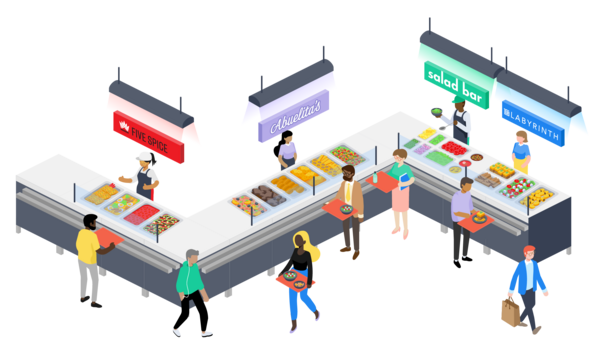
Orange by Fooda is the cafeteria replacement solution that transforms the dining experience on your campus. With a strategic mix of rotating popups and resident restaurants, you get to build a university dining service that’s tailored to your specific needs.
Unlike traditional contract models where you pay even for unsold trays, Orange by Fooda relies on a consumption-based model that ties costs directly to usage. So you only pay when students place their orders, making it easy to scale according to daily demand.
This type of cafeteria offering helps you effortlessly keep up with the demands of high-headcount universities without the risk of wasted spend on slow days.
A food hall management company like Fooda doesn’t restrict you to a single type of solution. You have the flexibility to customize your university dining experience with a mix of services that meet the unique requirements of your student community. This allows you to prioritize convenience and ensure always-on food services throughout the university.
Orange by Fooda features a blend of rotating guest restaurants and resident cafes alongside alternatives like micromarkets and pantry services. So whether students have time to sit down for restaurant-quality meals or they need a quick bite in between classes, there’s always something available.
Stuck in a long-term contract with a legacy provider? Fooda’s solutions can work alongside existing cafeteria setups, giving you the flexibility to upgrade without risking expensive termination fees.
With an expansive partner network comprising 4,500 local restaurants, Orange by Fooda lets you serve up a diverse menu featuring authentic cuisines from around the world. So variety is automatically baked into the program, making it easier to beat menu fatigue.
For example, you could have a resident sandwich shop providing a familiar anchor to students who need safe and predictable meals. Meanwhile, a weekly selection of local favorites and viral joints offers something new and exciting to those who crave novelty.
Fooda’s proprietary cafeteria technology streamlines workflows, making it easier to improve your university dining services management.
Online menus allow students to take their time researching options instead of panic-ordering on the spot to avoid holding up the line. Mobile ordering and integrated payments mean they can order and pay for their meals ahead of time without waiting in line. This significantly speeds up the ordering process, preventing long wait times.
Scan-to-pay systems and self-checkout kiosks also enable you to set up a pantry service that practically runs itself. So you can implement an always-on snacking solution that will keep students fueled through late-night study sessions.
If you’re offering subsidized meals, Fooda lets you effortlessly manage meal stipends for the entire university. Subsidies are digitally applied during checkout, reducing the need for manual reimbursements and paper-based meal coupons. You can easily add members and allot funds within the Fooda app, streamlining the process of managing subsidies for hundreds of students.
Ready to elevate your university dining service with Fooda? Talk to us today. If you have more questions about Orange by Fooda, you can view our dedicated FAQ page.

What are the most important factors in choosing a university dining services vendor?
Five factors carry the most weight: food quality and nutrition, menu variety and dietary accommodation, contract flexibility, cost transparency, and vendor reputation. Many universities score these on a weighted checklist, for example quality and nutrition at 30%, cost and financial transparency at 25%, operations and service at 25%, sustainability and sourcing at 10%, and student experience at 10%.
Why do so many students skip their meal plans?
Roughly 36% of students do not use their meal plans, according to Technomic research. Time is the most common barrier: students stuck in seminars or rushing between classes cannot spend a 15-minute window standing in a cafeteria line. Menu fatigue and limited options for dietary restrictions also push students toward off-campus fast food, even when their meals are already paid for.
What are the best ways to reduce wait times in university dining?
Mobile ordering with integrated payments removes the ordering step from the line entirely, and scan-to-pay systems and self-checkout kiosks cut transaction time at the register. Automatically applying meal stipends at checkout eliminates manual reimbursement steps. Adding a second and third service point, such as a micromarket or grab-and-go kiosk, distributes traffic away from a single peak-hour bottleneck.
What should a university dining services RFP include?
A complete university dining services RFP covers four areas: scope of work (operating hours, catering expectations, staffing levels), facility overview (dining halls, kitchen equipment, maintenance responsibilities, required buildouts), financial model (profit and loss, cost plus, or subsidized break-even), and technology integration (POS systems, mobile apps, online ordering, scan-to-pay, and student ID card compatibility). Define dietary and sustainability requirements before issuing it.
How does a consumption-based dining model differ from a traditional contract?
Traditional food service contracts bill universities for prepared volume, so the campus absorbs the cost of unsold trays on slow days. A consumption-based model such as Orange by Fooda ties cost to orders placed, meaning the university pays only for meals students buy. That structure scales with real demand, which matters most on campuses with variable schedules and seasonal enrollment swings.
Can a university work with Fooda while still under contract with a legacy provider?
Yes. Orange by Fooda operates alongside existing cafeteria setups, so universities locked into long-term agreements can add popups, resident cafes, micromarkets, or pantry service without triggering termination fees. This lets a campus test new formats and measure participation before its current contract comes up for renewal.
How does Orange by Fooda handle subsidized student meals?
Subsidies are applied digitally at checkout inside the Fooda app, which removes manual reimbursements and paper meal coupons. Administrators add members and allocate funds centrally, making it practical to manage stipends for hundreds or thousands of students. Students scan and verify their ID to draw on their allotment, so the subsidy adds no time at the register.
What food options can Orange by Fooda bring to a campus?
Orange by Fooda draws on a partner network of 4,500 local restaurants, supporting rotating guest restaurants, resident cafes, micromarkets, and pantry services on the same campus. Programs typically blend a familiar anchor, such as a resident sandwich shop, with a weekly rotation of local favorites. Themed popups can align menus with cultural festivals or heritage months.


_1200x800.jpg)