The 2026 Fooda Workplace Lunch & Food Program Survey sampled over 100 companies and concluded that 83% of workplace leaders say food has a moderate-to-significant impact on workplace culture, and 47% now actively encourage team members to eat together as a team-building behavior.
That means the catering coordination you’re stuck with between meetings carries real weight for the daily employee experience. Under order and you've sent the wrong signal. Over order and you've spent next quarter's snack budget and have food waste.
So how do you calculate catering per person? Start with your final headcount, then layer in three things: the type of cuisine, the type of event, and how long it'll run. From there, a good catering portions chart, plus a catering partner who knows workplace ordering, does the rest.
This guide breaks down why each input matters, gives you a cuisine-by-cuisine cheat sheet, walks through dietary planning, and how to eliminate the worry around workplace catering that meets everyone's needs.
The general rule of thumb for office catering is one pound of entrée per 3–4 people, plus about 4 ounces of sides or appetizers per person. That ratio holds across most cuisines, so it's a reliable baseline before you adjust for the specifics of your event.
Translated into common menu items, your per-person catering calculator looks roughly like this:
These standardized servings matter because everyone has a different mental image of a "serving," so anchoring to a chart takes the guesswork (and the leftovers) out of the equation.
Before you place a single order, run through three quick questions. They explain why two events with identical headcounts can need very different orders.
Cuisine drives portion size more than people realize, and it drives program quality: 83% of workplace leaders say variety is important or extremely important in their food program. A burrito bar will fill people up faster than a salad lunch, and that single decision changes how many sides, drinks, and desserts you should plan for.
For heavier cuisines like BBQ, Italian, or Mexican, scale back the sides because the entrée is doing the heavy lifting. For lighter fare like Mediterranean bowls or veggie-forward menus, bump up the side portions and consider adding bread or a starch so those with a plant based diet and lighter eaters leave equally satisfied.
Plan for one breakfast item per person for filling options like breakfast sandwiches, burritos, or grain bowls. For lighter or sweeter items like pancakes, pastries, or waffles, aim for two per person, since people graze on smaller items.
Don't forget coffee: one gallon serves 8 to 12 people depending on how caffeine-forward your team is.
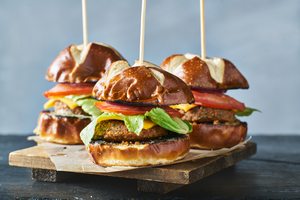
For assorted sandwich platters, order 12 sandwiches for every 10 people. Why the buffer? Guests appreciate having flexibility in what they grab, and one extra sandwich beats running out.
If you're ordering boxed lunches with a single sandwich per person, you don't need the buffer. For chips, plan for about 85% of headcount, some people skip them entirely and others grab two.
For a build-your-own taco bar, plan two tacos per person, plus rice, beans, and toppings. Depending on the event or if your office tends to eat more, three tacos per person can be a good bet as well.
For pulled pork, brisket, or similar comfort entrées, expect 4 to 5 ounces per person. For fried chicken, 3 pieces per person. These hit hard, which is why you should keep sides light: coleslaw, a fresh salad, or some cornbread is plenty.
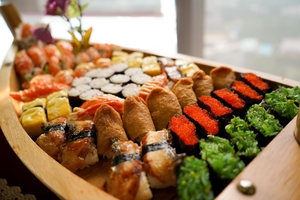
Sushi typically comes by the piece or the roll, with six pieces per roll. Plan for 8 to 10 pieces per person, or roughly 1.5 rolls per guest. That portion holds up even when you're serving sides like edamame, seaweed salad, or miso soup.
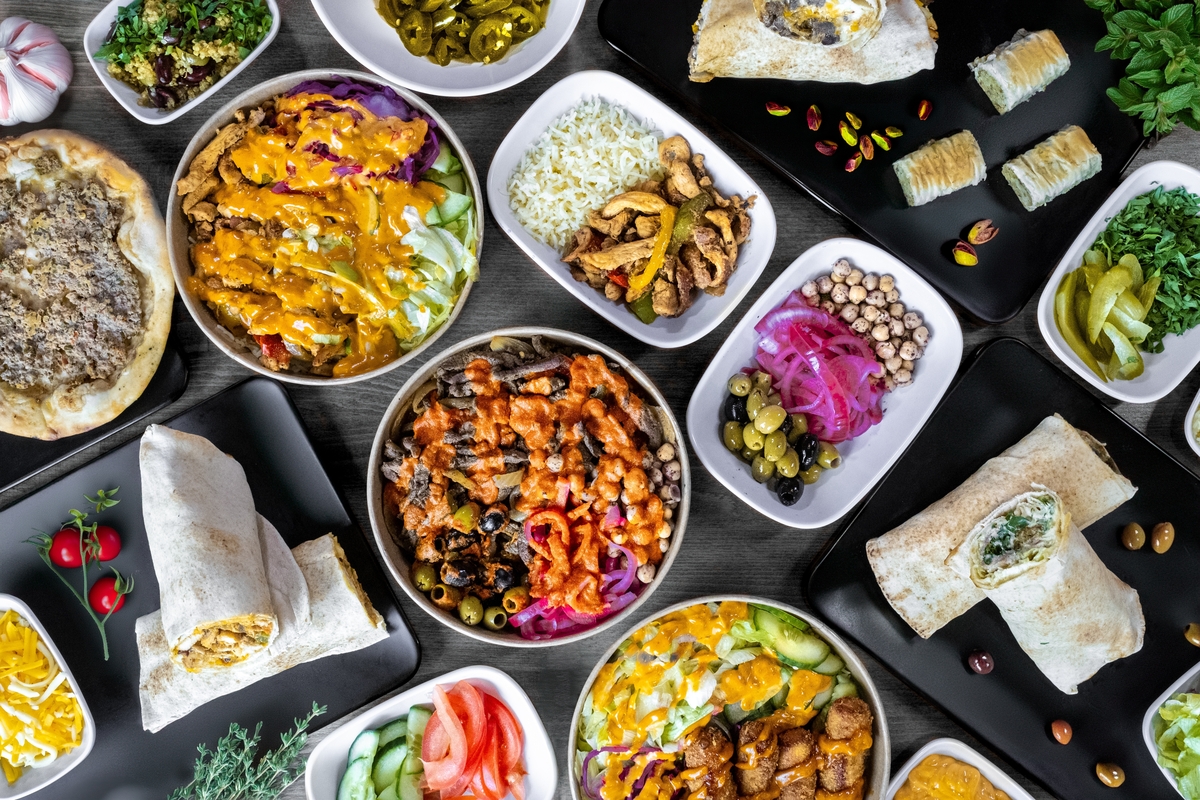
For Mediterranean spreads, aim for 2 skewers or kebabs per person, paired with hummus, pita, rice, and a chopped salad. It's a smart default for mixed crowds: Mediterranean flexes naturally across vegetarian, vegan, and gluten-free without a separate menu.
Desserts are usually a nice-to-have rather than the main event. Order one to two small items per person: brownies, bars, or cookies cut in half work well. For sheet cakes or pies labeled to serve a range (say, 8 to 12 people), base your count on the higher number so everyone gets a slice.
Cuisine sets the baseline. Event format adjusts it up or down, which is why a 30-minute board meeting (where people eat between agenda items) needs a different setup than an all-hands celebration (where food is the agenda).
Meetings and training are best with portable, low-cleanup food: sandwiches, wraps, grain bowls, or individually packaged boxed lunches. This format is also very effective when hosting a lunch and learn session.
Attendees typically eat once - meaning one item per person plus drinks. Individually boxed lunch catering also keeps the room clean and lets you respect dietary restrictions without a buffet line slowdown, which is why they're the workhorse format for any training over two hours.

For parties, food expectations scale with formality:
The longer the event, the more food you need, and not just because people eat more. Long events draw more drop-ins, late arrivals, and people grazing throughout, which is why duration matters as much as headcount. A simple framework:
For long events, staggered food drops or a popup-style setup beat a single buffet, which is why event planners increasingly choose them for half-day workshops, conferences, and all-day on-sites: the food stays fresh and so does the energy.

Modern offices include a mix of diets: vegan, vegetarian, gluten-free, dairy-free, halal, kosher, or keto - the list goes on.
More than 4 in 10 Americans now follow some kind of nutrition rule, and nearly 1 in 10 strictly avoid gluten or dairy. That makes what you order just as important as how much, which is why dietary planning belongs in your portion math from day one.
The portion math is half the job. The other half is choosing the right partner for the event in front of you, because a 50-person training, a 50-person holiday party, and 50 employees in the office on a random Tuesday are three completely different problems.
Fooda runs three workplace food programs to match. And for the 33% of companies still without a formal food program - picking the right starting point matters even more.
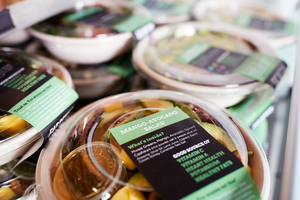
When you need traditional drop catering or individually boxed lunches for a specific event, Fooda's catering team handles the portion math so you don't have to.
Every order is managed by a dedicated account executive who prices things out, confirms quantities, and tracks delivery, all backed by a 99% on-time record.
With a single point of accountability, it means no more administrative overhead and someone other than you owns the "did we order enough" question.
Best for: holiday parties, board meetings, happy hours, training sessions, all-hands meetings, anything with a calendar invite.
The trickiest catering math shows up on a regular office day when you have no idea how many people are coming in. Fooda Office Lunch Delivery flips the model: every employee orders from a rotating lineup of local restaurants, and everything arrives together in a single drop.
Think about it as a virtual food hall. There’s no food waste, no overordering, and no leftover trays. Employers can subsidize at any dollar amount, and a dedicated Fooda driver brings orders straight to your office.
Orders scale with whoever shows up and places an order. And because 87% of workplace leaders say supporting local restaurants matters (Fooda 2026 Survey), every Delivery order doubles as values spend, channeling dollars to independent restaurants in your city.
Best for: Hybrid teams, fluctuating in-office headcounts, daily lunch programs, anywhere "how many people are in today?" is hard to answer.
If your office or building is busy enough that lunchtime is a daily logistical question, a Fooda Popup turns the answer into an amenity.
A rotating lineup of authentic, chef-driven local restaurants sets up on-site to sell fresh food directly to tenants and employees. No construction, kitchen, or daily management on your end.
If you’re wondering why workplace experience managers and or culture managers love Popup Restaurants: they activate common areas, bring employees together, and skip the "what's for lunch" debate entirely.
Best for: Office buildings, HQ campuses, large workplaces with daily on-site populations.
Calculating catering per person doesn't have to be the most stressful part of your week. Start with headcount, factor in cuisine and event type, account for dietary needs, and pick the Fooda program that fits how your team eats. Get in touch with Fooda and we'll help you design a highly customizable workplace food program that works across your entire organization.
How much does office catering cost per person?
Office catering typically runs $10 to $20 per person for standard lunch drop-off, $20 to $40 per person for elevated boxed lunches, and $30 to $75+ per person for full event catering with multiple courses. The biggest variables: cuisine type (pasta and sandwiches sit at the low end, sushi and full-service hot meals at the high end), drop-off versus full-service, and how much menu variety you need. Fooda works across this entire range because we source from a large network of local restaurants, which is why you can match the price point to the event without locking yourself into one caterer.
How far in advance should I order catering for an office event?
For standard office lunches, 48 to 72 hours of lead time is plenty. For events of 50+ people, aim for one week. For holiday parties, board offsites, or premium menus, give yourself two to three weeks. Popular restaurants book out fast for Q4 and around major holidays, which is when most office events cluster. If something comes up last-minute, Fooda's account managers can often find a way to turn around same-day or next-day orders when the typical caterer says no.
Is catering or individual lunch delivery cheaper for a daily office program?
Catering is usually cheaper per head when you know exactly how many people are eating, because bulk ordering drops the per-person price. Individual lunch delivery is usually cheaper overall when headcount fluctuates (think hybrid offices), because you only pay for what each person orders and food waste drops close to zero. Most companies running a daily program assume catering is the default, then waste 20% to 30% of the order. If your in-office headcount swings by the day, delivery typically beats catering on real cost.
How do you reduce food waste from office catering?
Three moves cut food waste the most. First, require RSVPs and base the order on the confirmed count, not the invite list. Second, choose individually portioned formats (boxed lunches, individual bowls) over family-style platters when headcount is uncertain. Third, default to individual delivery for daily programs so each person only orders what they'll eat.
What's the difference between drop-off catering and full-service catering?
Drop-off catering means a caterer delivers ready-to-serve food and leaves. Your team handles setup, serving, and cleanup. Full-service catering includes staff on-site to set up, serve, replenish, and break down. Drop-off is the default for most office lunches and meetings because it's faster and more affordable. Full-service makes sense for formal events, plated dinners, or anything over 100 guests where serving logistics matter. Fooda supports both formats.
Do you tip catering staff?
For drop-off catering, a $5 to $10 tip for the delivery driver is standard, or roughly 10% of the bill for larger orders. For full-service catering with staff on-site, plan for 15% to 20% gratuity on the total, though many caterers fold it in as a service charge on the contract. Always check the invoice first to avoid double-tipping.





%2010.49.58%E2%80%AFa.%E2%80%AFm..png)