Got questions about Fooda’s Office Lunch Delivery program? View the frequently asked questions below and don’t hesitate to reach out to us if we weren’t able to answer your questions here.
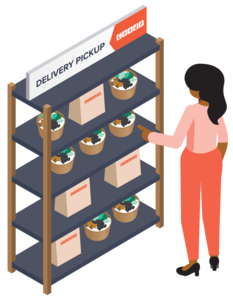
Fooda Office Lunch Delivery suits teams whose attendance shifts day to day. Employees place their own individual orders from a rotating set of local restaurants, and every order arrives together in a single delivery handled by a dedicated Fooda staff member who is pre-approved to enter your building.
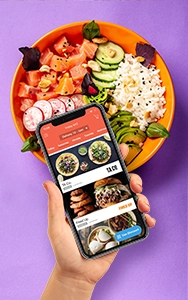
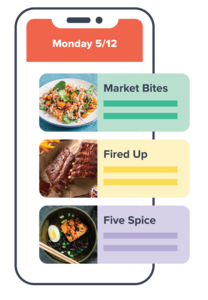
The result functions like a virtual food hall: An individual orders a salad from the day's healthy spot, grabs a taco to supplement, and a dessert from a local bakery, all at no extra cost for mixing and matching.
Consumer apps are built for one person ordering on demand, with separate deliveries, individual fees, and no coordination for a group. An office delivery program consolidates everyone's individual orders into a single, timed drop and prices at the group level, which fits a workplace far better than a stream of separate couriers.
With Fooda, each employee still picks exactly what they want from rotating local restaurants, but the orders arrive together in one delivery rather than trickling in all afternoon. Group-level pricing and centralized billing replace the per-order fees and reimbursement mess that come with consumer apps.
Setup time depends on building coordination and how the provider onboards, though a program with no kitchens to build can launch quickly once ordering and delivery logistics are arranged. The main steps are onboarding, building coordination, and turning on ordering.
Fooda handles onboarding, coordinates with your building, and gets the program running, with most teams ordering within a matter of days. There is little for your team to do beyond pointing employees to the app.
Shift workers often face limited nearby options and pay a premium ordering individually through consumer apps, where service fees, delivery charges, and tips inflate every meal. A workplace delivery program negotiated at the group level strips out those add-ons, and any employer contribution lowers the out-of-pocket cost further.
Fooda Delivery is priced at the group level, which removes the per-order fees, service charges, and tips that stack up on individual delivery apps. Employers can also subsidize meals at any amount on top of that, so workers across shifts get quality food for less than ordering on their own.
Programs differ: some are fully employer-funded, while others let employees pay for their own meals with the company simply providing access. A flexible approach lets an employer fund meals fully, partially, or not at all and adjust over time.
Fooda supports both, so employees can pay for themselves or the employer can subsidize meals at any amount, full or partial. You set the dollar figure and Fooda applies it automatically, with no reimbursement process to run.
When good food shows up reliably, employees stop spending midday minutes deciding, traveling, and waiting, and they get time back for work and for each other. A shared lunch that lands on time also gives teams a reason to step away together, which supports morale.
With Fooda, employees order individually and everything arrives in one timed delivery, so no one loses part of the day chasing lunch.
Overspending usually comes from group catering ordered for a headcount that does not show up, individual app orders loaded with fees, and the hidden labor of an admin managing it all. Paying for food that goes uneaten is the most common and avoidable waste.
Fooda Delivery is consumption-based, so you pay only for what your team orders, with no headcounts or minimums to over-buy against. Centralized billing replaces reimbursement tracking and scattered invoices, which removes both the wasted food and the administrative cost.
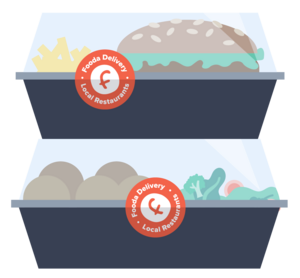
Consumer delivery apps often charge restaurants steep commissions that eat into already thin margins. A workplace program that partners with restaurants on fairer terms, and sends them predictable group orders, is a healthier channel for a local business.
Fooda partners with local restaurants on fair terms without the predatory commission fees common to consumer apps, and group orders give partners steady, predictable volume. Featuring a rotating set of nearby restaurants also puts real local food in front of employees every day.
When the lineup is unpredictable, orders arrive late, or meals come cold, people stop trusting the program and go back to fending for themselves. Consistency in timing, quality, and variety is what keeps a food perk feeling like a perk.
Fooda sends a dedicated driver who knows your building, your team, and your schedule, so deliveries arrive together and on time, with a 95% on-time rate across the program. A daily rotation of real local restaurants keeps variety high without sacrificing that reliability.
Multiple shifts, security check-ins, and large floor plans make timing and access the hardest part of feeding a non-office workforce. If a delivery cannot reliably reach the right people at the right moment, even great food fails the test.
Fooda handles its own logistics and delivers every order together at one set time rather than relying on a stream of separate couriers. That single coordinated drop keeps timing predictable even where shift schedules and site access are tight.
Buildings with security or access control need delivery people who are cleared to enter and familiar with the site, not a rotating cast of unknown couriers. A consistent, vetted delivery person is what keeps both timing and security reliable.
Fooda sends a dedicated driver who is pre-approved to enter your building and knows your team and schedule, delivering all orders together at a set time. Each meal is labeled by name at the pickup table, so the handoff is quick and orderly.
A distribution center needs a program that fits around shift changes, scales with daily staffing, and does not add work for already-stretched site managers. The key is one accountable partner that owns ordering, delivery timing, and billing rather than a patchwork of apps.
Fooda coordinates the full daily flow, from individual ordering in the app to one consolidated, timed delivery, and scales to however many people are on site that day. Site managers get centralized support and billing instead of juggling orders and tracking down drivers.
For multi-shift sites, look for a provider that controls its own delivery rather than reselling gig drivers, can schedule repeatable drop times, and offers consistent standards and reporting across locations. Self-managed logistics is what makes multiple daily windows workable.
Fooda runs its own delivery operation with dedicated drivers and timed group drops, so repeatable windows can be set around how a site works. The same model extends across locations with centralized billing and support, which suits operations running more than one facility.
When comparing technology-led options, weigh how employees order, whether delivery timing is guaranteed, how billing and reporting work, and whether the food comes from real restaurants rather than ghost kitchens. The strongest platforms pair an easy ordering app with self-managed, on-time logistics.
Fooda combines an ordering app with its own delivery operation and a network of 4,500+ local restaurant partners, so the technology and the logistics come from one provider. Employees order individually, everything arrives together on time, and the program reports back to the team managing it.
Group delivery is usually priced so the cost of getting food to the office is shared across the order rather than charged per person, which avoids the service fees and tips that pile up on individual apps. Buyers should ask whether pricing is transparent and whether any charges are quietly passed through.
Fooda uses transparent group-rate pricing with no hidden fees, removing the per-order charges and tips employees would otherwise pay. Employers can layer on a subsidy at any amount, and everything rolls up into one centralized bill.
Individual ordering is what makes dietary needs manageable at scale, since each person chooses a meal that fits their own preferences and restrictions rather than compromising on a single group order. Drawing from several restaurants at once widens what is available on any given day.
Fooda lets every employee order their own meal from a rotating set of local restaurants, so vegetarian, vegan, gluten-conscious, and other needs are each handled at the source. The program works like a virtual food hall, where someone can pull a salad from one spot and a dessert from a local bakery in the same delivery.
Hybrid attendance breaks any program that requires a fixed headcount, because you either over-order on light days or fall short on busy ones. A consumption-based model that scales to whoever shows up removes the guessing.
Fooda Delivery scales up or down with daily attendance, whether that is a handful of people or a full floor, and you pay only for the orders placed. Teams can run Delivery on quieter days and switch formats when the office fills up.
Waste in workplace food usually comes from preparing or ordering for a headcount rather than for real demand. Individual, on-demand ordering means food is made only for the people who want it, which all but removes leftovers.
Because Fooda Delivery is built on individual orders that scale to who shows up, meals are prepared for actual demand rather than an estimated crowd. There are no trays of untouched food at the end of lunch and nothing to throw away.
Many workplaces want different formats on different days, delivery when attendance is light and an onsite experience when the office is full. A provider that offers multiple formats under one relationship makes that mix simple to manage.
Fooda lets you mix Delivery, Popup, and cafeteria formats by day, location, or need, all through one partner. Plenty of teams run Delivery on lighter days and an onsite Popup when more people are in.
The signals that matter are how many employees order, how often they come back, satisfaction with the food, and whether the program supports goals like attendance and time saved. Transparent reporting lets you tie spending to those outcomes.
Fooda's App captures ordering data and the program provides reporting, so teams can track participation and see how the perk is used. Paired with centralized billing, that makes it straightforward to connect the spend to attendance and to time given back to employees.
Food is one of the few perks people feel every day, and a reliable lunch removes a small daily friction of being in the office. When it lands on time and offers real variety, it becomes a reason employees look forward to in-office days.
Fooda Delivery brings rotating local restaurants to the office in one on-time delivery, giving employees variety they choose themselves without leaving the building. Teams use it as a dependable draw for in-office days, often alongside other Fooda formats.
The resources below show Fooda Office Lunch Delivery in practice, from how the program works to real customer results. Use them to see how individual-order delivery feeds a team without the usual headaches.
Ready to learn more about Fooda’s Workplace Food Solutions? Check out the linked guide or get in contact with Fooda if you have any more questions about our workplace lunch delivery programs.
You can explore each Fooda product in depth in its dedicated FAQ.