Got questions about Fooda Popup Restaurants? View the frequently asked questions below and don’t hesitate to reach out to us if we weren’t able to answer your questions here.
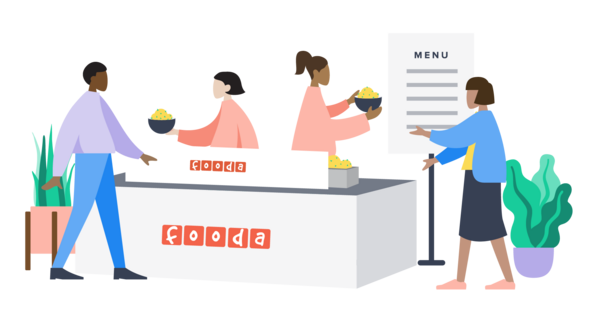
Fooda Popup is the company's core product.
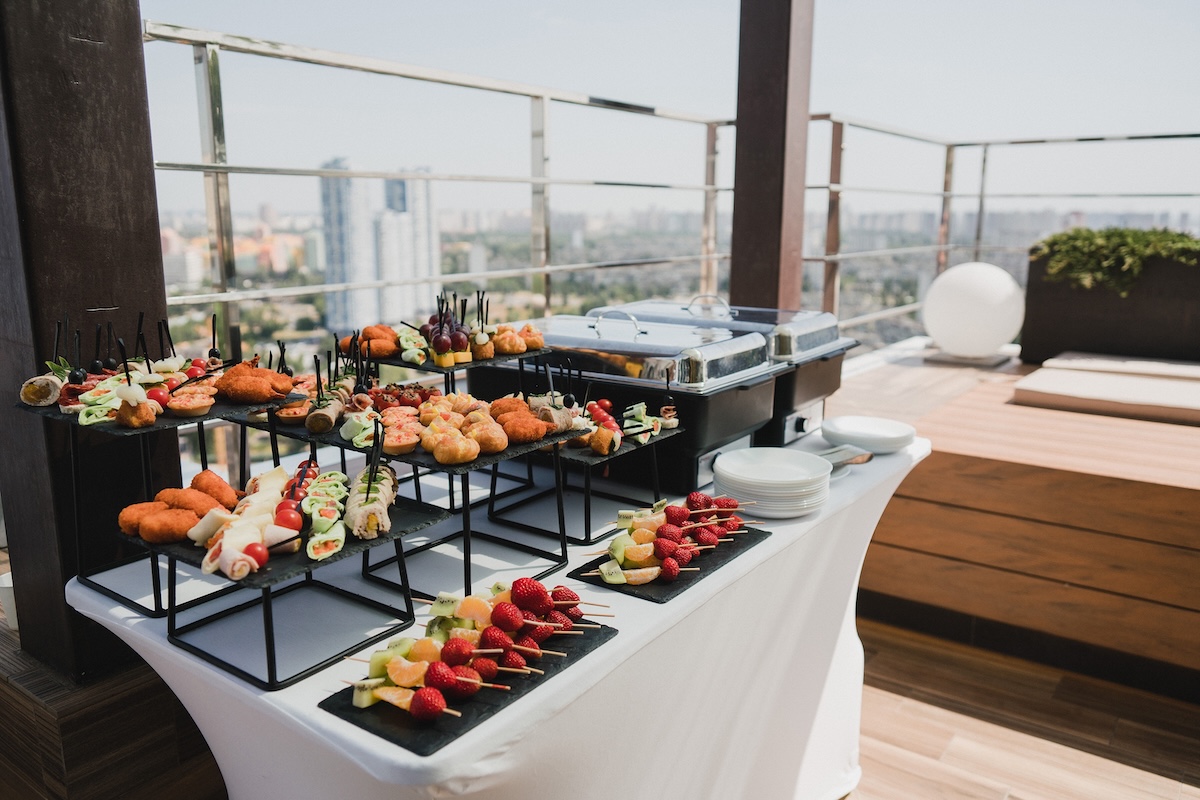
A different local restaurant arrives at your workplace each day, sets up in a breakroom, lobby, or common area, serves fresh made-to-order meals for roughly two hours, then packs up and leaves.
Your team does nothing operationally. Fooda curates the lineup, schedules the rotation, manages restaurant logistics, and handles employee communications.
Most Popup setups need only a modest footprint, typically a single serving table or station in a spot where employees already gather. A breakroom, lobby, cafeteria corner, or common area is usually enough, since the restaurant brings its own equipment and packs out at the end of service.
Fooda runs Popups in breakrooms, cafeterias, lobbies, and common areas, and requires a 12x7 space to operate. We assess your space during onboarding to confirm the best location. If your team has a place to gather, there is a good chance we can make it work.
Lead time varies by provider and by how much setup your space needs, though a well-run onboarding moves quickly once the location and schedule are confirmed. The main steps are a space assessment, restaurant scheduling, and employee communications.
Fooda has been pioneering the onsite dining experience since 2011, and that experience shows in the setup. We handle onboarding, assess your space, coordinate with restaurants, and build your schedule, and most workplaces are live within a matter of days with minimal lift from your team.
In general, traditional catering means a small set of vendors delivering large trays on a fixed schedule, with someone on your team placing orders, counting heads, and managing setup and cleanup. A Popup Restaurant service works differently, bringing a rotating set of local restaurants onsite to serve meals directly to employees, which removes the guesswork around quantities and cuts down on leftover waste.
With Fooda, a different local restaurant comes into your space each day to cook and serve fresh, and the program runs end to end with no work for your team. There are no trays to order and no headcounts to submit, since employees simply buy what they want at prices held at or below what the restaurant charges in store.
Modern programs run on an app or POS so employees pay for themselves, which keeps administration light. Employers who want to contribute can layer on a subsidy, either a fixed dollar amount or a percentage, without managing cash or reimbursements.
Employees pay through the Fooda App, and employers can set any subsidy amount per person, full or partial, with Fooda applying it automatically. You tell us the dollar figure and we handle the rest, so there is nothing for your team to reconcile.
Onsite Popups give independent restaurants a reliable new revenue channel and exposure to a built-in audience, without the cost of opening another storefront. That steady volume can be meaningful for a small business.
Fooda connects local restaurants with workplaces that provide consistent, predictable sales, and many partners have grown their businesses through the channel. Bringing those restaurants onsite also gives employees a direct link to the food culture of their own city.
The clearest signals are participation rates, repeat usage, employee feedback, and the link between the program and goals like office attendance or retention. Programs that report on these metrics let you see what you are getting for the spend.
Fooda provides reporting on participation and program performance, so you can connect the program to outcomes like return-to-office and retention and adjust the rotation based on what the data shows. That visibility makes it easier to justify and refine the program over time.
Onsite food service is governed by local health codes covering licensing, food handling, temperature control, and insurance. A serious program confirms that every participating restaurant carries the right permits and follows safe handling practices each time it serves.
Fooda verifies licensing, insurance, and health compliance for every restaurant partner and holds each one to defined food-safety standards. Partners are also taste-tested and quality-checked before they join the rotation.
When comparing providers across several sites, HR teams should weigh geographic coverage, the depth of the local restaurant network in each market, consistency of execution, the level of administrative support, and how well the program adapts to different office sizes and attendance patterns. Reporting and a single point of contact become essential once you move beyond one location.
Fooda operates across major U.S. cities and runs programs at thousands of workplaces, so multi-site teams get the same standards with local restaurant variety in every market. One partner manages scheduling, communications, and day-of logistics across all locations, and reporting gives HR clear visibility into participation site by site.
Coordinating individual restaurant vendors means juggling schedules, health and insurance documentation, payment terms, parking and load-in logistics, and a backup plan for cancellations. Handling this well takes time and food-service expertise that most office and HR teams were never meant to own.
Fooda absorbs all of that vendor management for you. We vet and schedule every restaurant, verify licensing and insurance, coordinate setup and breakdown, handle payments, and line up replacements if a partner ever cannot make it, so your team never has to chase a vendor.
Technology is what makes a modern Popup feel effortless, handling menus, ordering, payment, subsidies, and communications in one place. Without it, you fall back on manual coordination and cash handling.
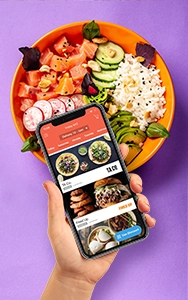
Fooda's App and proprietary platform manage scheduling, restaurant matching, ordering, payment, and employee notifications, and they tailor the rotation to each workplace over time. Employees can browse the day's menu, order ahead, and apply any subsidy automatically.
Programs tend to fall flat when the food feels repetitive, the lineup is poorly matched to the team's tastes, communication is weak so people forget it is happening, or pricing feels inflated. Without curation and promotion, even a strong concept quietly loses momentum.
Fooda keeps interest high by rotating a curated lineup that learns from employee feedback over time, promoting each day's restaurant through the app and email, and holding prices to what people would pay at the restaurant itself. That combination is part of why 80% of employees at Fooda workplaces call it a favorite perk.
Popups widen the range of cuisines available without requiring a building to invest in a full kitchen or cafeteria. Employees get hot, made-to-order food from real restaurants on site, a clear step up from vending machines, repetitive catering, or a long walk to find something decent.
Fooda brings a rotating mix of local spots to your space, so variety stays fresh week after week. Every restaurant is taste-tested and held to defined quality and health standards before it ever reaches your team.
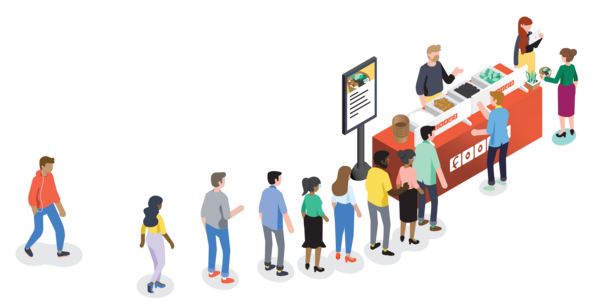
Throughput is a real concern when a crowd arrives in a narrow window, so a well-run program plans staffing, menu pacing, and ordering flow to move people through quickly. Order-ahead options and a focused menu help keep the line moving during the busiest minutes.
Fooda sizes each restaurant's staffing and setup to your expected volume, and the app lets employees order ahead and skip the line at pickup. Because service runs across a window rather than a single seating, demand spreads out and the line keeps moving.
Variable attendance is the central challenge for any onsite food program, because restaurants depend on predictable volume to justify the trip. The most reliable programs use data on daily population and, where offered, a meal subsidy to keep participation healthy enough to remain viable.
Fooda plans around your real attendance patterns and uses participation data to schedule accordingly. Restaurants generally need around 70 meals a day to make a visit worthwhile, and an optional employer subsidy can lift turnout on lighter days to keep the rotation steady.
A strong program offers enough cuisine variety that people with common dietary needs, such as vegetarian, vegan, gluten-conscious, or halal, can find something most days. Clear menu labeling and ingredient transparency are what make that variety usable for someone managing an allergy.
Fooda's daily rotation spans many cuisines, so options for different diets show up regularly, and menus are posted in advance through the app. Employees can see what each restaurant is serving before they arrive and choose what fits their needs.
Some models ask the employer to guarantee a spend or order count, which shifts financial risk onto your team. Others rely on natural demand and simply set up where participation is likely to clear the threshold a restaurant needs.
Fooda does not require your team to guarantee orders. We set each program up for success based on your population and any subsidy, and the viability calculator on our site helps you preview what participation might look like before you commit.
Multi-tenant buildings are a natural fit because the combined population of several tenants easily supports the daily volume restaurants need. A lobby or shared amenity floor becomes a draw that benefits every company in the building.
Fooda runs Popups in building lobbies and shared spaces, turning a common area into an amenity that serves all tenants at once. Property teams can use it to differentiate the building and give tenants a perk without each company managing it alone.
Scaling depends on a provider's footprint and operational consistency. The advantage of a single national partner is uniform standards, consolidated reporting, and one relationship to manage instead of a patchwork of local vendors.
Fooda operates in cities nationwide and runs programs at workplaces of every size, so growing companies can roll out a consistent experience across sites. Each location still gets its own local restaurant variety, managed from one central relationship.
Both bring outside food onsite, but a food truck depends on weather, parking, and curb access, and the meal happens outdoors. An indoor Popup sets up where employees already are, runs regardless of conditions, and tends to create more of a gathering inside the workplace.
Fooda Popup brings the restaurant indoors to your breakroom, lobby, or common area, so it runs rain or shine and pulls people together in a shared space. The rotating lineup and managed scheduling give it a consistency that occasional truck visits rarely match.
Quality depends on the network behind the program. Strong operators recruit established local restaurants, taste-test their food, check health and insurance documentation, and track performance so the lineup keeps getting better.
Fooda has built a network of more than 4,500 local restaurant partners, and every partner is taste-tested and screened for quality and compliance. The platform then matches restaurants to each workplace and refines the rotation based on what employees respond to.
The case studies and guides below all feature Fooda Popup in action, from single-site programs to multi-office rollouts. Use them to see how different workplaces put the rotating restaurant model to work.
Ready to learn more about Fooda’s Workplace Food Solutions? Check out the linked guide or get in contact with Fooda if you have any more questions about our Popup Restaurant programs.
You can explore each Fooda product in depth in its dedicated FAQ.