Nothing perks up employees quite like the promise of free food. You might offer generous pay packages and flexible hours, but when it comes to the daily workplace experience, free lunch at work often carries the most weight.
Below, we break down why providing lunch for employees pays off, the types of programs available, and how to launch one that works from day one.
It’s no surprise that when lunch is covered by the company, your employees get to save money.
But the benefits of free food at work go way beyond the obvious. Here are some of the ways free lunch changes the game for your company.

Free lunch gets people excited about coming to the office because it signals that the company genuinely cares about their day-to-day experience. That enthusiasm matters because engaged employees are more collaborative, more creative, and less likely to look elsewhere.
Free food addresses a major pain point: rising food costs. A BLogic Systems study found that the average employee spends $23.60 per day on lunch or $5,664 per year. When employees stop worrying about lunch costs, they free up mental energy to focus on the work that moves your business forward.

Free meals also create a competitive advantage when it comes to recruiting and retaining talent.
According to a Glassdoor survey, 60% of people say that benefits and perks are a major factor in deciding whether to accept a job offer. So attractive meal perks could be what tips the scales when a candidate is choosing between you and a competitor. It’s also what keeps your current team from entertaining outside offers.
.png)
A free meal program helps your team save time. Workers won’t have to leave the office campus for lunch, which means they reclaim 30–45 minutes that would otherwise be spent commuting to a restaurant or waiting in line. When lunch is handled, your people spend less time debating where to eat and more time doing focused work.
This has a strong impact on productivity. Tork’s “Take Back the Lunch Break” survey found that nearly 90% of workers say lunch breaks help them feel refreshed and ready to get back to work.
Employer-provided meals are a great way to make sure your team is eating lunch and eating it on time. A Talker Research survey of 2,000 employed Americans found that 55% skip lunch on busy days, and on average, workers completely forget to eat lunch two days out of the work week. That’s why eating on time matters: it stabilizes energy, sharpens focus, and helps employees sustain performance through the afternoon.
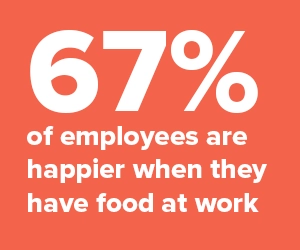
An Indeed survey of over 1,000 full-time workers backs this up: 67% of employees with access to free food at work report being “extremely” or “very” happy at their jobs, compared to just 56% overall.
When designing a free lunch program for your office, there are three main options to consider:
Providing free lunch at work goes beyond paying for the food your employees eat (though we wish that were all it took).
You also must think about the logistics:
All these “tiny” details help you build a free meal program that truly benefits your team. Here are some of the best practices to keep in mind when designing a food program.

A free meal program only works if it works for everyone on your team. Serving the same bland options every day will tank participation, no matter how “free” the meals are. Or even if the food is good, there may not be enough options for people who want something different or have certain dietary restrictions.
That’s why variety and flexibility should be top priorities when you plan your free lunch menu. A program that doesn’t work for everyone will quickly lose momentum.
Consider rotating between different restaurants and cuisines for starters. Whether you bring in catered lunches, order meal deliveries, or have popup restaurants come on-site, partnering with different restaurants throughout the week helps to keep things fresh so lunch is never boring.
An expansive menu gives your people a choice. Give them the freedom to choose between a bunch of different meal options – whether they’re in the mood for light bites like sandwiches one day or hearty meals like curry rice bowls the next.
You’ll also want to make sure your free food offering is inclusive and diverse. This means accounting for the dietary needs and preferences of different employees. Consider menus that accommodate different lifestyles, health conditions, allergies, and religious practices.

When you’re providing lunch for free, cost is a major factor in your decisions. And employers may consider less healthy options to save on costs because healthy foods are often more expensive. But seasonal sourcing and smart menu design can close that gap.
Build healthy and nutritious menus that make the most of seasonal produce and locally sourced ingredients. For instance, switch out the strawberries and kiwi in your fruit salad for watermelon and blueberries in summer and apples and grapes in fall. Seasonal sourcing can drastically bring down costs, which is why it’s one of the easiest levers for keeping your program both healthy and sustainable long-term.
Consider dishes that are equally delicious and healthy without compromising affordability. Some options include salad bars and build-your-own stations where staff can create meal bowls with their choice of protein. That way, you simultaneously ensure portion control and reduce food waste because people are only taking what they need.
Introducing a free food program takes planning, but managing it day-to-day is where the real complexity lives. Ordering food, managing expenses, allotting funds, and tracking participation are all essential tasks that add to the workload of running a successful program.
Make the most of technology to streamline the process. For instance, Fooda’s proprietary tech makes it easy to:
Providing free lunch at work can be complicated and expensive. That’s why choosing the right corporate food service provider matters. A strong corporate food service provider handles the complexity so your team can focus on the employee experience. Be sure to carefully weigh your options and thoroughly vet providers to find the right fit.
Here are some of the factors to consider:

For many workplace experience managers, it’s obvious how providing free meals to employees will instantly improve the daily office experience.
What’s difficult is convincing leadership to give your program a green light. Here are some tips to build the internal business case for your free lunch program:
Fooda offers a range of workplace food solutions to build your ideal free meal program.

With Fooda’s Popup Restaurant program, you can bring in guest restaurants to serve meals on-site. The restaurant serves meals for two hours, preparing every order on demand (with no on-site cooking needed). This offers flexibility even for companies with limited space and facilities.
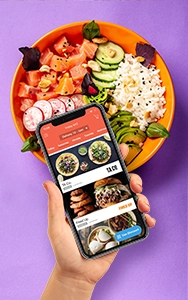
You can bring in a new restaurant each day to keep the lineup fresh. And your team gets to see the upcoming restaurant lineup through the Fooda app or a custom webpage for your company.
This is an affordable option as meals typically cost between $8 and $10 and never more than the restaurant’s in-store pricing. You can choose to cover the cost of the meal partially or in full.
Fooda’s Office Lunch Delivery service lets employees pick their own meals from a rotating selection of restaurants. They can browse menus from a virtual food hall and mix and match their orders between different restaurants. All orders are grouped into a single delivery, allowing employees to eat their meals together.
Full or partial subsidies are automatically applied when orders are placed through the app.

Fooda also lets you order corporate event catering. You can choose from your workplace’s favorite restaurants and have them deliver individual boxed meals or traditional drop catering.
A catering concierge handles everything from scheduling and ordering to payments. This is a great option for companies that want to offer free meals for special events and meetings.
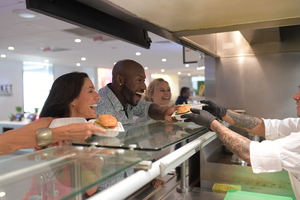
You can even set up a full cafeteria service with Orange by Fooda. Great for companies that want to serve fresh meals cooked on site by the best local restaurants, this option lets you bring in a rotating lineup of restaurants.
It even allows you to bring in multiple restaurants at a time (if you have the space) and mix things up between resident restaurants and workplace pantries.
Fooda streamlines office lunch subsidies with proprietary technology that lets you edit and scale your program with ease.
The meal subsidies are automatically applied and you can set a subsidy amount per employee, add or remove users, and track usage all within the app.
With a cost-per-use model, Fooda makes it affordable to provide free food to your employees. Ready to build a workplace lunch program that makes an impact on your entire organization? Get connected with Fooda today.

How long does it take to roll out a free lunch program?
Most programs can be up and running within a few weeks, depending on the model you choose. Popup Restaurants and Office Lunch Delivery tend to have the shortest setup time because your provider handles the logistics. If you’re hoping to implement a full cafeteria or pantry program, it could take anywhere from one to three months depending on resource availability.
What's a good starting budget per employee for a free lunch program?
A common range is $10 to $15 per employee per meal, though your actual cost will depend on your location, the type of program, and whether you fully or partially subsidize meals. Many companies start with a partial subsidy to keep costs manageable and then adjust based on participation data. A provider like Fooda can help you model different budget scenarios before you commit.
How do you handle free lunch for remote or hybrid employees?
For hybrid teams, the simplest approach is to align your free lunch days with in-office days so the perk doubles as an incentive to come in. For fully remote employees, some companies offer a monthly meal stipend or a gift card equivalent so they don't feel left out. The key is making sure the benefit feels equitable across your entire workforce, regardless of where people work.
How do you measure whether a free lunch program is working?
Track a mix of participation metrics and employee sentiment. On the quantitative side, monitor daily participation rates, subsidy utilization, and food waste levels. On the qualitative side, run short pulse surveys asking employees how satisfied they are with the food options and whether the program influences their decision to come into the office. Comparing these numbers month over month will show you what's working and where to adjust.