Historically, the role of the Chief Human Resource Officer (CHRO) has always been associated with the "human" aspects of an organization's performance. CHROs are responsible for recruiting high-quality talent, engaging employees, addressing their grievances, and retaining them.
The modern workplace makes this extra challenging. HR leaders must now navigate a landscape where employee engagement is at a near-historic low. Gallup reports that only 31% of U.S. workers are actively engaged at work, one of the most significant drops since 2020.
For CHROs, the shift from providing administrative support to actively designing the employee experience is no longer optional. That’s how you address the human-related metrics directly tied to your performance, from recruitment and beyond. Solutions like workplace food programs give you the leverage to align various functions with measurable outcomes.
A Chief Human Resource Officer is a C-suite executive who leads an organization’s human capital strategy. They oversee the management of employees, playing a vital role in various “people” functions that affect the company and its workforce. This includes:

• Staffing and recruitment
• Employee and labor relations
• Compensation and payroll
• Benefits
• Training and development
CHROs need to attract top talent, make sure employees perform at their best, and give them a good reason to stay. This puts them in charge of designing perks and experiences that accomplish all three goals simultaneously.
It makes sense, then, that CHROs take ownership of workplace food programs. Food perks directly shape the experience of working in an organization. And that experience influences how engaged employees are and whether they want to stay.
Beyond the impact on employee experience, food programs help meet CHROs’ key performance metrics.

Between mounting labor shortages and widening talent gaps, HR leaders need to design unique benefits that give them an edge over the competition. According to SHRM, 70% of organizations struggle to fill full-time positions. Candidates have plenty of options and they know it.
Competitive pay matters, but it’s not the deciding factor for attracting high-quality talent. A greater work-life balance and better personal wellbeing are what draw employees to new opportunities. 59% of employees in a Gallup survey consider them before taking a job elsewhere.
That’s why benefits like a comprehensive food program could be just the thing you need to gain a competitive advantage.
Candidates weigh the cost advantage of a free or subsidized meal program. According to the Fooda Price Index, the average employee spends an average of $14 a day on lunch. Even just $5 a day translates to over $100 saved per month. That’s money that could go towards their personal expenses, whether that’s the occasional dinner at their favorite restaurant or the Pilates class they’ve always wanted to try.
Food programs also help employees maintain a better work-life harmony since they no longer have to sacrifice their weekends for meal prep. Most candidates would jump at the chance to get a few extra hours to themselves.
An ADP Market Pulse Study found that 64% of professionals consider free onsite food as an important benefit when evaluating a new employer.
Mandates may bring employees back to the office, but they don’t always guarantee that workers will want to be there. When you consider rising gas prices and long commute times, the office needs to offer something worth showing up for.
CHROs are under more pressure than ever to create workplace experiences that genuinely pull employees in. And it’s more than just creating comfortable spaces for them to work. Anyone can carve out a sweet spot to work at home or in a neighborhood cafe. You need to up the ante with perks that they can’t find anywhere else.
That’s where food programs come in. From free or subsidized meals to restaurant-quality dishes, food-related benefits could be a major draw to go back to the office. Research from Robin links office perks like catered lunches with stronger attendance, with 44% of employees voting them a top draw.

CHROs thrive when employees are engaged. Gallup found that organizations with highly engaged employees report less absenteeism and lower turnover, metrics that are directly linked with HR performance.
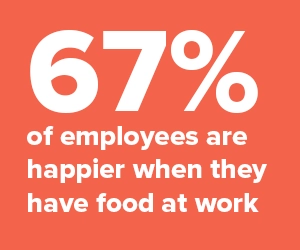
Food is one of the most straightforward ways to support that engagement. According to Fooda’s What’s Happening in the Workplace Now? survey, 80% of employees feel more enthusiastic about work when the company provides lunch. This means employees are actively looking forward to the workday, putting them in the mindset to meaningfully contribute.
Food programs also allow you to provide nutrition support and healthy food options. When baked into a more comprehensive wellness program, this helps you foster healthier, happier employees who are more present at work. Wellhub found that 89% of employees at organizations with a wellness program report higher job satisfaction.
That said, simply making food available isn’t enough. Here’s how to use food programs as a strategic engagement driver:
• Prioritize variety. Menu fatigue is real, and 80% of leaders in Fooda’s 2026 Workplace Lunch Report say variety is important to their food program. Rotating between cuisines daily gives employees something new to look forward to each day.
• Build anticipation. Share weekly restaurant lineups and upcoming menus in advance. This turns a daily meal into an ongoing reason to come in.
• Get employees involved. Set up build-your-own meal stations that let them customize their own salads, sandwiches, or grain bowls with a wide range of proteins and veggies.
• Upgrade the meeting experience. Whether it’s a quick snack break from an afternoon session or catered boxed lunches for an all-day meeting, food gives employees the energy to focus and engage.
• Upgrade the snack experience. Fooda links better snacks and drinks with an improved office experience. With Fooda Pantry, you can replace the stale breakroom coffee with barista-quality brews like French vanilla lattes or coconut mochas. Meanwhile, healthy snacks like fresh fruit, yoghurt cups, and dark chocolate take the place of vending machine candy.
High employee turnover reflects poorly on your work environment and on HR leadership. Add that to the high cost of replacing workers, and you’re dealing with a problem that ultimately sets you back hundreds of thousands of dollars per year.
And between the quiet quitting “epidemic” and high burnout rates, CHROs have to figure out how to create environments that delight and retain top talent. A paycheck alone is rarely enough to make employees stay. According to an iHire survey, toxic work environments are the top reason people leave their jobs. Conversely, employees are most likely to stay because of a positive work environment (83%) and an emphasis on work-life balance (68%).
A comprehensive wellness program that includes food perks signals to employees that the organization cares about their wellbeing, not just their productivity.
The Wellhub study also found that 62% of employees are more likely to stay at a company with a strong wellness program. That’s why a whopping 98% of HR leaders report reduced employee turnover through employee wellbeing initiatives.
As the architect and guardian of workplace culture, the CHRO is in charge of designing programs and rituals that build community and foster a positive work environment. Food programs are one of the most effective tools available for this because they center daily routines and shared spaces around something inherently social.
Daily sit-down meals give employees a chance to connect over topics outside of work, whether it’s the new episode of “Bridgerton” or the upcoming Bulls’ NBA Draft. Intentionally designed shared spaces, like dining halls and full-service cafeterias, create natural opportunities for cross-team connection that don’t require a scheduled meeting or a forced team-building exercise.
Fooda helps Chief Human Resource Officers build food programs that support metrics that matter, from recruitment and retention to engagement and culture.
Fooda offers a wide range of workplace food solutions, so you can build a program tailored to your team’s needs:
Fooda’s network of 4,500+ restaurants also means the menu is always rotating, so employees aren’t limited to the same options day after day. Meal subsidies are easy to manage, too. You can set amounts at the team or individual level, and they’re automatically applied when employees check out through the Fooda app. Employees decide when and where to use their subsidy, whether that’s the taco popup on Tuesday or a delivery order from a popular burger joint on Friday.
Fooda helps you balance the cost of providing attractive food perks with flexible demand-based models.
Subsidies can be customized to fit your budget. You can adjust amounts whenever you want, and employees pay the balance if the total exceeds the allotted amount.
All programs are also scalable, allowing you to increase or decrease operations based on demand. If you have heavy on-site attendance on Wednesdays but low headcounts on Fridays, we can shift the program to meet those numbers.
Fooda’s AI-powered software also provides participation insights. As the program runs, you get a clearer picture, and you can better adjust operations to meet demand.
This model minimizes waste while ensuring everyone always has enough to eat. It makes it easy for CHROs to offer competitive food perks without unpredictable costs, even with fully subsidized programs.
Interested in seeing how Fooda’s workplace food programs deliver real results? Get in touch with us today.
What is the importance of a CHRO?
A Chief Human Resource Officer (CHRO) helps organizations align their human capital strategy with larger business goals. As the main architects of workplace culture, they play a key role in shaping the employee experience. This ultimately reflects in metrics like retention and engagement.
What are the top performance metrics for CHROs?
Some of the top metrics to measure the performance of CHROs include: quality of hire, revenue per employee, HR spend per employee, employee net promoter score, burnout risk index, and inclusion and belonging index.
What role do CHROs play in workplace culture?
CHROs are responsible for building workplace environments where employees feel safe, valued, and engaged. They design policies, programs, and practices that foster community and align employee behavior with the company’s core values.
How do workplace food programs support employee recruitment?
Food programs address two of the top factors candidates weigh when evaluating a new job: personal wellbeing and work-life balance. A subsidized or free meal program reduces out-of-pocket costs and removes the time burden of meal prep, making an employer’s total compensation package more competitive without requiring a salary increase.
How can CHROs measure the impact of a food program on employee engagement?
The most direct indicators include changes in office attendance rates, participation in the food program itself, and scores from regular employee satisfaction or engagement surveys. CHROs can also track secondary metrics like absenteeism rates, voluntary turnover, and eNPS (Employee Net Promoter Score) before and after the program is introduced to assess broader impact.