Although meal stipends can be a versatile way to support your teams’ goals, boost office morale, and build out recruitment and retention initiatives, they tend to eat up valuable resources for your HR, admin, and finance teams.
This traditional approach to employer-paid food can also create inconsistent employee experiences and long reimbursement wait-times, leading to frustration and distrust. On top of that: manual tracking, complex expense reports, and the risk for human error or non-compliance all complicate the logistics of managing an employee meal reimbursement policy.
Below, we’ll review what factors you should consider when implementing or updating your reimbursement policy and look at a few modern alternatives.
A meal reimbursement policy outlines how and when a company compensates employees for their food expenses. Employees pay for their meals out of pocket first, and then are repaid at a later date, after the expense has been processed. These policies detail both the logistics of the reimbursement process and the circumstances that qualify employees for reimbursement.
Some companies have rather conservative meal reimbursement policies for their employees, with strict limits on use cases and spend amounts. Others are much less restrictive, giving employees more free choice as to when or where they buy their meals.
There are a plethora of different use cases for employee meal reimbursement, and they depend on each company’s specific needs. Below are some of the most common reasons companies reimburse their employees:
Regardless of why they’re reimbursing their employees, every company needs to have a written policy for consistency, tax compliance, and budget control.
.jpg)
Traditionally, employee meal reimbursement policies are handled manually. This means that each employee must retain and turn in a physical receipt for every meal they want to be compensated for. These receipts must then be logged and verified before the money can be issued back into the employee’s account.
Especially for companies with high headcounts and more expansive reimbursement policies, this process can quickly build to an unmanageable level, resulting in a significant and damaging backlog.
This manual approach also leaves room for human error and inconsistency. Because these policies require employees to handle physical receipts, there’s always a risk that something will get lost in the ever-growing pile-up.
The lack of a centralized program can also generate widespread confusion about policy changes. If your company chooses to alter spending limits, you’ll need to send out mass communications. These emails can be easily missed in crowded inboxes, making misunderstandings common.
Because reimbursement systems require employees to pay for themselves first, lengthy processing timelines can leave them with a gap in their funds for a significant amount of time. If employees are purchasing meals regularly, such as for frequent client meetings or daily lunches, they’ll end up with a near-permanent deficit. The resulting frustration will only build over time, negatively impacting engagement initiatives.
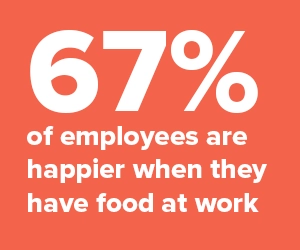
Encouraging regular meal breaks can improve employee satisfaction and productivity. In fact, a Slack survey of over 10,000 employees found that those that take breaks for food are 13% more productive and experience 46% higher job satisfaction. One of the most effective ways to encourage positive lunch behaviors is by providing employer-paid meals. In a market where replacing an employee can cost 50-200% of their annual salary, this investment can act as a low-cost way to combat high turnover rates.
But in order for a food program to be effective, it has to be executed well. Before constructing (or reconstructing) your employee meal reimbursement policy, there are several factors you need to consider to ensure you’re meeting your company’s needs.
Determining who qualifies for meal reimbursement is one of the first things you should consider. Are you limiting your policy to your sales team to fund client meals? Do you want to give everyone access for daily meals? Setting these boundaries will help you effectively set the rest of your parameters.
The easiest way to establish eligibility is to define your goals. If you’re looking to improve satisfaction rates, all employees should have daily access. If you want to make long hours a bit more comfortable, you can set it so that only employees that work beyond certain times qualify for reimbursement. It’s all reliant on what you hope to achieve.

The second thing you need to establish is spending limits. Again, this will be determined by your goals. You’ll want to set higher per diem rates or meal allowances when sales is trying to impress clients at a dinner and more moderate amounts for every day employee lunches.
The biggest challenge here is determining a monthly or annual budget. Employee meal reimbursements can be somewhat unpredictable. The number of employees that participate in your daily program, the number of client meetings your employees will have, and exactly how much those meals will cost are all difficult to forecast. Relying on historical data can be helpful, and it’s always better to overestimate than underestimate.
Each meal will come with a variety of expenses. If your employees are dining out, are you going to pay for drinks, dessert, appetizers, and tip, or will you only cover their entrees? For employees that opt for daily lunch delivery, will you cover their delivery fees? These are all factors to consider, as they’ll impact your budget and the way your team decides to dine.
Having a solid, detailed policy can decrease the risk of misunderstanding, ensuring that those waiting for meal reimbursement stay happy. This approach also helps streamline processing timelines, preventing employees from having to manage complex logistics.
By carefully designing and implementing your submission procedures, you can make your teams’ lives easier by keeping everyone on the same page. The level of detail you want is up to you. Consider whether you’d like to require employees to submit paper receipts, or if you’ll accept digital receipts, as well. Are you going to require them to justify the request in writing?
Employees should have an easy, reliable way of submitting their employee meal reimbursement requests. The process should be accessible while ensuring nothing gets lost along the way.

Once employees have submitted their requests, how will you process the reimbursement? How many people will be involved, and what will their exact roles be? Will one team handle the entire process, or will your workflow require collaboration across teams?
The answers to these questions will be different based on the demand. If you have a lot of employees or are reimbursing daily lunches for the entire company, you’ll need a much larger team to process everything without overloading your system.
Although manual reimbursement has been the standard for decades, modern technological evolutions have provided a second option; automated reimbursement.
Rather than having employees cross-check and process each request individually, automated processes use software to autonomously examine and execute reimbursement requests. They can compare submitted expenses against your company’s reimbursement policy and approve or reject each request without human intervention.
This approach eliminates the need for manual processing, greatly cutting down on processing time and reducing the number of people needed to stay on top of these requests.
Manual processing can lead to an overload of information to keep track of. Messy spreadsheets, long, easy-to-lose email chains, and piles of paper receipts all create unnecessary complications.
Here are some of the biggest benefits of switching to an automated reimbursement system:

Switching to automated reimbursement isn’t the only way to save time and reduce waste. As the workplace continues to evolve and daily meal programs become more common, many companies are dropping their reimbursement systems and daily meal allowances in favor of subsidized meal plans.
Typically, subsidized workplace food programs are built around a single point-of-sale system. This approach gives employers the freedom to add and adjust subsidies at will. These subsidies are then automatically applied at checkout, and the costs are billed directly to the employer.
Centralizing operations in this way prevents employees from ever having to pay out-of-pocket. They don’t have to wait to be repaid, and employers don’t have to execute overly complicated, time-consuming reimbursement processes.
To consolidate operations, employees all have to order through the same service. At first glance, it may seem like this removes some choice from employees’ meal options, but selecting the right workplace food partner is key.
A quality employee meal program will eliminate administrative complexity without robbing employees of personal variety. Look for a provider with variety built in. Offering new restaurant options each day can give employees the free choice they crave.
There are many different forms subsidized employee meal programs can take, and the right solution depends on your company’s unique needs. Here’s a look at some of the most popular options: