A deal closes on paper months before it closes for the people inside it. Legal, finance, and IT each get an integration checklist with owners and dates. The workforce gets a town hall meeting and a request for patience.
Gallup, citing EY research, reports that 47% of key employees leave within a year of a transaction and 75% leave within three years. The cost lands twice: in replacement hiring, and in the institutional knowledge those employees carried out the door with them.
People rarely quit over an announcement. They quit after accumulating enough small daily signals that the new organization has no room for them. Employee retention after an acquisition is won or lost in those signals, and a workplace food program is one of the few perks that touches all of them at once, for both sides of the merged company.
Ordinary turnover is individual whereas post-acquisition turnover is correlated. The same conditions hit everyone at once, so departures arrive in clusters that gut a function before leadership can respond.

In the months after close, employees build a working model of the new organization from whatever evidence is available. Every meeting that runs on the old company's norms, every tool that gets swapped, every perk that quietly disappears feeds that model.
Once it settles into "this place takes more than it gives," reversing it costs far more than establishing it correctly would have. Retention packages hold key talent through a vesting period without touching that model, so treat the time they buy as the window for building a real reason to stay.
Change fatigue in the workplace is the exhaustion that sets in when people absorb more disruption than they have capacity for. Acquisitions concentrate a decade of ordinary change into a single year, which is why the condition shows up often after a deal.
Harvard Business Review, drawing on Gartner data, found that the average employee went through two planned enterprise changes in 2016 and ten in 2022, while willingness to support enterprise change fell from 74% to 43% over the same period.
Employees arriving at an acquisition in 2026 have already spent years being asked to adapt while change management is out of their control.
Change fatigue presents as behavior, because fatigued employees conserve energy by cutting discretionary effort first and integration depends almost entirely on discretionary effort:
Communication plans address what people know. Change fatigue is a question of capacity, and an integration announcement does no work when people are running on fumes.
But predictability does. When most of the environment is in flux, a few reliable daily fixtures give employees somewhere to stand, and shared meals suit that role well:
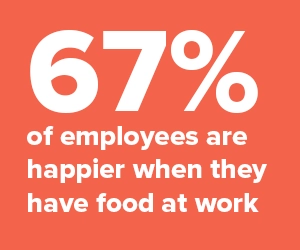
Fooda's 2026 Workplace Lunch Report found that 83% of workplace leaders believe food significantly shapes company culture, while a third of companies run no food program at all. During an acquisition, that distance between stated belief and daily practice is what employees read.

The value here is structural: one operational change addresses several distinct integration problems, which matters when the People team is already at capacity.
Two principles hold the list together. Voluntary beats mandatory, because a mixer asks people to perform enthusiasm for a merger they did not choose while a rotating lunch lineup asks nothing of anyone, and as Fooda's guidance on changing company culture in hybrid work puts it, culture spreads through repeated shared context that has to be designed once it stops happening on its own.
Speed matters more than sophistication. A program that launches in week six with rough edges beats a perfect one that arrives after the resignations start.
Fooda's best practices for customizable meal programs cover the operational detail, including how rotation prevents menu fatigue. A program cut in month seven confirms the exact fear employees are already carrying.
Retention initiatives get cut when nobody can defend them with numbers, so instrument the program from day one.
Sustained pressure without recovery turns integration strain into departures, a pattern Fooda examined in its work on burnout in consulting. Declining participation is one of the earliest ways to catch it.
Acquisitions ask employees to absorb an extraordinary amount of change at a moment when their tolerance for it is depleted. Leaders cannot remove the disruption, and pretending otherwise costs credibility.
What they can do is add a fixed point to the week that asks nothing of anyone and reliably delivers, because over a year of upheaval those repetitions accumulate into a different conclusion about the combined company.
Fooda runs one program across every format a merged company needs:
A single vendor relationship covers a footprint that changed overnight, which is how a food program becomes a competitive advantage rather than a line item during the year when talent is most at risk.
Talk to Fooda about a program that holds your combined workforce together through integration.
Attrition typically runs above baseline for 12 to 24 months, spiking first as uncertainty peaks and again as retention packages vest. Companies that invest in daily employee experience early see the curve flatten sooner, because the departure decision is made months before the resignation is submitted.
Change fatigue is exhaustion from absorbing repeated organizational disruption: new systems, new leaders, new processes. Burnout comes from sustained workload. They often occur together during an acquisition, but the remedies differ. Reducing hours addresses burnout, while change fatigue calls for stability, predictable routines, and fewer concurrent initiatives.
No perk offsets poor leadership or an unclear strategy on its own. Where daily benefits carry weight is as evidence. Employees judge the combined company by what they can observe, and a well-run food program is visible daily while most integration work stays out of sight.
Keep it through the first quarter if service is solid, since removing a familiar routine alongside everything else compounds change fatigue. Use that quarter to compare cost, coverage, and participation across both programs, then consolidate onto whichever model serves the combined footprint. Announce it with a start date for the new program rather than an end date for the old one.